Jackpot Slots in the UK: Rules, Odds and Play
 Available in GB
A practical overview of UK regulation, real-money costs, progressive prize pools, odds, free play and bonus conditions.
Table of Contents
- Jackpot Slots in the UK: The Rules Around the Spin
- Real-Money Play and the Cost of a Spin
- How Jackpot Slot Games Build a Prize
- Online Slots and the Route to a Jackpot
- Playing for a Jackpot Without Turning Play into a Promise
- Free Jackpot Slots: Practice Without a Cash Prize
- What “With Jackpot” Means in a Slot
- Jackpot Odds and the Limits of Prediction
- Progressive Jackpots and the Shared Prize Pool
- Bonus Terms Around Jackpot Slot Play
Jackpot Slots in the UK: The Rules Around the Spin
A jackpot label does not place a slot outside the ordinary rules of British gambling. Online casinos sit within a regulatory system that treats remote play as gambling activity, not as a separate digital frontier. The UK Gambling Commission oversees gambling in the United Kingdom, including online casinos, and is the sole regulator for commercial gambling in Great Britain. For people looking at jackpot slots online, the legal character of the operator matters more than the place where its servers happen to stand.
That last point is deliberate. A remote gambling business offering services to consumers in Great Britain falls under the Commission’s remit even when the equipment that runs its games is located elsewhere. Geography, in this case, does not provide a convenient escape hatch. The rules follow the service into the market.
The legal map is not quite identical to the political one. The Gambling Act 2005 sets the framework for gambling in England, Wales and Scotland; Northern Ireland is outside that Act’s scope. For commercial remote gambling offered in Great Britain, operators need the relevant UKGC licence. Online gambling is legal for adults aged eighteen and over when it is provided by an operator holding that licence. A site’s polished design, familiar games or prominent jackpot display cannot substitute for that status.
Choosing a casino for big jackpot slots means considering both the games on offer and how smoothly you can access any winnings. This list provides a starting point for UK players, with the available payout information noted for each operator.
Payout speed: 1-3 business days Revery Play lists a payout speed of 1–3 business days, a useful detail for players considering jackpot slots.
Payout speed: 1-3 business days Chanze lists a payout speed of 1–3 business days. This gives readers one practical point to consider when exploring its jackpot-slot offering.
Payout speed: 1-3 business days Amunbet lists a payout speed of 1–3 business days, providing a clear detail about access to winnings.
Payout speed: 1-3 business days SpinFormula lists a payout speed of 1–3 business days. Readers interested in jackpot slots can factor this information into their choice.
Payout speed: 1-3 business days NightLuck lists a payout speed of 1–3 business days, the available practical detail for players weighing up its jackpot-slot options.
Payout speed: 1-3 business days Zombillion lists a payout speed of 1–3 business days. This is a useful point to keep in mind when considering jackpot slots.
Payout speed: 1-3 business days BeOnBet lists a payout speed of 1–3 business days, offering a clear reference point for players interested in jackpot slots.
Payout speed: 1-3 business days EvoSpin lists a payout speed of 1–3 business days. Readers can use this detail when deciding whether to explore its jackpot-slot selection.
Payout speed: 1-3 business days Jetsetspins lists a payout speed of 1–3 business days, which is the available detail to consider alongside its jackpot-slot offering.
Payout speed: 1-3 business days NightWin lists a payout speed of 1–3 business days, giving players a practical point of reference when considering jackpot slots.
What a licence covers
The Commission issues operating licences to businesses and personal licences to individuals whose work falls within the regulated system. These are different forms of permission: one attaches to a business providing gambling, the other to people carrying out relevant functions. The distinction reflects an old regulatory idea adapted to a newer setting—that both the institution selling the activity and certain people responsible for it may need to be answerable.
For consumers, the practical consequence is that a legal online casino serving Great Britain must hold a current operating licence. The licence is not a decorative badge, nor does the word “casino” in a site’s name establish that it is authorised. Jackpot slot games remain part of the operator’s regulated offering. Their prize language does not create a separate legal category.
This is why “UK jackpot slots” is best understood as a question about both the game and the jurisdiction in which it is offered. The same kind of slot may appear on sites subject to different legal systems, but only a UKGC-licensed operator can lawfully provide remote gambling to consumers in Great Britain under the local framework. An overseas location for technical equipment does not alter that requirement.
The system also distinguishes the businesses that provide gambling from the individuals who perform regulated roles. Licensing is not a single stamp applied indiscriminately to every person and product in sight. It is a structure of permissions, with the operator’s licence at its centre when a consumer-facing casino offers play. The Commission’s remit concerns commercial gambling across Great Britain; it is not a general regulator of every activity that happens to involve a screen.
A limit attached to each game cycle
Rules also reach the size of a slot stake. Since 9 April 2025, the maximum stake for an online slot game cycle has been £5 for players aged twenty-five and over. For adults aged eighteen to twenty-four, the cap is £2 per game cycle, a limit that took effect on 21 May 2025. These are maximums, not recommended amounts, and the age distinction is part of the rule rather than a matter of casino preference.
A game cycle is the relevant unit for the cap. That matters because the rule is not framed as a general monthly budget or as a limit on every kind of casino activity. It applies to online slots, including jackpot slots, and sets a ceiling on the stake for an individual cycle. A jackpot feature does not lift that ceiling. Nor does the size of a possible prize change the permitted stake.
Stake Limits
Since April and May 2025, the maximum stake per game cycle is £5 for players aged 25+ and £2 for those aged 18–24.
The dates mark a staged change in the rules: the lower cap for younger adults arrived after the limit for older players. The result is a market in which the maximum stake depends on age, even when the game itself is identical. It is a small detail with a distinctly public purpose. Regulation has chosen to put a boundary around the cost of a single turn before asking what the turn might return.
For online jackpot slots in Great Britain, then, two questions sit ahead of the spectacle of the reels: whether the operator holds the required UKGC licence, and which stake cap applies to the player’s age group. The rules concern the supply of gambling and the amount that can be staked, not the promise implied by a jackpot sign. The sign is not the law.
Real-Money Play and the Cost of a Spin
A jackpot slot played for real money turns a balance into a series of paid decisions. Money is deposited into a casino account; a spin then uses part of that balance as its stake. The distinction is simple, but consequential: a large prize may attract attention, while the player’s immediate financial exposure is measured by what is put at risk each time.
That makes the cost of play more concrete than the word “jackpot” suggests. A real-money spin is not merely an attempt at a possible prize; it is also a debit from funds available to play. A balance can fall without a jackpot arriving, and the possibility of a future win does not change what has already been spent. The arithmetic is less glamorous than the promise, and more useful.


Depositing money sets the outer boundary of what is available in the account, but it does not by itself define a sensible budget. The balance may be used over many spins, or diminished quickly, depending on how play proceeds. Neither the size of a deposit nor the presence of a jackpot feature makes a particular session affordable. Those are separate questions, often blurred by the design of gambling products, where the prospect of a prize can make an ordinary expenditure feel like an investment.
There is a practical safeguard at the point money enters the account. UKGC-licensed operators must prompt customers to set a financial limit before the first deposit. If a customer lowers that limit, the change must take effect immediately. The timing matters: a limit is not merely a note made after play has begun, but part of the process before the first payment is made. A reduction should not be held in a queue while the account continues under the previous boundary.
The limit gives the deposit a frame. It does not tell anyone what amount is suitable, and it does not turn gambling into a predictable expense. Rather, it establishes a financial boundary chosen before the account is funded. That distinction is worth keeping. A boundary can restrict what happens next; it cannot recover money already spent or convert an uncertain activity into a controlled return.
- Set a financial limit before making the first deposit
- Distinguish between the total account balance and the individual stake
- Assume a deposit is a single cost rather than a pool for repeated play
- View the prospect of a prize as an investment
Real-money jackpot slots in the UK therefore involve two different figures: the money placed in the account and the amount staked on an individual spin. They are related, but not interchangeable. A deposit is the pool of funds made available for gambling; a stake is the sum exposed during a particular game cycle. Confusing the two can make a small-looking spin seem detached from its cumulative effect, or make a deposit feel like a single cost when it may support repeated play.
The word “real” also matters because it marks a change in consequence, not a change in the underlying uncertainty. Once funds are staked, losses affect the player’s money. A possible payout remains possible rather than assured. The account balance records what remains available, not what a player ought to spend, and a near miss or a run of losing spins does not create a financial entitlement to continue.
This is why the first deposit deserves more attention than the excitement surrounding a jackpot label. It is the point where an abstract interest becomes access to paid play. Setting a limit beforehand places a deliberate boundary around that access, while keeping the deposit separate from any hoped-for result. It is a modest piece of friction in a system built to make money move easily. Useful friction.
For anyone assessing online jackpot slots for real money, the meaningful question is not simply how much could be won. It is how much money is being made available, how a spin draws on it, and whether the chosen boundary remains intact. Those considerations do not predict a session’s outcome. They do make its cost harder to mistake for something else.
How Jackpot Slot Games Build a Prize
A jackpot slot is not defined by a single visual style. The prize sits within a game’s design, while the reels, symbols, paylines and bonus rounds shape what happens during ordinary play. That distinction matters: a slot can look elaborate without its jackpot being the centre of every feature, and a familiar reel layout does not by itself explain how a prize is awarded.
The basic structure is often deliberately legible. Reels turn, symbols land, and paylines determine which combinations count. A game may add scatter symbols or a feature round, giving the play more than one kind of event to follow. In an Amatic slot, for instance, the common video-slot layout uses five reels arranged in three rows, with nine or ten fixed paylines. Scatter wins and a “Book of” free-spin feature may sit alongside that core pattern. These are elements of the game’s design; they should not be mistaken for a description of a jackpot trigger.
That distinction keeps the word “jackpot” from doing too much work. It identifies a prize feature, not a guarantee that every spin will build towards it, nor proof that a particular symbol combination activates it. The precise connection between a slot’s main game and its prize depends on the individual game rules. Those rules are where the design becomes specific; the label alone is not enough.
Basic structures where symbols line up to determine wins based on fixed combinations.
Special game elements that can trigger specific wins or features.
Feature rounds, such as free spins, that provide a change of pace from ordinary play.
Familiar frames, different emphasis
The appeal of jackpot casino slot games can lie in the contrast between a recognisable format and a special prize feature. Some games foreground their theme through symbols and animation; others keep the presentation spare. A bonus round may provide a change of pace, but its presence does not necessarily mean that the jackpot is awarded there. The game’s information panel, rather than its artwork, sets out what each feature does.
This is also why “best” or “top” jackpot slots cannot sensibly be treated as a universal category. Players may mean the clearest rules, the most engaging theme, a particular kind of bonus, or simply a prize they find attractive. Those are different preferences, not a measurable ranking in themselves. A catalogue of names would not settle the question without verified details about each game’s mechanics and prize terms.
The broader design language has a history of its own. Reels and paylines turn chance into something visible: symbols line up, miss, or form combinations, and the screen gives those events a shape. The jackpot adds another possible outcome to that visual grammar. It does not make the underlying game more predictable. A bright celebration is still a presentation choice, not evidence about what a future spin will do.
What the game design can—and cannot—say
“New” and “mega” are often used as labels for excitement, scale or freshness, but they do not explain a slot’s construction. Nor does “daily” establish a particular prize schedule without game-specific terms to support it. The useful details are more concrete: the reel layout, how wins are counted, what bonus features are present, and what the rules say about the jackpot itself. A title can communicate a mood; its rules describe its machinery.
Amatic’s online division, AMANET, began around 2010, and the provider’s games are supplied to UK operators rather than sold as a standalone consumer product. That context helps explain why a player encounters a game as part of a casino’s offering, not as an independent prize system. The provider creates the software; the operator makes the game available and sets the conditions under which its casino operates.
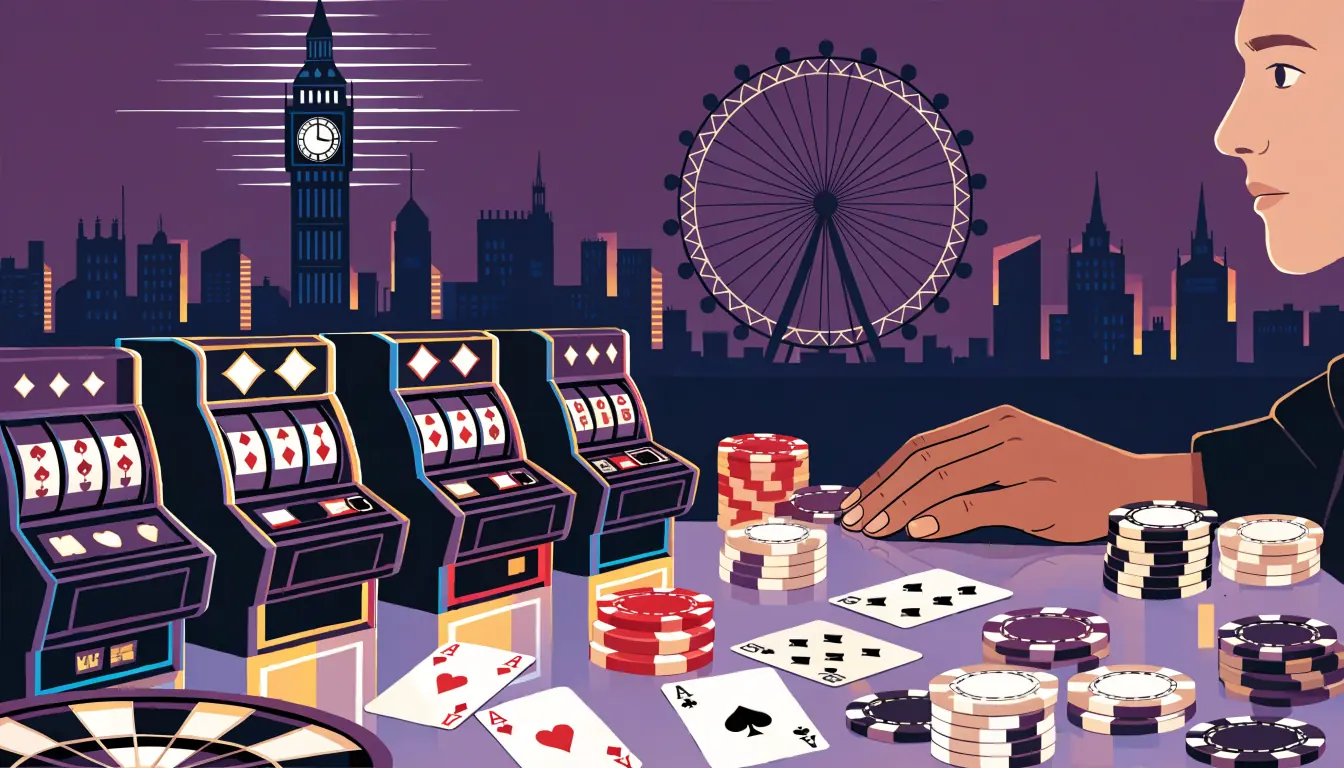
There is variety in presentation and feature design, but a jackpot remains a defined part of an individual game, not a promise hidden in the reels. The screen may make the possibility vivid. The rules do the quieter work.
Online Slots and the Route to a Jackpot
Putting a slot online changes where it can be reached, not what its prize feature means. A jackpot slot remains a game with a jackpot element; the online format is the means by which it is offered and played. The distinction matters because a bright digital lobby can make access seem like the whole story. It is not. A game’s presence online says little, by itself, about the character of its jackpot.
In Britain, remote gambling offered to consumers must be provided by an operator holding the relevant UKGC licence. A software supplier may create or supply a game, but it is the operator that makes it available to customers through its casino. That division reflects a familiar feature of modern entertainment: the people who make the product and the businesses that deliver it are not necessarily the same. The lobby is the shop window; the operator is responsible for the service behind it.
Attention: In Great Britain, online slots cannot offer autoplay, and a mandatory pause of at least two and a half seconds must occur between spins.
For someone looking for online jackpot slots, the practical route begins with availability. A title may be part of a provider’s catalogue without appearing in every casino’s games list. Even when the same game is offered in more than one place, the online setting does not turn those appearances into a single, universal version. The casino is the point of access, while the jackpot feature belongs to the particular game. Keeping those layers separate avoids mistaking a platform’s presentation for a promise about the prize.
That distinction is easy to lose on a screen. Search menus, categories and promotional panels compress many kinds of information into a small space. “Jackpot” may appear as a label, a filter or part of a game’s description, but those signs do not explain the game’s individual design. Nor does the word “online” settle how the prize works. The format describes the route to the game, not the rules of its feature.
The British rules also shape the pace of that route. Online slots cannot offer autoplay, and a minimum interval of two and a half seconds must pass between spins. Those requirements interrupt the fantasy of a machine that can simply be left to run. A spin requires an active action, followed by a pause. The pause is brief, but it is part of the product’s design as regulated in Britain, not a setting that a casino can quietly remove.

This matters to the experience of a casino jackpot slot because online play is often presented as continuous: one game, then another, each available through the same interface. Yet the rules place a small seam between one spin and the next. The screen may invite momentum; the design must retain a moment of friction. Regulation rarely makes for glamorous interface copy. It does, however, leave its mark on how the game behaves.
Online access, then, is neither a jackpot mechanism nor evidence that every casino offers the same title. It is the channel through which a licensed operator presents a game, within the limits governing remote slots in Britain. The route is digital; the conditions are not invisible. A screen can make the casino feel weightless, but the rules still keep time.
Playing for a Jackpot Without Turning Play into a Promise
To play jackpot slots is to take part in a game whose most conspicuous feature is also its least dependable: the possibility of a large prize. That possibility gives each spin a narrative shape. A player can imagine a turning point, a sudden change in fortune, even while the outcome remains uncertain. The story is easy to picture. Its ending is not.
This distinction matters because the language around jackpots can make a chance sound like a destination. “Play slots and win a jackpot” is a tidy phrase, but it compresses two different things into one: the act of playing and an outcome no player can command. A spin may produce a prize, a smaller result or nothing of interest. None of those outcomes becomes more certain because the game carries a jackpot label.
Honest Perspective
A jackpot slot is a game of possibility and entertainment, not a contract or a guaranteed appointment with a prize.
There is no best way to play jackpot slots that can turn uncertainty into a promise. A chosen rhythm, a preferred time or a personal ritual may make play feel more familiar; none establishes control over the result. The urge to find a method is understandable. People have long made rituals around uncertain events, from games of chance to harvests and journeys. Repetition offers a sense of order, even when it cannot alter what happens next.
The same restraint applies to claims about the best-paying jackpot slots. A label or promotional description cannot, by itself, settle what a particular player will receive. A game’s appeal may lie in its theme, pace or the prospect of a jackpot, but appeal is not evidence of a likely personal return. Treating a dramatic prize as an expected result turns entertainment into a private forecast.
That is where the social theatre of the slot becomes visible. The game presents a compact drama: anticipation, interruption, reveal. The player supplies the meaning, reading a near miss as a hint or a run of ordinary results as a pattern. Human beings are skilled at finding order in fragments. Chance does not owe those fragments a plot.
Playing online does not change that basic uncertainty. The screen can make a game feel immediate and intimate, while its outcome remains outside the player’s control. The sensible distinction is not between a clever and an unskilled method, but between playing for the experience and expecting the game to deliver a particular ending. The latter expectation is where disappointment can become costly in attention as well as money.


A jackpot slot can be played as a game, not a contract. Its promise is possibility, not an appointment. That is less thrilling than the grand version, perhaps, but it is the honest one.
Free Jackpot Slots: Practice Without a Cash Prize
The word “free” changes the financial meaning of a slot session. In real-money play, a stake leaves an account for the chance of a return; in free play, no money is put at risk on each spin. That difference matters more than the visual resemblance between a free game and one played for cash.
A free version may be presented as a way to try a game, but the label alone does not establish what its symbols, features or displayed prizes represent. Nor does seeing a jackpot on screen mean that a free session can award withdrawable money. A cash prize depends on the terms that apply to the particular game and mode. Without those terms, “jackpot” describes what is shown, not what a player can collect.
The distinction is easy to blur because the screen can make both kinds of play look alike. Reels turn; symbols land; a counter or prize graphic may appear. Yet a familiar interface does not make the underlying arrangement the same. Free jackpot slots are not a cost-free route to a cash jackpot. If no stake is being placed, there is no real-money win to take from that session.
No Cash Payouts
Free jackpot slots are for demonstration only; if no stake is placed, there is no real-money win to collect.
That can still make free play useful in a limited sense: it may let someone see how a game is presented without risking money. But “practice” should not be mistaken for proof of how a paid session will feel or what it might return. A demonstration does not settle the financial terms of real play, and it cannot make a jackpot more attainable.
The quiet virtue of free play is its boundary. Money is not being staked, so the session does not carry the same financial exposure as paid spins. The quiet limitation is equally clear: a displayed prize is not automatically a cash prize. Free online jackpot slots can offer an experience of the interface, but the word “free” cannot turn that experience into a claim on money.
That distinction also helps make sense of phrases such as “jackpot slots free online” or “free casino jackpot slots”. They may point to a no-stake mode, but they do not define one universal format. The details belong to the game and the operator’s description of that mode; they should not be inferred from the title or artwork. A free slot jackpot is not a promise in miniature.
No stake. No cash claim.
What “With Jackpot” Means in a Slot
“With jackpot” is a description of a prize feature, not a complete account of how a slot works. It signals that a game presents a jackpot as a possible prize, but the phrase alone does not explain how that prize is awarded, how its value is set or what a player must do to qualify. Those details belong to the individual game’s rules.
That distinction matters because the word can sound more definite than it is. A jackpot is a prize category; it is not a promise that a particular spin will produce a large payout. Nor does the label tell whether the prize is fixed, changes over time or is attached to a separate feature. Without the rules for the specific game, none of those interpretations can safely be assumed.
The phrase “online slot with jackpot” can therefore be useful as a broad description, but not as a substitute for reading the game information. A title may be presented as a jackpot slot while leaving the essential conditions elsewhere in its help screen or paytable. The name on a tile is the shop window, not the contract.
The same care applies to claims about a jackpot win in online slots. A game may advertise the possibility of a jackpot, yet the label does not establish what counts as a win or how any prize is credited. The game’s own terms define those matters. That is a less glamorous answer than a bright jackpot badge, but a badge is not fine print.
What “with jackpot” means
It is a description of a prize feature signaling that a jackpot is a possible outcome. It does not explain how the prize is awarded or its specific value, which are detailed in the game’s individual rules.
“Slots with jackpot” also does not identify a single style of game. The phrase can cover titles with different themes, layouts and rules. It should not be taken to mean that all such games share one feature, or that a jackpot is triggered in the same way across them. Even a familiar-sounding term can conceal a different set of conditions from one game to another.
For the same reason, “big jackpot” is not a precise description by itself. It may be promotional language, but without an stated prize amount and the game’s rules it says little about the feature. A sensible description separates the existence of a jackpot from its size and from the conditions attached to it.
In short, “with jackpot” tells what kind of prize a slot advertises, not what outcome a spin will produce. The distinction is modest but important: a feature can be real without being a forecast.
Jackpot Odds and the Limits of Prediction
The odds of winning a jackpot on slots are not a property of the word “jackpot”. They belong to a particular game and to the conditions under which its prize is awarded. A label can identify a possible outcome; it cannot, by itself, say how likely that outcome is.
That distinction matters because a prize may be reached through a feature within one game, while another title may use a different trigger. The visual drama of a bonus round, the size of a displayed prize and the pace of ordinary wins do not establish the chance of hitting the jackpot. Nor does a run of near misses provide a useful forecast. Each impression is vivid; none is a calculation.
A meaningful figure needs a defined event. What counts as a jackpot win? Which game and version is being described? What rules govern the trigger? Without those particulars, a percentage would look precise while answering no precise question. The same restraint applies to broad claims about “winning jackpot slots”: a category name cannot make unlike games comparable.
Published game information can help explain the conditions attached to a win, but a chance of success is a separate matter. Terms such as return to player are not a shortcut to jackpot odds. They describe a different measure and should not be treated as a prediction that a particular player will receive a particular result, or as the probability of landing the top prize.
There is a social habit behind the search for a dependable number. People prefer uncertainty when it can be put into a column, compared, and made to look manageable. Gambling regulation can set boundaries around how a game is offered; it does not turn chance into a schedule. A stated maximum stake, for instance, concerns the amount permitted per game cycle, not the likelihood of a jackpot.
So what are the odds of hitting a jackpot on slots? The answer can only be specific to the game and its stated rules. A claim detached from those details is not a useful estimate. It is atmosphere dressed as arithmetic.
The outcome remains uncertain even when the rules are clear. That is not a flaw in the calculation. It is the point at which calculation ends.
What are the odds of hitting a jackpot on slots?
The odds are specific to each individual game and its stated rules; there is no universal percentage for all jackpot slots.
Does RTP predict jackpot odds?
No, return to player is a different measure and should not be treated as the probability of landing the top prize.
Does a run of near misses increase the chance of winning?
No, each spin is independent, and near misses do not provide a useful forecast for future results.
Progressive Jackpots and the Shared Prize Pool
A progressive jackpot is often imagined as a prize that grows while play continues, perhaps through contributions from many spins. The phrase “shared prize pool” can suggest that players at different casinos are feeding one common total. That picture should not be assumed from the label alone. A game’s name or jackpot display does not, by itself, establish how a prize is funded, whether it is linked across venues, or which operator is responsible for it.
That distinction matters in Britain, where a progressive jackpot slot is still part of remote gambling, not a separate kind of licence. A business offering real-money play to British customers must hold a UKGC licence, wherever its equipment is based. The licence belongs to the operator providing the gambling service; a software supplier’s role is different. Offshore sites sit outside the UKGC system, so their jackpot claims do not carry the same regulatory framework.

The search for progressive jackpot slots at UK sites therefore cannot be settled by a broad label or a promotional banner. Availability can vary by operator, and a game’s presence in a lobby is not evidence that its prize is pooled across casinos. Nor does the word “progressive” reveal the rules for qualifying, the prize calculation or the conditions for a payout. Those details belong to the specific game and operator terms.
Crypto does not change that boundary. A site accepting digital currency is not thereby a UK-licensed casino; British-facing real-money gambling remains subject to the local licensing requirement. A list of “top” progressive slots would be little more than a list of claims unless the games and their current arrangements were checked individually.
There is no dependable shortcut to a progressive jackpot. The label describes a prize feature, not a method of predicting or securing a win. The pool may sound communal. Its terms are not.

Bonus Terms Around Jackpot Slot Play
A jackpot-slot promotion is not a separate kind of money. It is an offer attached to play, and its conditions determine what happens to bonus funds before they can be withdrawn. In Britain, that part of the bargain has a statutory boundary: the UK Gambling Commission’s cap on wagering requirements for bonus funds took effect on 19 December 2025, limiting the required playthrough to ten times the bonus amount.
That limit does not mean every jackpot slot bonus works the same way, or that every game is included in a particular promotion. The offer’s own terms still matter. They set out which games qualify, how a bonus is credited and what conditions apply to any winnings. A welcome offer, a code entered during registration and a bonus round built into a game are different things; the word “bonus” does not make them interchangeable.

The distinction is especially useful when promotional language is expansive. A jackpot casino offer may sound as though it covers every slot with a prize feature, while its rules may define a narrower set of eligible games. The cap governs wagering requirements on bonus funds; it does not promise that a jackpot game qualifies, nor does it remove other stated conditions.
Bitcoin-themed searches can create a similar blur. A payment method and a promotional offer are separate matters, and the phrase “bitcoin jackpot slots” says nothing by itself about a casino’s UK status or its bonus rules. In Britain, remote gambling operators serving the market must hold a UKGC licence. A promotion’s wording cannot substitute for that regulatory standing.
Promotional copy sells possibility. Terms do the less glamorous work of defining it. With a jackpot slot bonus, the useful questions are therefore not whether the offer sounds generous, but what funds it applies to, which games count and what the stated wagering condition permits. The legal ceiling is clear; the details still need reading.
Prepared by the Rainbow Riches Casino 3 editorial staff.