Casinos That Accept Bitcoin in the UK: What to Check
 Available in GB
Bitcoin and Bitcoin Cash are separate assets, so general cryptocurrency claims do not confirm a specific cashier option or its terms.

Table of Contents
- Bitcoin Cash Claims Need More Than a Casino Label
- What “Online Bitcoin Casino” Says—and What It Doesn’t
- Deposits, Bonuses and the Small Print
- GamStop Is a Separate Question from the Payment Method
- Free Spins and the Conditions Attached to Promotions
- Bitcoin Slots, with the Usual Limits on Play
- Bitcoin Casino Sites and the Route Back Out
- A Bitcoin Casino List Without Unverified Names
- Bitcoin Payouts, Anonymity and Ownership Checks
- Instant Bitcoin Withdrawals: What the Clock Includes
Bitcoin Cash Claims Need More Than a Casino Label
A casino described as accepting cryptocurrency has not, by that description alone, established that it accepts Bitcoin Cash. The label is broad: it can cover different digital currencies, and the name of one does not stand in for another. Bitcoin and Bitcoin Cash are distinct payment assets. Treating them as interchangeable turns a potentially important cashier detail into a guess.
A specialist casino review mentions Visa, Mastercard, bank transfer, e-wallets and several cryptocurrencies. That is useful as a sketch of the payment landscape, but it does not identify a Bitcoin Cash casino or set out Bitcoin Cash terms. It cannot support a claim that a particular site takes that currency, still less that it is the best choice in the UK. The distinction is modest in wording and substantial in practice.
“Best” also asks for more than availability. It might mean a clearly stated Bitcoin Cash option, terms that explain how it can be used, or an operator licensed to serve the British market. Those are separate questions. A page that names cryptocurrencies in general answers none of them for Bitcoin Cash specifically. A confident ranking built on that gap would be decoration, not evidence.
When considering casinos that accept Bitcoin in the UK, payout timing is one practical detail to check alongside the available payment options. The verdicts below reflect only the payout information provided.
Payout speed: 1-3 business days Revery Play has a stated payout speed of 1–3 business days.
Payout speed: 1-3 business days Chanze has a stated payout speed of 1–3 business days.
Payout speed: 1-3 business days Amunbet has a stated payout speed of 1–3 business days.
Payout speed: 1-3 business days SpinFormula has a stated payout speed of 1–3 business days.
Payout speed: 1-3 business days NightLuck has a stated payout speed of 1–3 business days.
Payout speed: 1-3 business days Zombillion has a stated payout speed of 1–3 business days.
Payout speed: 1-3 business days BeOnBet has a stated payout speed of 1–3 business days.
Payout speed: 1-3 business days EvoSpin has a stated payout speed of 1–3 business days.
Payout speed: 1-3 business days Jetsetspins has a stated payout speed of 1–3 business days.
Payout speed: 1-3 business days NightWin has a stated payout speed of 1–3 business days.
This is where the language of casino promotion can blur the edges. “Crypto-friendly” sounds like a defined feature, though it may simply announce that some cryptocurrencies appear somewhere in a payment list. Even a cryptocurrency logo, where one is shown, needs to be read in context: it does not on its own establish that Bitcoin Cash is supported. A casino label is not a payment specification.
The same restraint applies to claims about the “best Bitcoin Cash casinos” or a leading Bitcoin Cash option for UK players. Without an identified operator and its stated terms, there is no sound basis for comparing one with another. A list might look decisive while leaving the central question unanswered: which currency is actually accepted? More names do not repair that omission.
Nor should a broad reference to Bitcoin be quietly expanded to include Bitcoin Cash. Similar names invite that shortcut; payment systems do not become equivalent through resemblance. The casino’s own cashier and account terms would need to name the relevant currency. If the wording is limited to “cryptocurrencies,” that leaves the detail unresolved rather than confirming it.
There is a further distinction between a site’s payment claims and its legal status in Britain. Remote gambling businesses selling into the British market must hold the relevant Gambling Commission licence. A payment method, whether conventional or digital, says nothing about that licence. Likewise, a licence does not itself establish that Bitcoin Cash is available. Each claim needs its own evidence; one credential cannot be made to answer for another.


A useful assessment would therefore begin with particulars rather than superlatives: an operator identified by name, Bitcoin Cash explicitly shown as accepted, and terms that explain the conditions attached to using it. The UK-facing status of the operator would need checking separately. Without those details, “best” has no stable object to describe. It is an adjective looking for a fact.
This is not a reason to assume that no casino accepts Bitcoin Cash. It is a reason not to turn a general mention of cryptocurrencies into proof that one does. The difference matters most when a phrase sounds precise but its supporting detail is not. For a player comparing payment options, an unverified label can be less informative than no claim at all.
The same standard holds for a supposed best Bitcoin casino, or a collection of leading Bitcoin casino sites. Bitcoin Cash cannot be included in those descriptions by implication, and a broad cryptocurrency reference cannot stand in for a coin-specific confirmation. Any comparison that collapses those distinctions risks ranking a feature that has not been established.
In Britain, where remote gambling is regulated through operator licensing, precision is not fussy bookkeeping. It separates a payment claim from a marketing shorthand and a legal status from a convenient impression. A specialist review can report that several cryptocurrencies are mentioned; it cannot, on that wording alone, certify Bitcoin Cash support or crown a winner.
No podium, then. Just the wording that can be substantiated, and the limits it leaves in place.
A general mention of cryptocurrencies does not serve as proof that a specific coin, such as Bitcoin Cash, is accepted by a casino.
What “Online Bitcoin Casino” Says—and What It Doesn’t
The phrase “online Bitcoin casino” sounds like a complete description: a place to play, with Bitcoin as the way in. In practice, it compresses several separate questions into a label. A site may discuss cryptocurrency without identifying which coins it accepts, whether Bitcoin can be used by customers in the UK, or what conditions apply to the payment route. The word “Bitcoin” in a description is a starting point, not a cashier confirmation.
A review of casino payment pages describes a mixture of Visa, Mastercard, bank transfer, e-wallets and several cryptocurrencies. That gives a picture of the kinds of payment methods mentioned, but a broad reference to cryptocurrency does not establish that Bitcoin is available at every site—or even that a particular site accepts it. Nor does a general payment list show whether the method appears for a UK account. Payment menus are specific to operators and can change; a label elsewhere on a page may not reflect the options actually offered at the point of transaction.
This distinction matters because payment language can do more work than it deserves. “Crypto-friendly” may be used to describe a general policy, a limited set of coins or a feature available only under certain account conditions. It is not, by itself, an assurance that Bitcoin will appear in the cashier. A search result or promotional description can flatten those differences into one attractive phrase. The cashier is less poetic.

For a UK account, the relevant check is the operator’s live payment information and the cashier available after account registration. The two should agree about the method and the customer’s eligibility to use it. If a page lists cryptocurrencies collectively but the cashier does not identify Bitcoin, the collective wording cannot fill in the blank. If Bitcoin is shown, the account conditions still matter: a payment option displayed in general information is not necessarily an option for every customer or every location.
There is also a difference between accepting a payment method and being authorised to offer gambling to people in Great Britain. Remote gambling licensees selling into the British market must hold the relevant UK Gambling Commission licence, whether they are based in Britain or elsewhere. A Bitcoin payment facility does not replace that requirement, and a licence does not prove that Bitcoin is among the available payment methods. These are separate properties of a site, not two ways of describing the same one.
That separation reflects a broader feature of British gambling regulation. The rules attach to the activity and the operator, not to the novelty of the instrument used to move money. A new payment channel may change how a transaction is made; it does not turn the operator’s regulatory obligations into a different category. The law is interested in who is offering gambling to the public, not in whether the cashier looks modern.
The phrase “Bitcoin online casino UK” therefore needs to be read as a claim requiring two independent checks. One concerns the operator’s status in the British market. The other concerns the actual payment choice available to the account. Neither can be inferred from the other. A cryptocurrency mention does not establish UK payment compatibility, while a UK-facing service does not establish that it accepts Bitcoin.
Remote gambling businesses serving the British market must hold a relevant UK Gambling Commission licence, regardless of the payment methods they offer.
Careful wording helps keep those distinctions visible. “The site mentions cryptocurrencies” reports a broad statement. “The cashier offers Bitcoin to this account” is a narrower claim, and one that depends on what the operator currently presents. Treating the first as proof of the second invites an avoidable misunderstanding. It can also make a general description sound like a promise of practical access.
The same caution applies to labels such as “Bitcoin casino” when they appear in headings, adverts or payment summaries. The label may be convenient shorthand, but it cannot tell a reader which specific currency is supported, where the option is available, or what account conditions govern it. Those details belong in the operator’s payment information and the live cashier, where the actual transaction begins.
In Britain, gambling at a real-money online casino is legal only when the operator holds a current UK Gambling Commission licence. That is the baseline for assessing the service, while payment compatibility remains a separate matter to establish from the operator’s own current information. A cryptocurrency reference can point towards a possibility; it cannot settle the question. The distinction is small in wording and large in consequence.
Deposits, Bonuses and the Small Print
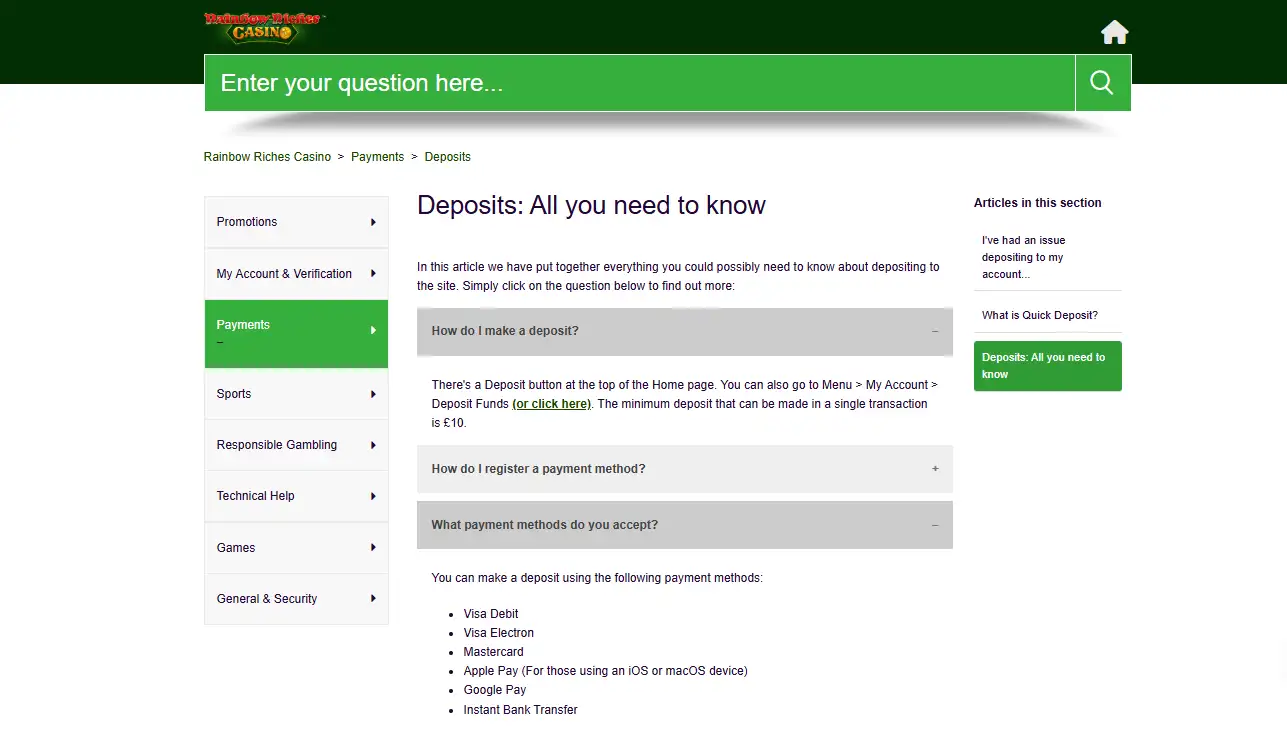
A deposit option is not a promise that every payment route will qualify for a promotion. The cashier determines which methods can fund an account; the bonus terms determine whether a deposit made that way counts. Those are separate decisions, often displayed in separate places.
That distinction matters when a casino is described as accepting Bitcoin. A label on a promotional page does not establish the minimum Bitcoin deposit, whether the cashier currently offers it to a UK account, or whether a Bitcoin-funded deposit qualifies for a bonus. The relevant details are the live cashier and the terms attached to the specific offer. A general reference to cryptocurrency cannot settle those conditions.


Deposit thresholds are not uniform. A specialist review puts minimum deposits at £10–£20, with the amount depending on the payment method. That is a reported range, not a fixed rule for every casino or a guarantee about a Bitcoin deposit. The amount shown in the cashier is the operative one. It may differ by method, and a threshold stated on an older page may no longer describe the account’s current options.
The ceiling can vary too. A specialist review notes that maximum deposits may be set per transaction, per day or per month, with the applicable cap depending on payment method and account status. These limits are not interchangeable: a transaction cap may prevent one large payment even where an account-level limit leaves room for further deposits. The cashier and account controls are more useful than a generic payment guide when the figures matter.
There is also a legal boundary around cards. UK-licensed casinos cannot accept credit-card payments for gambling, including credit-card funding routed through a money service business. Debit cards are commonly accepted in the UK, but the payment product must still be eligible at the particular cashier. The distinction is not merely a label on a card: the funding route matters.
Promotions add another layer. A specialist review describes PayPal as a popular option for speed and convenience, while noting that it may be excluded from bonus eligibility. That is a report about a possible condition, not a universal rule. Similar caution applies to any method shown alongside an offer: the promotional terms may name excluded payment types, or define which deposits count. A payment can reach an account without satisfying the offer’s requirements.
- Confirm the payment method appears in the live cashier
- Read the stated minimum and maximum limits
- Inspect promotion terms for payment exclusions
- Assume a payment method qualifies for a bonus based on a label
- Rely on generic payment guides for operative deposit figures
- Infer bonus eligibility from a cryptocurrency logo
The phrase “no-deposit bonus” should not be read as evidence that a deposit method is relevant at all. By its name, the offer is not triggered by an ordinary deposit; its own terms govern access and eligibility. A Bitcoin-themed casino promotion, meanwhile, does not prove that Bitcoin deposits are available, nor that such a deposit activates the advertised bonus. The label is marketing. The cashier and terms do the accounting.
Before making a payment, the practical checks are modest but consequential: confirm the method appears in the account’s cashier, read its stated minimum and any applicable maximum, and inspect the promotion’s payment exclusions. If the offer depends on a particular deposit route, that condition should be explicit rather than inferred from a logo or headline.
For new customers, UKGC rules require a financial limit to be set before the first deposit, with accessible account-level controls available thereafter. This sits alongside payment limits, not in place of them. One governs planned gambling spend; the other governs what a payment route or account will accept. Different pieces of small print.
GamStop Is a Separate Question from the Payment Method
A Bitcoin cashier and a site’s self-exclusion arrangements answer different questions. The presence of Bitcoin among payment options says nothing by itself about whether an operator participates in GamStop, what account controls it provides, or which regulator governs its service. A payment method is not a safeguard.


That distinction matters because “not on GamStop” can sound like a narrow technical description when it may point to a more consequential difference in oversight. In Great Britain, remote gambling licensees serving customers must hold the relevant UK Gambling Commission licence, wherever the company is based. UKGC-licensed casinos must provide responsible gambling tools, including self-exclusion, and remote operators must offer accessible account-level limit controls. These obligations are separate from the choice of deposit method.
So a non-GamStop Bitcoin casino is not automatically a casino with stronger privacy, fewer checks or better control over gambling. Nor does the phrase establish that the operator is outside UK regulation. Those are separate matters, and a label on a payment page cannot settle them. The licence status can be checked on the UKGC public register; the site’s account controls and self-exclusion terms need to be examined in their own right.
There is a legal boundary as well as a practical one. Online gambling in the UK is legal only at licensed and regulated sites. An offshore casino without a UKGC licence sits outside that regulatory system, even if it accepts British customers or advertises Bitcoin. The fact that such a site can be accessed does not make it a UK-licensed service. Payment access and regulatory status are not the same thing.
The social purpose of self-exclusion is easy to miss beneath the payment terminology. It is an account-level barrier, intended to interrupt access to gambling; a coin does not replace it, weaken it or prove that it is absent. Where a person is seeking a route around an existing exclusion, changing payment method does not alter the underlying concern. Bitcoin is a means of transfer, not a reset button.
Regulatory Status
Online gambling in the UK is legal only at sites that hold a current UK Gambling Commission licence; offshore casinos without this licence sit outside the regulatory system.
For anyone assessing a casino, the relevant checks therefore sit side by side rather than inside one another: whether the operator holds a current UKGC licence, what self-exclusion options it provides, and whether its cashier actually supports the chosen payment method. A site may mention cryptocurrency broadly without confirming a particular coin or explaining the conditions attached to it. None of that establishes the site’s GamStop status.
The clean distinction is modest but important: self-exclusion belongs to the account and regulatory relationship; Bitcoin belongs to payments. Treating one as evidence about the other turns a search label into a claim it cannot support. Different questions.
Free Spins and the Conditions Attached to Promotions
A free-spin promotion and a Bitcoin payment option answer different questions. One describes a promotional offer; the other describes how an account may be funded. Seeing both mentioned on a casino page does not, by itself, establish that the offer is available to customers who choose Bitcoin. The promotion’s terms need to connect the two.
That distinction matters because a free-spin headline rarely contains the whole offer. Its conditions may define which customers qualify, which games the spins apply to, how winnings are treated and when the promotion ends. Those details belong to the specific promotion, not to the phrase “free spins”. A casino can advertise spins while restricting eligibility in ways that are not apparent from the headline.
Payment method can be one such condition. A specialist review has reported that PayPal may be excluded from bonus eligibility, despite its appeal as a payment option. That is a report about a particular source and a condition that can change; it is not a rule that applies across casinos. The practical point is narrower: a payment route should not be assumed to qualify merely because it is accepted for an account transaction.


The same care applies to searches for free spins at Bitcoin casinos in the UK. “Bitcoin” in a description does not establish that a particular offer is available to Bitcoin users, and a free-spin banner does not prove that Bitcoin is an accepted payment method. The cashier and the promotion terms must each support the claim. If either side is unclear, the headline cannot settle it.
There is also a difference between receiving spins and being able to use their proceeds without conditions. Promotion terms may attach requirements to winnings, restrict the eligible games or state how long an offer remains available. None of these details should be inferred from the number of spins displayed. The terms are the substance; the banner is the invitation.
This is why a free-spin offer should be read as a separate agreement within the account, not as a general feature of every payment method the casino lists. The relevant wording is the current wording for that promotion and account. An older review, a general payment page or a broad claim about Bitcoin support cannot substitute for it.
The distinction also keeps the offer in proportion. Free spins are promotional play, not a guarantee of a cash return. A displayed offer may have conditions, and eligibility may depend on the method selected. When the promotional page and payment information do not clearly align, the responsible description is simply that the terms need to be confirmed before treating the offer as available.
There is no useful shortcut in the label “Bitcoin casino with free spins”. It joins two features grammatically, not necessarily contractually. The casino’s current promotion must permit the customer’s chosen payment route, and the offer’s conditions must be understood on their own terms. A neat phrase is not proof.
Bitcoin Slots, with the Usual Limits on Play
The phrase “Bitcoin slots” can make the payment method sound like part of the game. It is not. A slot remains a slot whether an account is funded with Bitcoin or another accepted method; the coin does not change the rules governing play. Nor does the label establish that a particular casino offers Bitcoin deposits or a particular machine. Those are separate questions.
In Britain, the rules around online slots are unusually concrete. A spin must last at least two and a half seconds, and autoplay is prohibited. The restrictions place a small pause between decision and result, and remove the option of letting a sequence run unattended. That is not much of a dramatic intervention. It is, however, a deliberate refusal to make the machine entirely frictionless.
Stake limits apply too. The maximum stake per game cycle is £5 for adults aged 25 and over, and £2 for those aged 18 to 24. The lower limit for younger adults remains in place; the later change that set a £5 ceiling for all adults did not replace it. A jackpot theme, a familiar cabinet style or a cryptocurrency payment does not create an exception.

The more personal safeguard sits at account level. UK Gambling Commission rules require remote operators to ask new customers to set a financial limit before their first deposit and to make limit controls accessible within the account. This is not a feature of one slot, and it is not a Bitcoin-specific condition. It applies before play begins, as part of how a licensed remote gambling account is supposed to be managed.
That distinction matters when a casino presents its games and payment options as one glossy package. The slot catalogue concerns what can be played; the cashier concerns how money moves; account limits concern the boundary set around spending. A search for Bitcoin casino slots may bring all three ideas together, but they do not become one promise. A machine cannot confirm a payment route, and a payment method cannot tell whether a particular game is available.
For jackpot slots, the same limits apply. The size or style of a prize does not suspend the stake cap, shorten the required spin or restore autoplay. The spectacle belongs to the game; the conditions belong to the market in which it is offered.
Small brakes, by design.
Bitcoin Casino Sites and the Route Back Out
A payment method is only half a route. The other half is how money leaves the account, and a deposit option does not, by itself, establish that the same option can be used for a withdrawal. With a Bitcoin casino site, that distinction matters: a label on a payments page is not a map of the full journey.
The least complicated arrangement is often to use one account, held in the same name, for both deposits and withdrawals. Consistency can reduce avoidable questions about who owns the payment route. It also makes the trail easier to follow if a transaction needs checking. A different route may be possible, but it can introduce extra steps rather than a shortcut.
Using a single account held in the same name for both deposits and withdrawals can reduce questions about ownership and make transactions easier to track.
Costs can sit at several points along that route. A specialist payment review identifies possible casino charges, fees from a payment provider, bank or card-issuer charges, exchange-rate spreads and network fees. That is a list of places to check, not a promise that every transaction will incur each charge. Nor does a visible flat fee tell the whole story: conversion can affect the amount received without appearing as a separate line item.
Bitcoin adds another layer to the arithmetic when a transaction involves conversion or a network charge. The displayed amount, the amount sent and the amount ultimately credited need not be identical if fees or exchange rates intervene. The relevant terms are those attached to the particular payment route, not a general claim that a casino accepts cryptocurrency. No route should be assumed to be fee-free.
A useful comparison therefore follows the money in both directions. The cashier should make clear whether the chosen method is available for deposits and withdrawals, whether the account currency introduces conversion, and which parties may charge along the way. If the stated deposit route differs from the stated payout route, the gap deserves attention before money moves.
This is less glamorous than a list of Bitcoin casino sites, but more practical. A site can advertise a payment badge while leaving the cost of moving funds unclear; a familiar account used consistently can make the route more legible, though it cannot erase provider or exchange costs. The cleanest path is the one whose fees and return route are visible before the transaction begins.
Small print, large consequences.

A Bitcoin Casino List Without Unverified Names
A useful list of Bitcoin casinos needs more than a collection of names beside a Bitcoin symbol. Each entry should establish which operator is involved, whether it serves the British market legally, and whether Bitcoin is actually available to its customers. Without those distinctions, a list can look precise while leaving its central claim untested.
A specialist review of casino payment pages reports seeing Visa, Mastercard, bank transfers, e-wallets and several cryptocurrencies across the websites it examined. That describes a range of payment options, not a verified directory of Bitcoin casinos. It does not identify which operators accept Bitcoin, whether the option is available to UK customers, or what conditions apply. A general mention of cryptocurrency cannot fill those gaps.
The word “legit” adds another question. In Great Britain, remote gambling licensees selling to local customers must hold a UK Gambling Commission licence. A payment label cannot establish that status. Nor does an operator’s use of a familiar brand name or a polished site demonstrate that it is authorised to offer gambling in the UK. Licence status and payment support are separate claims, and each needs its own evidence.
That distinction matters because a list is not neutral decoration. Readers may treat inclusion as an endorsement, or assume that every named site has been checked against the same standard. A list built from unconfirmed payment mentions risks lending authority to claims it cannot substantiate. The neatness of the format is no substitute for the work.
A responsible UK directory would need to name operators only where both the relevant licence and the Bitcoin option are confirmed for the intended market. The UKGC public register provides a way to check an operator’s licence; the operator’s own current information would need to establish whether Bitcoin is accepted. Those checks should not be collapsed into one.
Verify Bitcoin Casino
- Check the operator’s licence on the UKGC public register
- Confirm Bitcoin is explicitly shown as accepted in the cashier
- Review the specific terms and conditions for cryptocurrency use
Until names meet that standard, a list of all Bitcoin casinos—or a shortlist presented as legitimate for UK players—would imply certainty that the evidence does not provide. Better no catalogue than a confident one assembled from labels. The empty space is informative.
Bitcoin Payouts, Anonymity and Ownership Checks
A Bitcoin casino payout is sometimes presented as a way to keep money movements private. That claim sits awkwardly beside the controls used by UK-licensed casinos. Anti-money-laundering rules commonly require a payout to go back to the original payment source, while returning funds that way is also a familiar anti-fraud safeguard. A payment method does not make the account holder anonymous to the operator.
The practical question is therefore not simply whether a casino mentions Bitcoin. It is whether the proposed payout route fits the account’s payment history and whether the casino can establish who controls it. If funds are requested through a different route from the one used to pay in, the operator may need additional checks. That is not evidence of misconduct; it is the consequence of a system designed to connect the person, the account and the movement of funds.
The phrase “Bitcoin casino payouts” can suggest a clean separation between identity and payment. In a regulated UK setting, that separation should not be assumed. A casino may need to verify account details and the ownership of a destination before releasing funds, particularly where the requested route is not the original source. Alternative arrangements can bring further verification rather than less.
This matters when a site describes a Bitcoin casino payout as anonymous. “Anonymous” is too broad if the operator still has to apply ownership and anti-money-laundering controls. A transfer may use a different payment rail, but that alone does not remove the casino’s responsibility to check where funds are going. The distinction is plain enough: privacy from the public is not the same as anonymity from the operator.

For a Bitcoin casino payout in the UK, the useful test is whether the site explains how original-source returns work and what happens when that route cannot be used. If the answer is vague, the advertised privacy is doing more work than the payment method. Not quite invisible.
Instant Bitcoin Withdrawals: What the Clock Includes
“Instant” can sound like a description of the whole journey, from pressing the withdrawal button to having funds available. In practice, a withdrawal has stages, and the casino’s own review of the request is part of the elapsed time. A specialist review notes that this internal approval can affect how long payment takes; it is not simply a matter of choosing a digital currency.
The first withdrawal may take longer while the account is verified. That makes the distinction between requesting a payout and receiving it important: a request can be waiting for checks before the casino authorises payment. Withdrawal speed depends both on that approval process and on whether verification is complete. A headline claim about speed, without explaining where its clock starts and stops, leaves out the part most likely to matter.

Bitcoin does not make those account-level steps disappear. A casino describing itself as accepting Bitcoin does not, by that label alone, establish that a withdrawal will be immediate. Nor does a fast deposit demonstrate that the payout follows the same timetable. The relevant information is the casino’s withdrawal procedure and the status of the account, not the shorthand attached to the payment method.
For a meaningful comparison, the published terms need to distinguish processing by the casino from the time after approval. They should also make clear what verification is needed and whether it must be completed before a first withdrawal can proceed. If those stages are bundled into a single “instant” claim, the word tells little about when the money will actually arrive.
There is no useful clock until its start and finish are defined. A pending request is not a completed payout.
What is the fastest withdrawal method for UK casinos?
PayPal, open banking services and debit cards linked to fast payout systems are generally among the quickest options. The casino’s approval process and your verification status also affect how quickly funds arrive.
Why must withdrawals return to the deposit method?
Returning funds to the original payment source is a common anti-fraud and anti-money-laundering control. Using a different route may require additional verification.
What is the current minimum deposit?
The minimum deposit usually starts at £10–£20, depending on the payment method. Check the cashier for the minimum that applies to your chosen option.
Which method has the lowest fees?
There is no universal lowest-fee method. Compare casino and provider charges, any exchange-rate spread, and network costs for the amount you plan to deposit or withdraw.
Are Visa and Mastercard deposits definitely debit cards?
No—the card logos alone do not confirm which card products are eligible. Credit-card gambling is banned in the UK, so check that the cashier accepts your specific debit card.
Do UK casino withdrawals require verification?
Verification can be part of the withdrawal process, particularly for a first payout, and may take longer to complete then. Having a fully verified account can affect withdrawal speed.
Why can a fast payout casino still delay my withdrawal?
A fast payment method does not remove the casino’s internal approval step. An unverified account can also delay processing, and bank transfers may be affected by cut-off times, weekends or currency conversion.
Published by the Rainbow Riches Casino 3 team.