Casinos That Accept Zimpler in the UK: What to Check
 Available in GB
Payment methods belong to a casino’s cashier, while slots come from its game catalogue; neither alone confirms the other.

Table of Contents
- Zimpler, Slots and the Limits of What Can Be Verified
- Bonuses and Slots Are Separate Questions
- What a Casino Cashier Can—and Cannot—Confirm
- Cards, Card Products and UK Gambling Rules
- The Deposit Route Is Not the Same as the Withdrawal Route
- Deposits, Minimums and Limits Before Play
- Withdrawal Timing and the Return-to-Source Rule
- Payment Alternatives When Zimpler Is Unavailable
- A Casino’s Payment Menu Is Not Proof of Zimpler Acceptance
- Gamstop Searches and the Limits of Payment Evidence
Zimpler, Slots and the Limits of What Can Be Verified
A search for Zimpler-compatible slots can blur two separate things: a casino’s payment options and the games available on its site. A payment method belongs to the cashier; a slot is supplied through a game catalogue. One does not establish the other. Without a confirmed connection between a named operator and Zimpler, or between a particular slot and that operator, neither a casino list nor a list of games can be treated as dependable.
That distinction matters when labels such as “best games” or “new casinos” appear beside a payment name. A title may be present at a casino without having any special relationship to Zimpler. Equally, a casino’s general payment information does not identify which games it carries. The word “compatible” can sound precise while concealing a missing link.
A catalogue also changes over time. Games may be added, removed or made unavailable in particular markets, while payment options can differ between operators. A slot name on a review page therefore cannot, by itself, settle whether the game is available at a particular UK casino or whether that casino accepts Zimpler. Nor does the phrase “mobile casino” settle the matter: it describes access by device, not a payment arrangement or a particular game selection.
When looking for a UK casino that accepts Zimpler, check the payment options available to you before signing up. The listed payout times offer one practical detail to consider.
Payout speed: 1-3 business days Revery Play lists a payout speed of 1–3 business days.
Payout speed: 1-3 business days Chanze lists a payout speed of 1–3 business days.
Payout speed: 1-3 business days Amunbet lists a payout speed of 1–3 business days.
Payout speed: 1-3 business days SpinFormula lists a payout speed of 1–3 business days.
Payout speed: 1-3 business days NightLuck lists a payout speed of 1–3 business days.
Payout speed: 1-3 business days Zombillion lists a payout speed of 1–3 business days.
Payout speed: 1-3 business days BeOnBet lists a payout speed of 1–3 business days.
Payout speed: 1-3 business days EvoSpin lists a payout speed of 1–3 business days.
Payout speed: 1-3 business days Jetsetspins lists a payout speed of 1–3 business days.
Payout speed: 1-3 business days NightWin lists a payout speed of 1–3 business days.
No named slot or operator should be presented as Zimpler-supported without direct confirmation of that specific pairing. The distinction is less glamorous than a ranked list, but it is the difference between a useful claim and a guess dressed as a recommendation.
There is another limit to what a slot search can promise. In Britain, online slot autoplay is banned. Spins must be initiated individually, and each spin must last at least 2.5 seconds. That rule shapes the play itself, regardless of which payment option a casino offers or which title appears in its catalogue. A payment method does not alter the rules governing a game.
The wider British framework treats remote gambling as a regulated activity, not simply a website feature. Real-money operators serving the British market must hold the relevant Gambling Commission licence. That requirement concerns the operator; it does not certify that every payment method or every game is available to every customer. Those are separate questions.
So a search for Zimpler slots cannot sensibly be answered with a list assembled from game names alone. The only sound distinction is between what a slot catalogue shows and what a casino’s payment arrangements establish. They are not interchangeable.

Bonuses and Slots Are Separate Questions
A payment button and a promotion belong to different parts of a casino’s terms. One describes how an account may be funded; the other describes the conditions attached to an offer. Seeing a payment method mentioned alongside a welcome bonus does not, by itself, establish that deposits made with it qualify.
That distinction matters when Zimpler appears in the same discussion as slots and bonuses. A casino might make a payment route available without making it eligible for every promotion. Conversely, a promotion’s payment exclusions do not prove that a method is unavailable for ordinary deposits. Availability and eligibility need separate confirmation.
The offer’s terms are the relevant place to establish eligibility. They may identify excluded payment methods, specify when a bonus is credited, or set conditions on the games that contribute to wagering. Those details can differ between offers at the same site. A general statement that a casino accepts a method cannot settle the rules of a particular promotion, and a bonus banner cannot settle whether that method appears in the cashier.
A payment method is not a bonus qualification
Promotional wording often makes the bonus look like the main event and the payment method like a small detail beneath it. In practice, the detail can determine whether the offer applies at all. A deposit may be accepted and credited to an account while remaining outside a promotion’s eligibility rules.
A deposit may be accepted and credited to an account while remaining outside a promotion’s eligibility rules.
That is not a contradiction. The casino’s cashier handles the transaction; the promotion’s terms govern the offer. The two systems overlap, but neither automatically answers the other’s question. A Zimpler deposit, if offered by a particular casino, should therefore not be treated as bonus-qualifying merely because the casino advertises a slot offer. Nor should an exclusion from one offer be taken as evidence that Zimpler cannot be used for a standard deposit.
Promotions can also distinguish between game categories or impose separate contribution rules. A bonus described as suitable for slots does not necessarily mean that every slot counts in the same way, or that every payment route is permitted. The wording attached to the offer matters more than the broad label on a promotional tile. Marketing likes a clean headline. Terms tend to restore the furniture.
What other payment exclusions show
PayPal is valued for speed and convenience, but a specialist review has reported that it may be excluded from bonus eligibility. That is a report about a possible restriction, not a rule that can be applied to every operator or offer. The practical point is that a familiar payment name does not guarantee access to a promotion.
Skrill and Neteller are offered at some casino sites, while a specialist review reports that promotions often exclude them. Again, this does not establish a universal policy. Eligibility may depend on the casino and the specific offer, so exclusions should be read as terms attached to an offer rather than as a property of an e-wallet in general.
Neither example supplies a rule for Zimpler. Similarity between payment methods is not evidence that their bonus treatment is the same. A casino might treat one method differently from another, and conditions can change between promotions. It would be misleading to infer that Zimpler is included because another method is included, or excluded because an e-wallet is excluded.
The same care applies to the phrase “bonus with Zimpler”. It can mean that a player wants to use Zimpler while claiming an offer; it does not demonstrate that the operator links the two. A bonus page may describe eligible deposits without naming every available payment method, while a payment page may list methods without discussing promotions. One page cannot quietly do the work of the other.
Read the offer as its own contract
Before a promotion is treated as available, its terms need to establish whether the intended payment method is eligible. The wording should be checked for explicit exclusions and for any requirement that the qualifying deposit be made in a particular way. If the terms are silent or unclear, the silence is not confirmation.
This is especially important where an offer is advertised for slot play. The word “slots” describes the eligible kind of game only if the terms say so; it does not answer the separate question of which deposits qualify. Nor does a slot promotion identify a list of games or prove that a named title can be played with a particular payment route. Those are distinct facts, not interchangeable clues.
- Check the offer terms for explicit exclusions
- Establish if the qualifying deposit must be made in a particular way
- Confirm the rules for games that contribute to wagering
- Assume silence or unclear terms as confirmation
- Rely on the word “slots” to identify qualifying deposits
- Use a slot promotion as proof of payment route availability
There is also a difference between receiving a promotion and being able to use it under its conditions. Eligibility may be limited by the offer’s own rules, and the method used for the deposit can be one of those rules. A successful transaction alone does not establish that a bonus has attached. The account balance may show that money arrived while the promotional balance remains subject to a separate decision.
For Zimpler specifically, no general bonus rule follows from the fact that other payment methods can be excluded. Each offer needs to be considered on its own wording, and each payment method on its own availability. The sensible reading is neither “all deposits qualify” nor “this method is excluded”; it is that the promotion’s terms must say what applies. Separate questions. Separate answers.
What a Casino Cashier Can—and Cannot—Confirm
A payment logo on a casino’s home page is a broad signal, not a promise that every account can use that method. The cashier is more specific: it shows which options the operator makes available within the account, at that point in time. For a method such as Zimpler, that distinction matters. A general payment page may describe a service, while the live cashier indicates whether it is actually offered to the account in question.

Availability can depend on more than the operator’s name. A method might be mentioned in a site-wide list yet not appear in a particular account’s cashier. Conversely, a cashier may present a method without the casino featuring it prominently elsewhere. The useful question is therefore not whether a casino has ever referred to Zimpler, but whether its current payment interface identifies Zimpler as an available option for that account.
That is a narrower test than a marketing label. It is also less theatrical.
A cashier can confirm that an option is displayed; it cannot, by itself, guarantee that every transaction will be compatible or completed. Payment services apply their own eligibility conditions, and casino systems can distinguish between customers, locations, account settings or payment products. A method’s name appearing on screen is evidence of listed availability, not proof that every version of the service will work. Nor does a list of familiar methods establish that an unlisted one is accepted under another label.

This is why method names should be read literally. A generic reference to “online banking” does not automatically mean Zimpler; “e-wallets” does not identify every wallet; and an instant-banking description is not a substitute for a named service. Categories are useful for orientation, but they blur the point at which compatibility becomes concrete. If a cashier names only a category, it cannot settle whether Zimpler itself is supported.
The same caution applies to payment cards. A specialist review reports Visa and Mastercard among the methods listed by the sites it examined, but that is not a guarantee of current UK availability or eligibility for every card product. Those details need to be checked in the casino’s cashier. A brand name can cover products that behave differently, and a general list may not reflect the conditions attached to a particular account. The cashier is a better indicator of what the operator presents, though it is not a substitute for the terms attached to the payment service.
Currency is another compatibility detail easily lost in a broad payment summary. A specialist review reports sterling support on the pages it covers, but the account currency still needs to be confirmed before a first transaction. If the account is set to another currency, conversion may enter the picture even when the payment method itself is available. A cashier can make the selected currency visible; a general claim that a site supports GBP cannot establish the setting of an individual account.
The distinction between a site’s public information and its account-specific interface is not peculiar to digital gambling. It reflects a familiar feature of online commerce: the public page describes the shop, while the signed-in account reveals what the shop is prepared to offer this customer. In gambling, the stakes of that distinction are practical. Payment options are not merely branding; they are part of the conditions under which an account can be used.

For someone comparing casinos with Zimpler in mind, a sound assessment therefore separates three statements: a casino mentions a payment category; a casino names Zimpler in its public information; and Zimpler appears as an available method in the live cashier. These are not interchangeable claims. The last is the most relevant indication of current account-level availability, while still leaving compatibility and any provider conditions to be confirmed.
A cashier also cannot establish facts outside its own payment menu. It does not certify that a casino’s broader description is complete, nor does it turn a general payment label into evidence for a specific service. The interface answers a limited question: what payment options are being presented to this account? That boundary is useful. It keeps a visible menu from being mistaken for a universal guarantee.
Cards, Card Products and UK Gambling Rules
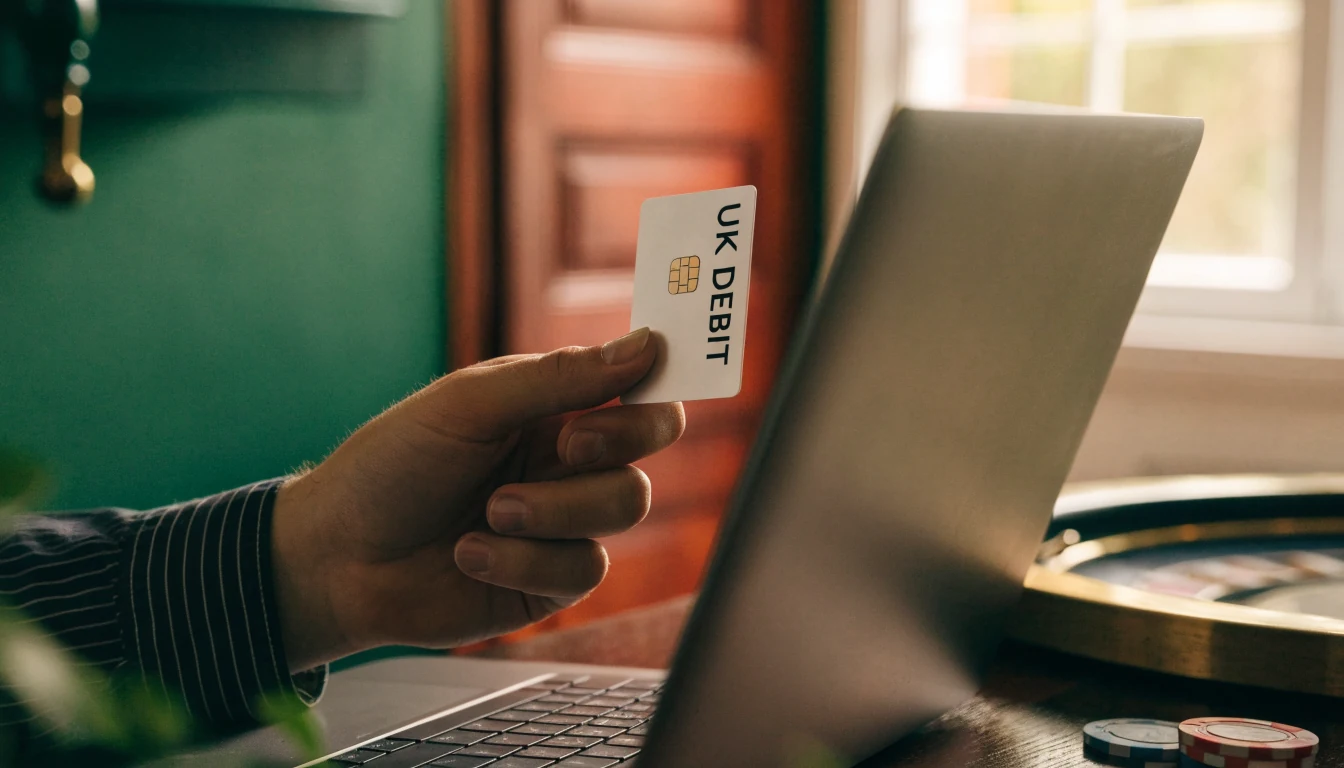
A card is not a single, interchangeable payment category. The distinction between debit and credit matters in Britain, where the rules are shaped not only by the technology in a wallet but by the source of the money. A plastic card, a virtual card and a card linked to a payment service may look similar at checkout. Their eligibility is not therefore identical.
UK casinos commonly accept debit cards, including Visa and Mastercard. That is a broad market pattern, not a promise that every card carrying either logo will work at every operator. Issuer restrictions and the particular card product can matter. A debit card draws on funds held in an account; a credit card provides borrowed funds. For gambling payments, that difference is decisive.
The credit-card ban took effect on 14 April 2020 and has not been relaxed. Remote gambling operators cannot accept credit-card payments for gambling. The restriction also covers credit-card funding routed through a money service business, so changing the route does not make borrowed card funds eligible. The rule applies to the payment, not merely to the label displayed beside a checkout button.
Credit Card Ban
Remote gambling operators cannot accept credit-card payments for gambling, including funds routed through a money service business.
That distinction can get blurred in searches for casinos taking Zimpler cards or Zimpler debit cards. Those phrases do not establish that Zimpler itself issues a particular kind of card, nor that a casino accepts a Zimpler-linked card. A Zimpler payment service and a Visa or Mastercard debit card are not interchangeable simply because both may appear in a payment conversation. The relevant question for a card is whether it is a debit product and whether the operator accepts that specific payment route.
The rules also reflect a wider policy choice. Credit makes a purchase possible before the money exists in the account; gambling can turn that interval into a source of risk. The UK ban drew a boundary around that use of borrowed funds, rather than treating all card payments as alike. A practical distinction, though not a particularly glamorous one.
For British customers, remote gambling operators serving the market must hold a Gambling Commission licence. That regulatory setting matters because the credit-card restriction is part of the rules governing legal remote gambling, not a voluntary preference that an individual casino may quietly waive. A site’s acceptance of debit cards does not imply permission to use credit cards, and a card brand appearing in general payment information does not settle the status of every product issued under it.
Searches for online casinos accepting Zimpler payments can therefore conceal two separate questions: whether a particular operator supports Zimpler, and whether a card being considered is eligible for gambling payments under UK rules. The card rules answer only the latter in general terms. Debit cards, including Visa and Mastercard, are commonly accepted; credit-card payments for gambling remain prohibited. Product labels deserve more attention than logos.
The Deposit Route Is Not the Same as the Withdrawal Route
A payment method appearing as a way to fund a casino account does not, by itself, show that the same method can receive a payout. Deposit acceptance and withdrawal support are separate properties. A site may display a route for adding funds while handling withdrawals through another route, subject to its own payment arrangements and account checks.

That distinction matters for searches about Zimpler. A reference to a Zimpler deposit would establish only that deposits are accepted through that route at the relevant site and for the relevant account. It would not establish that withdrawals can also be sent to Zimpler. Nor does the name of a payment service, on its own, establish what any particular casino supports in either direction.
The tidy assumption—that money enters and leaves by the same door—is appealing, but payment systems do not always arrange themselves so neatly. The route available for a payout may depend on the casino’s rules, the payment service’s capabilities and the individual account. A deposit option should therefore not be treated as evidence of a matching withdrawal option.
The less troublesome arrangement is often one named account used consistently for both transactions. When the casino account details and payment route belong to the same customer, there is less chance that a basic mismatch in ownership information will create avoidable friction. That is a practical benefit, not a promise that every transaction will follow the same path.

Consistency also means that account details should not be borrowed, shared or substituted casually. A payment route registered to someone else can make it harder to establish that the funds and casino account belong together. Even where the name appears familiar, small differences between the account holder’s details may prompt questions or require clarification. The simplest arrangement is the one in which the same customer is clearly identified throughout.
Before treating a method as suitable for the whole cycle, the deposit and withdrawal terms need to be read as separate statements. “Accepted for deposits” answers one question. “Available for withdrawals” answers another. A general payment-method label, a promotional mention or an old description may not settle the second point. The relevant terms for the account are what matter.
This does not mean that a deposit route is unusable if it cannot also receive a payout. It means that the route may not be a complete payment plan. Where the two directions differ, the casino’s stated process determines what happens next, and extra checks may be needed before a different route can be used. No particular Zimpler arrangement should be assumed from the deposit label alone.

The sensible distinction is plain: a payment method can be accepted at the point of entry without being established as the point of exit. A consistent, same-customer account route reduces one avoidable complication; it does not turn a deposit option into proof of withdrawal support.
Deposits, Minimums and Limits Before Play
A minimum deposit is set by the casino and may differ between payment methods. One specialist casino review places common starting amounts in the £10–£20 range, but that is a reported range, not a promise about every site or a Zimpler transaction. The amount shown for a particular account is the one that matters; a figure attached to another method cannot safely be carried across.
Maximums are less uniform still. A casino may set a cap for an individual transaction, a day or a month, and the applicable ceiling can depend on the payment method and the customer’s account status. That means a stated maximum is not necessarily a universal allowance. Limits can differ between accounts, and an amount accepted through one route does not establish what another route will permit.
For Zimpler, the same distinction matters. A general description of deposit thresholds cannot confirm that a particular casino accepts the service, or establish its Zimpler minimum. Nor does a search for a £5 deposit settle the matter: the cashier’s terms and the account’s available controls determine what can actually be deposited. Payment labels have a way of sounding more definite than they are.
There is also a separate limit, set by the customer rather than the payment provider. UK Gambling Commission rules require remote gambling licensees to ask new customers to set a financial limit before the first deposit. They must also make account-level limit controls accessible. These safeguards are not a statement about Zimpler’s own thresholds: they apply to the gambling account and sit alongside any payment-method minimum or maximum.
UK Gambling Commission rules require remote gambling licensees to ask new customers to set a financial limit before the first deposit and provide accessible account-level limit controls.
The distinction is useful because several figures can govern the same transaction, each for a different reason. The payment method may impose one boundary, the operator another, and the account’s chosen financial limit a further one. A deposit is possible only within the controls that apply to that particular account and route. No single advertised minimum tells the whole story.
Withdrawal Timing and the Return-to-Source Rule
A deposit route and a payout route are not automatically identical. A payment method may appear at the point of deposit without being available for withdrawals, and a casino’s general payment information does not settle whether Zimpler can receive a payout. That depends on the operator’s arrangements and the account’s available options; acceptance for one transaction does not establish acceptance for the other.
UK anti-money-laundering controls generally direct winnings back to the original payment source. This return-to-source approach helps link the money leaving an account with the funds that entered it. Where a method cannot receive a payout, the casino may need to use another permitted route and carry out additional checks. The existence of an alternative does not make it an automatic choice.
Timing also has more stages than the word “withdrawal” suggests. The casino must process the request internally before the payment provider or bank handles the transfer. A specialist review notes that approval and verification can add time, particularly for a first withdrawal, when the account may still need to be checked. A request shown as submitted is therefore not necessarily money already moving through the banking system.

The gap between deposit and payout can be striking. A specialist review reports that a card deposit may arrive instantly while a payout takes several business days. That comparison concerns card payments generally; it is not evidence about Zimpler’s speed or whether a particular casino supports Zimpler withdrawals. “Instant” describes one part of a transaction, not the whole journey.
KYC can be part of the delay. If identity or account details still need confirming, approval may wait until those checks are complete. The casino’s processing stage and the payment route then shape what happens next. A consistent account name and payment ownership can reduce avoidable friction, while mismatched details may prompt questions before funds are released.
For anyone comparing Zimpler casinos for withdrawals, the useful distinction is between a payment method being named and a payout being supported on the account. A displayed deposit option cannot establish the withdrawal route, its timing, or whether extra verification will be required. No shortcut there.

Payment Alternatives When Zimpler Is Unavailable
There is no single substitute that fits every casino account. Payment menus differ between operators, and a method’s presence does not by itself establish that it can handle both deposits and withdrawals. The practical comparison is between the routes offered at a particular site, their stated transaction functions and any costs attached.
Open banking services connect a payment to a bank account, while a bank transfer moves funds through the banking system. A specialist review reports that these routes can make deposits available immediately and support prompt payouts at many sites; that is a description of some operators’ services, not a promise that every casino offers either route or processes it at the same speed. Bank transfers can also be affected by cut-off times, weekends and currency conversion, so the displayed timing and account currency matter.
Prepaid vouchers have a different purpose. Paysafecard is deposit-only: it can put money into an account, but it should not be treated as a route for receiving a withdrawal. That distinction matters more than a familiar logo on a payment page. A method that gets funds into a casino may leave the payout to another route, subject to the operator’s rules and any additional checks.

E-wallets offer another possible alternative, but availability is operator-specific. Skrill and Neteller appear at some sites; their presence should not be taken as evidence that every casino supports them or that they are suitable for both directions of payment. EcoPayz changed its name to Payz in 2022, so older references to the former brand may not match the current label. Jeton is listed by a specialist review as remaining available at a small number of UK online casinos in 2026. That is a limited, time-sensitive observation, not a claim of broad availability.
A useful comparison therefore separates three questions: whether the casino lists the method, whether it accepts deposits through it, and whether withdrawals can be sent to it. Terms and the payment screen can answer different parts of that picture. A voucher may be deposit-only; an e-wallet or bank route may have functions that vary by operator. Where a casino requires a different payout route, its closed-loop rules and ownership checks still apply.
Cost also resists a universal ranking. Charges may come from the casino, the payment provider, a bank or issuer, or currency conversion; a visible flat charge is not the whole calculation if an exchange-rate spread applies. The account currency should be confirmed before a transaction to avoid an unintended conversion.
So an alternative to Zimpler is not a fixed shortlist of guaranteed options. It is whichever supported method matches the intended transaction, account details and actual cashier terms. A tidy payment menu is not a promise.
A Casino’s Payment Menu Is Not Proof of Zimpler Acceptance
A casino’s payment menu can look comprehensive while answering a narrower question than it appears to. A specialist payment-method review describes Visa, Mastercard, bank transfer, e-wallets and several cryptocurrencies. Those categories tell something about the kinds of routes discussed; they do not establish that any particular casino accepts Zimpler.

That distinction matters when a broad list of casinos is expected from a search for Zimpler casinos in the UK. A named payment category is not interchangeable with every service that might be grouped beneath it. E-wallets, for instance, are a category, not a synonym for Zimpler. Nor does a list of familiar brands demonstrate that an unmentioned method is supported by those same operators. The boundary is plain, if less satisfying than a directory.
The same caution applies to card-related descriptions. Visa and Mastercard appear in specialist payment material, but that does not confirm current availability in Britain or eligibility for every card product. A payment label is not a ruling on the individual card behind it. More importantly, a card reference cannot be treated as evidence that Zimpler itself is accepted, whether the intended payment is described as a Zimpler card, debit payment or another Zimpler route.
Searches for casinos that take or use Zimpler often collapse several separate claims into one. One claim is that a casino supports a broad payment class. Another is that it supports a particular provider. A further claim would be that the service works for a specific transaction. Evidence for the first does not, by itself, prove the second or third. “E-wallets accepted” may sound like an answer; it is only a category label.
This is why a list assembled from general payment descriptions can create false certainty. Familiar methods may sit beside one another in a review, yet each has its own availability and conditions. The presence of bank transfer, cards or cryptocurrency in such a list cannot be extended to Zimpler by association. Neither can an operator’s general reputation for offering varied payments fill that gap.
The phrase “casinos that accept Zimpler UK 2026” therefore calls for operator-specific evidence, not a broad inventory of payment types. Without that distinction, a list risks presenting inference as fact. It may look decisive, but its neatness is doing the work the evidence has not done.
A payment menu is a map of named routes, not a universal promise. A category is not a provider. And a provider’s name, where it appears, still does not establish that every account or transaction can use it.

Gamstop Searches and the Limits of Payment Evidence
A casino’s payment options and its Gamstop status are separate questions. Seeing Zimpler mentioned beside a gambling site does not establish whether that site is connected to Gamstop, whether it accepts people who have self-excluded, or whether any account restriction applies. A payment label tells very little about the safeguards governing an account.
That distinction matters because a familiar method can lend an undeserved air of certainty. Payment information describes a route for moving money; it is not evidence of a site’s self-exclusion arrangements. The same applies to claims that a Zimpler casino is “not on” or “not covered by” Gamstop. Those phrases cannot be confirmed from the payment method alone.
Nor does a casino’s offer of a particular payment option settle what protections operate around play. For remote gambling operators, UKGC rules require new customers to be prompted to set a financial limit before making their first deposit. Operators must also make account-level limit controls accessible. These are concrete requirements, not clues from which a site’s Gamstop connection can be inferred.
The distinction is easy to lose in a list of payment brands and casino claims. Yet a cashier menu and an account safeguard belong to different parts of the relationship between an operator and its customers. One concerns how a transaction may be made; the other concerns controls placed around the account. Neither substitutes for evidence about the other.
A search for Zimpler alongside Gamstop therefore cannot, by itself, identify a casino’s self-exclusion status. It may surface statements about payments, but those statements do not prove whether a site is connected to Gamstop or how it handles self-exclusion. Where the status matters, it has to be established independently of the payment method.
The limit-setting requirement is clear: a prompt before the first deposit, with accessible controls at account level. Beyond that, Zimpler’s presence offers no reliable answer about Gamstop. A payment method is not a safeguard.
Why must withdrawals return to the deposit method?
Returning funds to the original payment source is a common anti-fraud and anti-money-laundering control. An alternative route may require additional verification.
What is the fastest withdrawal method for UK casinos?
PayPal, open banking services and debit cards linked to fast payout systems are generally among the quickest. The casino’s approval process and your verification status also affect the time.
Are Visa and Mastercard deposits definitely debit cards?
No. Visa and Mastercard are accepted at many UK casinos, but check the cashier to confirm that your specific card product is eligible. Credit card gambling has been banned in the UK since 14 April 2020.
Why can a fast payout casino still delay my withdrawal?
The casino must approve the withdrawal, and first withdrawals can take longer while verification is completed. An unverified account can also slow the process.
Can I deposit in GBP?
Yes, GBP is supported. Confirm your account currency before making a transaction to avoid conversion.
Is Skrill available?
Yes, Skrill is available at some UK-friendly casino sites and remains a common deposit method. Check the cashier for availability at the casino you use.
Which method has the lowest fees?
There is no universally cheapest method. Compare casino and provider charges, any bank or issuer fees, currency conversion spread and network costs for your transaction.
Prepared by the Rainbow Riches Casino 3 editorial staff.