Online Bingo UK: Tickets, Patterns and Slots
 Available in GB
Online bingo combines shared number draws and pattern-based wins, while slot-style games follow a different format and pace.
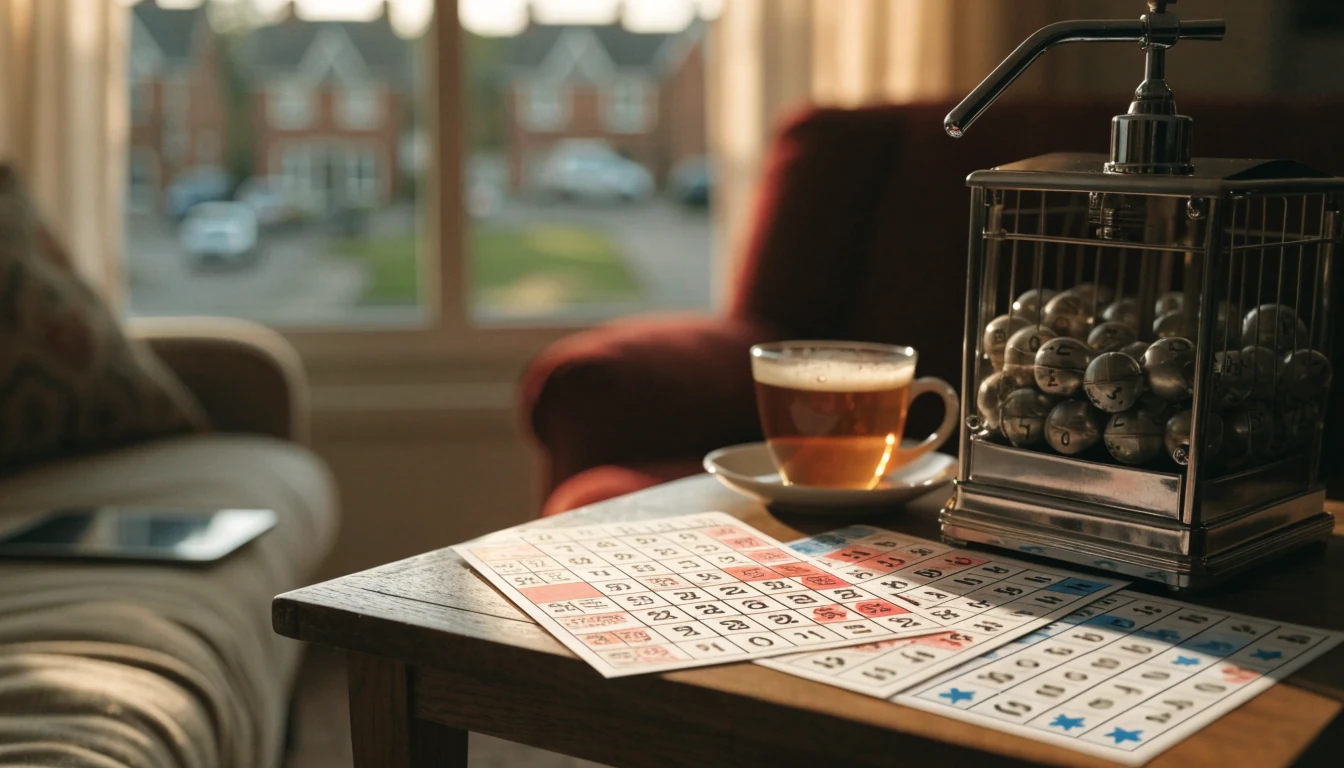
Table of Contents
- Bingo Rooms Still Run on Tickets, Numbers and Patterns
- Bingo and Slots: Two Games, Different Odds
- Bingo Sites with Slots, Without the League Table
- Real-Money Bingo: Ticket Prices and Prize Scale
- Free Bingo and Slot-Style Extras: Read the Conditions
- Where Bingo and Slots Meet in a Bingo Room
- Playing Bingo and Slots on a Phone
- The UK Rules Behind Online Bingo
- Bingo Slot Machines and the Pace of Online Play
- Limits and Player Safety Are Part of the Game
Bingo Rooms Still Run on Tickets, Numbers and Patterns
Online bingo has acquired screens, chat boxes and an electronic caller, but its central arrangement remains old-fashioned in the useful sense: players hold tickets, numbers are drawn, and a win depends on completing the required pattern before anyone else. The interface can alter the pace and presentation. It cannot remove the shared suspense of waiting for a number that may finish a line.
The formats differ chiefly in the shape of the ticket and the pattern that counts. In 90-ball bingo, the familiar room format, each ticket has three rows and nine columns. Prizes are awarded for completing one line, then two lines, and finally a full house. The sequence gives a round several moments of consequence rather than a single finish; a partial win does not end the game.
The 80-ball version rearranges the grid into four rows and four columns. Instead of relying on the line-by-line progression, it uses coloured patterns. A card may call for four corners, a letter shape or a full card. That makes the visual design part of the game: the important question is not simply how many numbers have arrived, but whether they occupy the right places.
When choosing an online bingo site in the UK for 2026, payout timing is one practical detail to check. This list gives a brief reference point based on the payout information available.
Payout speed: 1-3 business days Revery Play lists a payout speed of 1–3 business days.
Payout speed: 1-3 business days Chanze lists a payout speed of 1–3 business days.
Payout speed: 1-3 business days Amunbet lists a payout speed of 1–3 business days.
Payout speed: 1-3 business days SpinFormula lists a payout speed of 1–3 business days.
Payout speed: 1-3 business days NightLuck lists a payout speed of 1–3 business days.
Payout speed: 1-3 business days Zombillion lists a payout speed of 1–3 business days.
Payout speed: 1-3 business days BeOnBet lists a payout speed of 1–3 business days.
Payout speed: 1-3 business days EvoSpin lists a payout speed of 1–3 business days.
Payout speed: 1-3 business days Jetsetspins lists a payout speed of 1–3 business days.
Payout speed: 1-3 business days NightWin lists a payout speed of 1–3 business days.
The 75-ball format uses a five-by-five grid, with wins likewise tied to patterns. A cross, an X, a diamond, a letter T or a picture frame can define the target. The caller’s numbers therefore build towards a shape, and the ticket becomes a small map whose marked route may be completed in several ways.
These distinctions matter in online rooms because the word “bingo” does not describe one universal set of rules. A player moving between 90-ball, 80-ball and 75-ball games encounters different ticket layouts and different conditions for a win, even though the underlying ritual stays recognisable. Numbers arrive; players mark them; the room waits to see whose pattern is finished first.
That ritual also explains why bingo can sit beside slot games without becoming the same kind of activity. A bingo round is organised around a shared draw and a pattern on a ticket. Its pace comes from numbers being called and claims being settled. The screen is modern; the social grammar is not.
Three grids, one old suspense.
Bingo and Slots: Two Games, Different Odds
Bingo and slots may sit side by side on the same screen, but they do not offer the same kind of chance. A bingo ticket belongs to a room: numbers are called, players follow them, and a win depends on completing the required pattern before others do. A slot game is a separate pursuit, with its own rules and return figure. The shared menu does not make the underlying odds interchangeable.
That distinction matters when return to player, or RTP, is used to compare games. An RTP percentage describes a theoretical return across a large number of plays; it is not a promise about what an individual will receive. Nor does it tell the whole story of a bingo room, where the prize is tied to a particular game and its players. The number can be informative, but only when its context is clear.
In bingo, the room is part of the calculation. A ticket competes within a draw, and the outcome is shaped by the numbers called, the pattern being played and the other tickets in that game. The experience is therefore social in structure even when the players are alone at home: each person follows the same sequence, but the prize depends on who completes the pattern first. The suspense has company.
A slot game has no shared bingo draw to follow. Its RTP belongs to that game’s own design, rather than to a room full of tickets chasing a common pattern. Comparing it directly with a bingo figure can obscure more than it reveals, particularly if one number is presented as a settled property of a game and the other reflects a specific room or prize arrangement. The labels may look alike; the things they summarise need not be.
Side games offered within a bingo environment often have lower RTP percentages than the bingo room itself.
There is a further wrinkle when slots appear as side games within a bingo environment. Side games often have lower RTP percentages than the bingo room itself. That is a useful warning against treating every activity offered under one roof as if it had identical terms. It does not establish a fixed gap, or mean that every side game will have the same figure. The relevant information belongs to the particular game, not to the site’s general identity as a bingo destination.
This is why a headline percentage should not be read as a verdict on whether one activity is “better”. RTP is a measure of theoretical return, not a guide to how soon a win might appear, how large it may be, or whether a particular session will finish ahead. A higher figure does not turn uncertainty into certainty. It only describes one aspect of a game over an extended span of play.
Bingo prizes also carry a different kind of meaning from a slot return figure. In a room, the prize is attached to a shared contest: players watch the same numbers arrive and wait to see whether a line or pattern is completed. The room’s apparent generosity cannot be inferred from the presence of slots beside it, and a slot’s RTP cannot be used to calculate the result of a bingo game. Each has its own arithmetic, and neither cancels the other.

The arrangement can still encourage a misleading mental shortcut. When bingo and slot games are grouped together, it is tempting to treat the entire site as one product, then carry an impression of the bingo room into the slot lobby or vice versa. But a room is not a guarantee about every game it hosts. Side games may have different RTP percentages, and individual game information is what matters when assessing the terms of play.
The contrast is not merely technical. Bingo places attention on a sequence shared with other players; slots place it on a game’s separate return structure. One makes the room and its contest visible, while the other centres the individual game. Neither format can promise a personal result through its RTP figure, and a comparison between them needs to respect what each percentage actually describes.
Same screen, different sums.
Bingo Sites with Slots, Without the League Table
A site that puts bingo rooms and slot games under one roof is not simply a bingo hall with a row of machines added at the back. It is a small entertainment complex arranged in menus: rooms for shared games, individual games played at one’s own pace, and account pages that hold the practical machinery together. The distinction matters. A bingo room has a collective rhythm; a slot game does not wait for company.
The appeal of online bingo sites with slots often lies in that change of pace. A player can move from a room where numbers are drawn for a group to a game whose events unfold independently. The site’s design makes the transition look seamless, perhaps too seamless: one click leads from a social room to a solitary game, while the underlying activities remain different. A shared lobby does not make them the same pastime.
A shared lobby allows players to move between the collective rhythm of a bingo room and the independent pace of a slot game with a single click.
The room itself is where a site’s character becomes visible. Titles, descriptions and entry details tell players what kind of game is being offered, while the room rules determine how participation works. Some rooms may have their own patterns of play or restrictions on ticket purchases. These details are not decorative text. They shape how many chances a player can take in a single game and how the room distributes participation among those present.
Most bingo rooms set a ceiling on tickets bought for one game. The cap commonly falls somewhere between 10 and 50 tickets, with the permitted number depending on the ticket price. That rule has a social effect as well as a practical one: it limits how much of a shared game can be occupied by a single player. The room remains communal in format, though not necessarily equal in the number of tickets held by each participant.
The menu can also make a difference. A site with many rooms may divide them by game style, pace or entry conditions, leaving the player to choose not only a game but a setting. More choice is not automatically more clarity. When room descriptions are skimmed, the small rules become surprises; when they are read, they explain why two rooms on the same site can feel quite unlike each other.
This is one reason a league table is a blunt way to describe UK bingo sites with slots. A ranking can compress a varied environment into a row of names, but the useful question is often what the site lets players do once inside: whether bingo and slots are presented as separate destinations, how clearly room conditions are shown, and whether the layout makes it easy to understand what a particular game involves. No single label settles those matters.

The phrase “best bingo sites with slots UK” suggests that there is one stable winner, as though the experience could be reduced to a trophy. In practice, “best” depends on what a person values in the site environment: a room that is easy to understand, a broad choice of games, or a layout that does not blur one activity into another. A newcomer may care most about clear explanations; a regular may care more about finding familiar rooms quickly. These are preferences, not universal measures.
The same caution applies to claims about new bingo sites with slots in 2026. Newness describes a launch date, not the quality of the rooms or the usefulness of their rules. A fresh design can be attractive and still leave basic details hard to find. Conversely, a long-established layout may be plain but legible. The interface is part of the experience, but novelty is a thin substitute for information.
A combined site is therefore best understood as a place with several kinds of play sharing one entrance, not as a promise that every part will suit every visitor. Bingo rooms bring rules that organise a group; slots offer a separate form of play. The room cap is a small, concrete example of how the site environment shapes that first activity. Menus, descriptions and limits do the quieter work. A shared roof, different rooms.
Bingo sites with slots
- A shared lobby does not mean that bingo and slots are the same pastime.
- Room caps limit the number of tickets per player to maintain a communal format.
- The quality of a site depends on clarity of rules and layout rather than novelty or rankings.
Real-Money Bingo: Ticket Prices and Prize Scale
A bingo ticket is a small purchase with a visible price and an uncertain return. Online rooms make that exchange unusually easy to compare: penny games sit alongside rooms where a single ticket costs pounds. The difference is not merely a matter of a larger number on the screen. It changes how much is committed to a round, and often the scale of the prize attached to it.
At the lower end, ticket prices can run from 1p to 5p. Other descriptions of the market place penny-room tickets at 2p, with high-stakes games reaching £5 or more. These are different price bands, not a single ladder followed by every room. A room may set its own ticket price and prize structure; the label “penny room” is a useful indication of low cost, not a promise that every ticket costs the same.
Premium games may charge £1 or more per ticket. That price can look modest in isolation, but repeated purchases add up, particularly when a room allows several tickets in one game. The cost of a round is therefore not always the price printed beside one card. It depends on how many are bought. The ticket is the unit; the outlay is the total.
Prize scale can move with ticket price, although no price alone guarantees a particular return. A specialist review describes a 1p game offering a £10 full-house prize and a £1 game with a jackpot in the hundreds or thousands. Those figures illustrate one reported comparison, not a standing promise across online bingo rooms. Prize pools may be structured differently from one game to another, and the advertised jackpot is not the same thing as a likely personal win.
This is where the phrase “real money” can mislead by sounding like a measure of seriousness. It only distinguishes paid play from free play. A low ticket price still involves money, while a higher one does not make the outcome more predictable. Bigger prizes attract attention; they also sit beside higher individual costs. The arithmetic remains rather less glamorous than the display.
The sensible comparison is between the price of the ticket and the prize terms for that particular game, rather than between jackpot headlines in isolation. A large prize may depend on a specific pattern or a qualifying condition, while the amount spent is immediate. Even a small stake can become a meaningful total if tickets are bought repeatedly. Bingo rooms turn that repetition into part of the experience: the purchase is brief, the round moves on, and the next ticket is readily available.
For recreational players in the United Kingdom, bingo winnings are not taxable. That concerns the treatment of winnings, not the cost of entering a game, and it does not make paid tickets a source of dependable income. A prize can be substantial, modest or absent; the ticket price is known before the draw, but the result is not.
The older social bargain of bingo survives in its digital form. People pay to join a shared round, watch numbers appear and hope a pattern will bring a return. Online rooms have widened the range of prices, from spare-change territory to premium games, but have not altered that basic uncertainty. The numbers on the ticket are exact. The promise is not.
Free Bingo and Slot-Style Extras: Read the Conditions
A free bingo ticket looks simple until its small print starts sorting players into rooms. A promotion may apply only to a named room or a particular ball format, rather than to every game on the site. That distinction matters: a ticket that cannot be used in the room a player intended to enter is not much of a gift.
A specialist review reports that some free tickets can expire after 24 hours. That is a description of an offer, not a rule that applies everywhere; the operator’s terms set the actual deadline. The clock may leave little room to wait for a preferred game, so expiry and eligibility belong together in the terms. A ticket can be both limited in where it works and short-lived. Read the two conditions as one.
The win is not necessarily withdrawable
A free ticket cannot itself be cashed out. If it wins, the resulting amount may be credited as cash, but that does not necessarily make it available for withdrawal. The winnings may carry a wagering requirement, sometimes the same one attached to a deposit bonus. In practical terms, the balance can appear in an account while still being subject to conditions.
The word “free” describes the ticket’s purchase price, not necessarily the route from a win to withdrawable money. The distinction is easy to miss because the ticket and its winnings sit within the same promotion, while the terms may treat them differently. The win is real; access to it may be conditional.
Attention: Winnings from free tickets may be subject to wagering requirements, ranging from 20x to 65x, before they can be withdrawn.
A specialist review has described wagering requirements on free-ticket winnings ranging from 20x to 65x. That range should not be taken as a standard for every offer. The relevant terms need to say what amount is multiplied, which play counts towards completion, and whether the requirement applies to the winnings or to another bonus balance. A multiplier without its calculation base is only half an explanation.
This is where a free ticket can begin to resemble a deposit promotion, even though no ticket price was paid. If the winnings inherit the same wagering requirement as a deposit bonus, the promotion’s value depends on more than the chance of a prize. The play required before withdrawal may be substantial, and the permitted games may matter too. Conditions do the quiet work.
Terms worth separating
Three details should be kept distinct when reading an offer:
- Where it can be used: a room or ball format may be specified.
- When it expires: an offer’s stated deadline governs; a specialist review has reported a 24-hour expiry in some cases.
- What happens to a win: winnings may be credited as cash but remain subject to a wagering requirement before withdrawal.
That separation prevents a common misunderstanding: a ticket being free does not mean its winnings are automatically unrestricted. Nor does a cash credit necessarily mean cash ready to leave the account. The offer’s terms determine the route between those states, and the promotional label cannot replace them.

Where Bingo and Slots Meet in a Bingo Room
A bingo room can sometimes attach a slot spin to the purchase of a ticket. A specialist review describes an arrangement in which each ticket bought brings a free spin. That is a specific room feature, not a promise that every bingo game comes with a slot attached.
The distinction matters. In this arrangement, the spin is linked to the bingo ticket: it is an extra within the room’s offer. A standalone slot, by contrast, is its own game, with its own play and stake. The two may sit under the same site roof, but they are not the same activity merely because both use numbered symbols and a chance of a win.
This answers the practical question of whether slot play can be found at an online bingo site: sometimes, and sometimes as a ticket-linked extra rather than as a separate game. The details belong to the particular room. A spin connected to buying a ticket should not be mistaken for a general entitlement across the site, nor for a feature of bingo itself. Bingo’s old social machinery remains intact; the slot is an add-on.

That small distinction reflects a broader habit of online gaming: familiar products are bundled together, while their rules remain separate. The ticket buys entry to a bingo draw; the linked spin belongs to the slot offer. The room may present them side by side, but the connection is commercial, not a change to how bingo works.
A free spin can sound like a gift. In practice, it is also a prompt to move between games. The room’s layout makes that transition feel effortless; the terms determine what the offer actually means. An extra, not a new rule.
Playing Bingo and Slots on a Phone
A phone makes a bingo room and its slot games fit into the same small frame, but it does not make the account behind them any less formal. Before play can begin, an operator must establish who is opening the account. Identity checks commonly involve a photo ID and proof of address, while age must be verified before funds can be deposited. The screen may be compact; the paperwork is not.
That can make registration feel less like entering a game than being admitted to a building. There is a reason for the threshold: gambling accounts involve money, and operators are expected to know the person using them. A phone camera may make submitting documents possible without switching devices, but the exact steps depend on the operator. A mobile-friendly layout does not remove the check.
- Use a debit card or permitted payment method.
- Verify identity with photo ID and proof of address.
- Check for the UKGC licence number in the footer.
- Attempt to use a credit card for gambling.
- Use wallets that route credit-card funds.
- Deposit money if the licence number is missing.
Payment rules travel just as neatly. Credit card gambling has been banned in Great Britain since April 2020. A player using a phone therefore needs a debit card or another permitted payment method, rather than assuming that a card stored in a digital wallet will be accepted. Remote operators cannot accept credit-card gambling payments routed through a money service business, and wallets that allow credit-card funds to be used for gambling are also excluded. The small screen does not create a loophole.
Mobile bingo and slot sites may place several kinds of play within reach, but the essential distinction is between the device and the account: a handset is only the means of access. Identity verification, age checks and payment restrictions remain part of the transaction, whether the site is opened in a browser or through an app.
The licence information matters on a phone, too. If a gambling site does not prominently display its UKGC licence number in the footer, close the tab immediately. A footer can be easy to overlook on a narrow display; that is not a reason to overlook it. Before depositing, the licence number should be checked against the UK Gambling Commission’s public register. The screen is smaller. The standard is not.
The UK Rules Behind Online Bingo
Online bingo is legal in the United Kingdom, but legality depends on the operator as well as the game. A company selling remote gambling to customers in Great Britain must hold the relevant licence from the UK Gambling Commission (UKGC), even if the company is based elsewhere. A website’s availability to British players is not, by itself, evidence that it is authorised to serve them.
That distinction matters for bingo offered alongside casino games. The room may look like a social corner of a larger entertainment site, with chat and shared draws; the law sees a gambling service being supplied to customers. The operator’s location does not remove the licensing requirement. Nor does a bingo label make the rules optional. Online bingo sits within a system that treats gambling as a commercial activity requiring public oversight.
The licence behind the screen
A UKGC licence is not a general badge attached to every company in a group. An operator must hold the appropriate authorisation to offer its services to UK players. The licence sets the boundary between a legal online bingo service and one operating outside the British regulatory system.
The Gambling Act 2005 provides the central statutory framework for gambling in England, Wales and Scotland. It does not apply to Northern Ireland, so the legal picture should not be casually reduced to one rule for every part of the United Kingdom. For the British market, remote gambling operators must obtain a UKGC licence if they sell their services to consumers there, wherever their business is located.
This makes the regulator’s role more than a matter of paperwork. Licensing is the mechanism through which the state sets conditions for commercial gambling and holds operators to them. It also reflects a particular public bargain: companies may offer gambling, but only within a supervised system, with obligations attached to the privilege of doing business.
The practical check is plain. A gambling site must prominently display its UKGC licence number in the footer. That number can be checked against the Commission’s public register before money is deposited. If the number is missing, the sensible response is to close the tab. A polished design, familiar games or a busy chat room cannot stand in for the licence.
What regulation is meant to cover
The licence requirements include standards on fairness, anti-money laundering and responsible gambling. These obligations address different risks. Fairness concerns whether games are operated on proper terms; anti-money-laundering controls concern the movement of funds; responsible-gambling measures concern the operator’s duties in a product designed to involve spending and chance. None is a decorative policy page.
The rules also affect the relationship between an operator and its customers. UKGC-licensed operators must verify identity, and age must be checked before a customer can deposit. Players must be 18 or older. Verification commonly involves identity documents and proof of address, a process that can feel administrative precisely because it is. Its purpose is to establish who is using the account and whether that person is legally old enough to gamble.
Licensed operators must provide responsible-gambling tools, including self-exclusion, and remote operators must prompt new customers to set a financial limit before their first deposit while making account-level controls accessible. These measures do not turn gambling into a risk-free activity. They give the regulated service duties that would not be secured merely by placing a warning beside the play button.
There are also rules for what happens when a dispute arises. UKGC licensees must have an internal complaints process and provide access to an approved Alternative Dispute Resolution service. This gives a customer a route beyond informal exchanges with support staff if a complaint remains unresolved. It is a modest safeguard, not a promise that every disagreement will end in the customer’s favour.

The boundary of legal play
The system applies to the operator, not just to the games it chooses to display. A site offering bingo and casino games must be authorised for the services it provides to British customers. The Commission’s framework is therefore relevant whether bingo is the main attraction or one room among several.
Credit card gambling is banned in the UK. Remote operators cannot accept credit-card payments for gambling, including where credit-card funds are routed through a money service business. They also cannot accept wallet payments where the wallet allows credit-card funds to be used for gambling. The payment route does not erase the underlying restriction.
An offshore service may be reachable online, but reachability is not the same as UK authorisation. Operators serving Great Britain without a UKGC licence sit outside the British regulatory system; a player should not confuse a site’s international presence with permission to offer gambling here. The legal framework is built around licensed supply, rather than a claim that every site accessible from a British connection belongs to that framework.
Legal play
UK legality requires a UKGC licence, regardless of where the operator is based.
This is the quiet architecture behind online bingo: a licence, standards, checks and routes for complaints, all largely invisible during a draw. The entertainment may be arranged as a room, but the permission to run it is a public matter. Licensing is the price of admission.
Bingo Slot Machines and the Pace of Online Play
A bingo slot machine online is not a bingo room with a faster draw. It is a slot game: each spin produces its own result, and the rules governing online slots apply. The distinction matters because the rhythm of a bingo room comes from numbers being called and shared patterns being completed; a slot’s pace is built into the spin itself.
In Britain, an online slot spin must last at least 2.5 seconds. Autoplay is banned, so a game cannot keep launching spins on its own while a player watches passively. These rules place a deliberate pause between decisions. Not much of one, perhaps, but enough to make the next action visible rather than automatic.
There are also limits on the stake for each game cycle. For players aged 25 and over, the maximum is £5; for those aged 18 to 24, it is £2. The £5 limit for all adults took effect on 9 April 2025, replacing the lower limit that had applied to younger adults. Players must be at least 18 to gamble.
That framework changes what “fast” means. A slot can still feel brisk, with its repeated buttons, animations and immediate outcomes, but it cannot run through spins unattended or make each spin shorter than the prescribed minimum. The pause is part of the design imposed by regulation, not a feature borrowed from bingo.
The word “machine” can suggest a physical cabinet, a lever and a room thick with noise. Online, it describes the game format, not the setting. The screen may be quiet; the rules are not.

Limits and Player Safety Are Part of the Game
A bingo ticket and a slot spin may sit side by side on the same account, but neither becomes easier to judge because the other is familiar. The limit belongs to the account, not to a particular game. It can set a boundary around the money available for play; it cannot explain how a room works or make a game predictable.
UK-licensed remote operators must prompt new customers to set a financial limit before their first deposit and provide accessible controls for managing account limits. Deposit limits can be set for a day, week or month. A specialist review also describes these intervals as common options, though the controls available may differ between operators. The useful detail is not the label on the limit but the period it covers and when a change takes effect.
That makes the limit part of the routine rather than an emergency measure. A boundary set before play is less exposed to the moods of a session: the near miss, the unexpectedly long game, the small urge to continue because stopping now feels untidy. Account controls cannot remove those impulses. They can make the amount committed less dependent on them.

The distinction matters for people who play bingo and slots through one site. A deposit limit governs funds entering the account; it does not divide them into separate allowances for bingo tickets and slot play unless the operator’s controls explicitly provide that arrangement. Nor does it tell anyone whether the ticket price or game suits them. Those remain separate decisions.
The practical question of where to play both games online therefore has a quieter companion: what account controls are available, and how clearly are they presented? A limit that is difficult to find is less useful as a routine tool. Setting one does not replace understanding the games, and understanding the games does not make a limit unnecessary.
There is no drama in a sensible boundary. That is the point.
What is the best payment method for online bingo in the UK?
Use a debit card or an alternative payment method; credit cards have been banned for gambling in Great Britain since April 2020.
How long do online casino withdrawals take in the UK?
E-wallet withdrawals typically process within 24 hours after the operator releases the funds.
When is the best time to play for smaller prize pools?
Try playing outside the peak hours of 7pm to 11pm, when operators schedule their largest prize pools.
Published by the Rainbow Riches Casino 3 team.