Jackpot Mobile Casino UK: Types, Odds and Rules
 Available in GB
Jackpot types describe different prize structures, while UK rules, payment boundaries and random triggers shape how mobile play works.

Table of Contents
- Four Kinds of Jackpot, One Familiar Word
- Playing Jackpot Slots Online Under UK Stake Limits
- The UK Jackpot Casino: A Regulated Market, Not a Label
- Comparing Jackpot Casinos Without a Borrowed Top Ten
- Real-Money Play, Verification and Payment Boundaries
- Bonus Terms and the Limits Set Before a Deposit
- Progressive and Networked Jackpots: Where the Pool Comes From
- Mobile Jackpot Games and the Shape of Play
- Crypto Jackpot Casinos and the Offshore Question
- Slot Jackpot Odds: Random Triggers, No Reliable Schedule
Four Kinds of Jackpot, One Familiar Word
“Jackpot” sounds like one prize with one set of rules. On a slot screen, however, the word can point to four different families: progressive, fixed, daily or must-drop, and networked. They are not interchangeable labels. Each describes a different way of framing the prize, and the distinction matters before a game’s bright counters and celebratory graphics start to blur them together.
A progressive jackpot is identified by movement: its value can grow rather than remain a set figure. The word describes a changing prize, not a promise about what a particular spin will return. A fixed jackpot, by contrast, is defined by stability in the prize amount. The contrast is simple, though the word “jackpot” makes both sound like versions of the same thing. It is a useful reminder that a large-sounding prize and a changing prize are not necessarily the same feature.
Daily and must-drop jackpots form another family. Their names place time or a required drop at the centre of the description. That distinguishes them from a fixed prize, whose defining feature is its set value, and from a progressive one, whose defining feature is that the prize can grow. The label itself does not make all daily or must-drop games identical; it tells what kind of jackpot language is being used, not every condition attached to a particular game.
Choosing a jackpot mobile casino involves more than the games: payout timing is also useful to check. This list gives a concise reference point for the payout speed stated for each operator.
Payout speed: 1-3 business days Revery Play lists a payout speed of 1–3 business days.
Payout speed: 1-3 business days Chanze lists a payout speed of 1–3 business days.
Payout speed: 1-3 business days Amunbet lists a payout speed of 1–3 business days.
Payout speed: 1-3 business days SpinFormula lists a payout speed of 1–3 business days.
Payout speed: 1-3 business days NightLuck lists a payout speed of 1–3 business days.
Payout speed: 1-3 business days Zombillion lists a payout speed of 1–3 business days.
Payout speed: 1-3 business days BeOnBet lists a payout speed of 1–3 business days.
Payout speed: 1-3 business days EvoSpin lists a payout speed of 1–3 business days.
Payout speed: 1-3 business days Jetsetspins lists a payout speed of 1–3 business days.
Payout speed: 1-3 business days NightWin lists a payout speed of 1–3 business days.
Networked jackpots are named for connection: a jackpot belongs to a networked arrangement rather than being described only as a prize within one isolated game. That is a different distinction from the size or movement of the prize. The categories can therefore describe different aspects of a jackpot, and the name alone may not answer every question about how a particular slot works. A tidy taxonomy is not a complete rulebook.
The four families are most useful as a first sorting exercise. Progressive points to a changing amount; fixed to a set one; daily or must-drop to a prize framed around time or a required drop; networked to a connected arrangement. These plain-language contrasts help explain why two games advertised as jackpot slots may not offer the same kind of feature, even if their screens use similar coins, counters or fanfare.
That distinction is especially useful when the word appears in several forms: jackpot slot, jackpot slot game, casino jackpot slot. The phrase can refer to a slot with a jackpot feature, but it does not say which family the game belongs to. A jackpot slot machine may present a progressive prize, a fixed prize, a daily or must-drop prize, or a networked one. The broad label identifies the appeal; the family identifies the type.

This guide separates the account-free label from what it guarantees, covering registration, session recognition and…


There is a small piece of cultural history in the word’s persistence. “Jackpot” carries the suggestion of a single, decisive windfall, a word polished by games of chance and repeated in advertising until it can seem to explain itself. But in a modern slot catalogue, the same word sits over several arrangements. It is less a precise description than an umbrella, and umbrellas are designed to cover differences.
For anyone comparing jackpot slot games in the UK, the useful question at this stage is not which label sounds most exciting. It is which family is being described. A fixed prize and a progressive prize differ at the level of the amount; a networked jackpot is characterised by its connection; daily or must-drop wording signals another type of framing. Once the family is clear, the game’s own rules can be read in their proper context rather than inferred from the headline.
This is why “jackpot slots” is not one neat category of machine. It is a shared name for several kinds of prize structure. The label may be familiar, but familiarity is not precision. Four meanings, one word.
Playing Jackpot Slots Online Under UK Stake Limits
Playing jackpot slots online for real money means placing a cash stake on a slot game rather than using a free-play mode. The distinction is simple, though the language around it can make it sound grander: a jackpot does not turn a slot into a different kind of wager. The game still takes a stake for each cycle, and the rules for online slots still apply.
UK Slot Stake Limits
Adults aged 25 and over are subject to a £5 limit per game cycle (as of 9 April 2025), while those aged 18 to 24 have a limit of £2 (as of 21 May 2025).
A specialist review of UK slot rules records the current stake limits as £5 per game cycle for adults aged 25 and over, in force from 9 April 2025, and £2 for adults aged 18 to 24, in force from 21 May 2025. These are ceilings, not suggested stakes. A game may allow a lower amount, and choosing a jackpot title does not lift the applicable maximum.
The phrase “per game cycle” matters. It refers to the stake attached to an individual slot cycle, rather than a total for an entire visit. In practical terms, a player selecting an online jackpot game encounters the same cap as on another online slot. The label on the game does not create an exception. Nor does the size of the prize advertised beside it alter what may be staked on a cycle.
That distinction is useful because jackpot language tends to pull attention towards the prize and away from the mechanism that precedes it. A progressive pool, a fixed prize or a must-drop feature may give a game its particular character, but the stake remains a slot stake. A casino jackpot online is still an online slot when it is played as one; a large prize does not make the underlying game a table game or a separate class of gambling.
The limits are different from the rules for roulette, blackjack and live table games. The online slots cap applies to slots only. It does not set the stake for a roulette bet, a hand of blackjack or a live table game. Those formats may appear beside slots in the same online casino, but proximity on a screen is not a common rulebook. One interface, different games.

That separation can be easy to miss when a casino groups its games by theme or presents a jackpot feature across several formats. The useful question is not whether a game advertises a jackpot, but whether the game being played is a slot. If it is, the relevant online slot limit applies. If it is roulette, blackjack or a live table game, this particular cap does not govern its stake.
The age bands also mean that a single figure cannot describe the limit for every adult playing online slots in Britain. The applicable maximum depends on whether the player is aged 25 or over, or falls within the 18–24 group. The dates attached to the two limits mark when each cap took effect; they are not renewal dates or temporary offers. A promotional banner cannot make the limit larger, and a jackpot title cannot do so either.
For anyone comparing real-money jackpot slots, the limit is part of the game’s basic conditions, not a feature to be discovered after play begins. The same ceiling applies whether a slot is reached through a mobile browser, an app or a desktop site. The screen changes; the stake rule does not. This is one of those points where the machinery of gambling regulation makes itself visible in a very small unit: the individual cycle, before the promise of a prize has had time to become a story.
Attention: Statutory maximum stake limits apply regardless of the prize size advertised or the specific jackpot title being played.
A lower stake may also be available within a game. The statutory maximum does not require a player to use it, and it does not mean every slot is configured to charge the maximum. The amount selected for a cycle remains the concrete cost of that spin. A jackpot’s headline value is a separate matter from that cost, and the two should not be read as if one explains the other.
In short, jackpot slots played for cash remain online slots, subject to the age-related stake ceilings introduced in 2025. Roulette, blackjack and live tables sit outside that particular limit. The game’s name may promise a special outcome. Its category determines the rule.
The UK Jackpot Casino: A Regulated Market, Not a Label
“Jackpot casino” describes a kind of game or an emphasis in a casino’s offering. It is not a regulatory status. A site does not become suitable for British players because its name, design or games suggest large prizes; the relevant question is whether the business holds the licence required to offer gambling here.
In Great Britain, the UK Gambling Commission is the sole regulator for commercial gambling. Its remit includes online casinos and remote gambling offered to consumers in Great Britain, even when the operator’s key equipment is located elsewhere. The location of a server, then, does not move the regulatory boundary. What matters is the market being served.
That distinction is central to the idea of a UK jackpot casino. An online operator selling real-money gambling to customers in Great Britain must hold the relevant Gambling Commission licence. A legal online casino serving UK players needs a current operating licence; jackpot-themed branding is no substitute for it. The regulator oversees gambling activity, not the language a casino uses to describe itself.

The UK Gambling Commission’s licensing system separates the business from the people who operate within the regulated market. Businesses receive operating licences, while individuals operating in Great Britain may require personal licences. These are different responsibilities: one attaches to the organisation offering gambling, the other to people performing specified roles. A polished mobile site can make the distinction easy to overlook. The paperwork is less decorative.
The legal geography is worth keeping straight. Great Britain refers to England, Scotland and Wales; the United Kingdom also includes Northern Ireland. The Commission’s stated role as the sole regulator for commercial gambling applies to Great Britain, while its wider remit includes gambling activity in the United Kingdom. For a remote casino serving consumers in Great Britain, the practical licensing requirement does not depend on where its equipment sits.
There is also a threshold before play begins. Great Britain’s rules require age and identity checks before someone can gamble online. These checks are part of access to gambling, not an optional feature attached to a jackpot promotion or a particular payment method. The regulated market expects the operator to establish who is using the account and whether that person is old enough before online gambling takes place.
This makes “mobile jackpot casino” a description of how a service is accessed and what kind of play it foregrounds, not a separate class of licence. A mobile screen may compress menus and terms into a neat little space; it cannot compress the operator’s obligations. The same regulatory question applies whether the casino is opened on a phone or another device.
Licensing Requirement
An online operator offering real-money gambling to customers in Great Britain must hold a valid Gambling Commission licence; branding or foreign licenses are not substitutes.
The word “UK” in a casino’s marketing can therefore carry less weight than the licence behind its service. Regulation is not a flavour of the brand. It is the structure that determines whether a commercial operator may offer gambling to people in the market, and which business and personal responsibilities attach to that offer. A jackpot may be the attraction; jurisdiction is the less glamorous part that makes the offer lawful.
Comparing Jackpot Casinos Without a Borrowed Top Ten
A ranking can make unlike things look comparable. One casino may advertise a large jackpot, another may emphasise a welcome offer, while a third puts the game catalogue first. Calling any one of them the best jackpot casino in the UK turns those different priorities into a single verdict, usually without explaining whose priorities count.
A useful comparison starts with the claim itself. Is the advertised prize fixed, or does it change as play contributes to a pool? Is the amount a current figure, a maximum headline, or a prize that must be won under particular game rules? The label “jackpot” covers more than one arrangement, so a comparison that treats every prize as equivalent is not much of a comparison.
The same care applies to jackpot casino bonuses. A prominent offer is only one part of the account, not a measure of the jackpot games themselves. Its terms should be read separately from the game’s prize rules: an offer may have conditions governing which games count, while the jackpot has its own way of being awarded. The headline is the invitation; the rules are the furniture.
A comparison can therefore look at how clearly a site explains its games, prize mechanics and offer conditions. It can also ask whether the information is easy to find and whether the language distinguishes a guaranteed prize from a possible one. These are observable features. Claims such as “best payouts” or “biggest wins” need context before they mean anything: a striking figure alone says little about the experience behind it.

There is no neutral way to rank every jackpot casino site for every player. Someone interested in a particular kind of jackpot may value a different catalogue from someone comparing offers. A sober guide can set out those differences and identify what each claim means, but should not turn a preference into a universal award. No borrowed top ten required.
Complaints are another practical measure, though not a promotional feature. The operator’s own complaints procedure comes first. If that process has been exhausted and the dispute remains unresolved, a player can take it to IBAS. Its rulings are binding on the licensed operator. That gives a complaint a route beyond the company whose decision is being challenged; it does not make every disagreement disappear.
The strongest comparison is consequently less a podium than a set of distinctions: what kind of prize is described, what the offer actually concerns, and how clearly the operator explains both. A polished badge can be bought. Clarity has to be read.
Real-Money Play, Verification and Payment Boundaries
Real-money play turns a jackpot account into a place where money must travel in both directions. Deposits may make a balance available for play; withdrawals bring the less theatrical part of the arrangement into view: the operator has to establish who is asking for the funds and whether the account activity passes its checks.
Verification Process
Before releasing a withdrawal, operators must complete Know Your Customer (KYC) and Anti-Money Laundering (AML) checks to verify the identity of the person requesting the funds.
Before releasing a withdrawal, any operator must complete KYC, or Know Your Customer, and AML, or Anti-Money Laundering, checks. These are not optional formalities reserved for a particular brand or a large jackpot. They apply across the board, so a request to withdraw can remain pending while the checks are completed. The display of a balance is not the same thing as money already cleared for release.
That distinction can matter to anyone searching for a jackpot casino withdrawal time. There is no single timetable to infer from the word “jackpot”: the checks have to be completed before funds can be released, and the time taken depends on the process being carried out. A promo code, free spins or a real-money jackpot offer does not make identity and anti-money-laundering checks disappear. Promotional language can make an account feel like a game; the withdrawal process insists that it is also a financial relationship.
The familiar sequence—deposit, play, withdraw—therefore has a gate in the middle. If verification is incomplete, the balance may be visible while the withdrawal is not yet available. This is why the distinction between a real-money jackpot casino and a free-play experience is more than a matter of interface: real funds engage checks that a simulated balance does not.
Then there is the payment boundary. Credit cards cannot be used for gambling payments in Great Britain. The restriction concerns gambling transactions, not merely a particular casino’s preference, and a credit-funded wallet does not provide a way around it. A payment route that appears indirect remains subject to the same boundary when credit-card funds are being used for gambling.



This makes the source of a payment consequential. A card label or a wallet screen may not tell the whole story if credit is involved behind the transaction. Operators cannot accept credit-card payments for gambling, including through a money service business, and cannot accept wallet payments where credit-card funds can be used for gambling. The route matters, not just the logo on the checkout page.
For a player, the practical point is plain: a withdrawal is conditional on completed checks, while a deposit cannot be funded with credit for gambling. Neither a jackpot nor a promotional feature changes those conditions. The machine may be built around suspense. The payment system is built around verification.
Bonus Terms and the Limits Set Before a Deposit
A welcome offer can make a casino account look like a gift waiting to be opened. In practice, a bonus is a set of conditions attached to play, not cash that can simply be treated as winnings. A no-deposit offer changes the point at which an offer is made; it does not make its terms irrelevant. The distinction matters especially when a jackpot is part of the attraction.
Before a new customer makes a first deposit, remote gambling businesses must prompt them to set a financial limit and make limit controls accessible. A specialist review of account safeguards describes this as a point-of-entry measure: the limit is not an afterthought to be found only after play begins. It gives the account a boundary before deposited money enters the picture. The controls should remain available afterwards, so the limit can be reviewed and adjusted through the account.
- Set a financial limit before making a first deposit
- Check which games qualify for bonus wagering
- Assume progressive jackpot slots count towards wagering requirements
- Treat bonus balances as immediate cash winnings
This requirement applies whether the offer is called a welcome bonus, a sign-up bonus or a no-deposit bonus. Those labels describe how the promotion is presented, not a different approach to managing money. A bonus balance may also be subject to conditions that shape which games count towards withdrawal eligibility. The headline can be generous; the small print does the accounting.
Progressive jackpot slots should be excluded from games that count towards bonus wagering requirements. That matters because a player attracted by a jackpot may otherwise assume that every spin contributes equally to clearing the offer’s conditions. It does not. The exclusion belongs in the terms, where it can be checked before bonus play starts, rather than discovered after a balance has been built around a mistaken assumption.
Other bonus conditions can vary between offers, so the useful comparison is not simply the displayed amount. Terms should make clear which games qualify, how bonus funds are treated and what conditions apply before winnings can be withdrawn. If those points are hard to locate or expressed ambiguously, the promotion is harder to assess. The same scrutiny applies to offers attached to bitcoin deposits: a payment method does not turn unclear bonus wording into a clearer bargain.
The financial limit and the bonus conditions answer different questions. The limit is an account-level tool for setting a boundary around spending; the promotional terms determine how an offer can be used. Neither substitutes for the other. A jackpot in a casino may be the vivid part of the pitch, but the quieter details determine what the account is being asked to do.


Set the boundary first. Then read the offer.
Progressive and Networked Jackpots: Where the Pool Comes From
A progressive jackpot is not simply a prize with a large number beside it. Its defining feature is that the pool can grow as play continues. In a networked version, the pool is shared across participating operators rather than being built from activity at one casino alone.
The network gives the prize a wider financial base. Once its starting floor has been reached, every spin at every operator contributing to that network adds a slice to the pool. The amount shown can therefore reflect play taking place across several sites, not just the activity visible to someone playing at one of them. A jackpot may look local on a screen; its funding need not be.
That arrangement changes the scale of the pool, but not the basic relationship between an individual spin and the jackpot. A progressive trigger is independent of stake size: the trigger is the same on a £0.10 spin as on a £5 spin. The larger contribution is not a larger claim on the chance to trigger the prize.
This distinction is useful when comparing an online progressive jackpot casino with a game whose prize is funded or awarded in a different way. The displayed total answers one question: how much is in the pool at that moment? It does not explain the trigger, nor does the size of a stake tell a player that the jackpot has become more attainable. Those are separate parts of the mechanism.
A prize pool that grows as play continues, often independent of stake size.
A shared pool connected across multiple participating operators rather than a single casino.
A networked pool also makes the word “shared” quite literal. Each participating operator supplies a route into the same accumulating prize, while spins across the network add to it. The arrangement depends on contributions from the network’s play, rather than on the impression that a single casino is steadily filling a private pot. The casino is the visible doorway; the pool may be collective.
There is a small social history in that design. A prize once imagined as belonging to one room can now be assembled from activity dispersed across operators, with the shared total made visible to players who may never see the other participants. The number on screen gathers that distant activity into a single spectacle. A neat piece of accounting.
For anyone reading jackpot casino reviews, the useful distinction is structural: does the prize build progressively, and is its pool connected across operators? That is more informative than treating every large jackpot as the same kind of offer. A live jackpot casino may display a prize as events unfold, but the word “live” alone does not explain where the money comes from. The pool’s funding arrangement does.
Mobile Jackpot Games and the Shape of Play
The move to mobile has changed the setting of casino play more than the idea of the game. A jackpot slot still presents its reels and prize in much the same conceptual frame; what changes is the screen’s place in ordinary life. The casino is no longer necessarily a room set aside for gambling. It may be a phone held on a sofa, on a train, or during a pause in the day. The setting becomes less visible, and play can sit more easily among other habits.

An affiliate review reports that 80% of UK casino sessions take place on a mobile device. That figure belongs to one review’s account, not to a settled measure of the market: device habits and the way sessions are counted can change. It does, however, point to the scale of the shift described in the industry. Mobile is not merely a smaller screen at the edge of casino play; it is a principal place where that play is said to happen.
This helps explain the appeal of jackpot casino games on phones. A short, self-contained session fits the format, while the possibility of a large prize gives a familiar slot a longer horizon than its immediate sequence of spins. The phone makes that horizon portable. It does not make the outcome more predictable, and it does not alter what a jackpot means. It changes the circumstances in which the game is encountered.
The phrase “jackpot casino app” can suggest a dedicated application, but the phrase alone says nothing about whether a particular operator offers one. Mobile access may be presented through an app or a browser; availability and design are matters to establish with the operator, not assume from a label. The more useful distinction is practical: does the interface remain legible on a small screen, and can its controls be used without awkwardness? Those are questions about presentation, not evidence of a better chance at a prize.
There is a social change in this portability. Gambling used to be associated more readily with a particular venue; a phone lets casino play travel into spaces where it is less conspicuous. Convenience is the visible part. The quieter change is that the boundary between a gambling occasion and an ordinary interval becomes harder to see.
Mobile Play Summary
- Roughly 80% of UK casino sessions occur on mobile devices
- Portability does not change game outcomes or jackpot meanings
- Interface legibility and control usability are the primary practical considerations
Crypto Jackpot Casinos and the Offshore Question
A crypto payment option says something about how a casino accepts funds. It does not establish that the casino is authorised to serve people in Great Britain, or that its protections match those of a UKGC-licensed operator. The payment method and the legal status are separate matters.
That distinction can disappear in the polished language of a jackpot casino crypto offer. A site may display a foreign licence, accept digital currency and advertise large prizes; none of those details substitutes for a Gambling Commission licence when the business is offering remote gambling to the British market. Offshore casinos sit outside the UKGC system. Their availability online is not proof of local authorisation.
Licence checks need to be specific to the business, not inferred from a badge or a group of associated brands. A specialist review reports that the Curaçao Gaming Authority’s public register lists Usoftgaming N.V. with active B2C licence CGA/2025/1353/1345. That is a finding about the named company and register entry, not evidence that every casino using crypto is licensed, or that the entry is a UK Gambling Commission licence.
The same specialist review says it found no Hustles Casino entry in that register. A missing result should be treated as a reason for caution, not quietly converted into proof about every company or trading name connected with a site. Registers can identify legal entities differently from the names seen by players; the relevant question is whether the operator serving British customers holds the required UK licence.
A search for a top jackpot casino should therefore not be settled by a coin logo, a jackpot figure or a foreign register entry. Those may describe payment, promotion or another jurisdiction’s oversight. They do not make an offshore casino equivalent to a UKGC-licensed operator. The distinction matters most when something goes wrong: protections attached to British licensing cannot simply be assumed to travel with a crypto transaction.
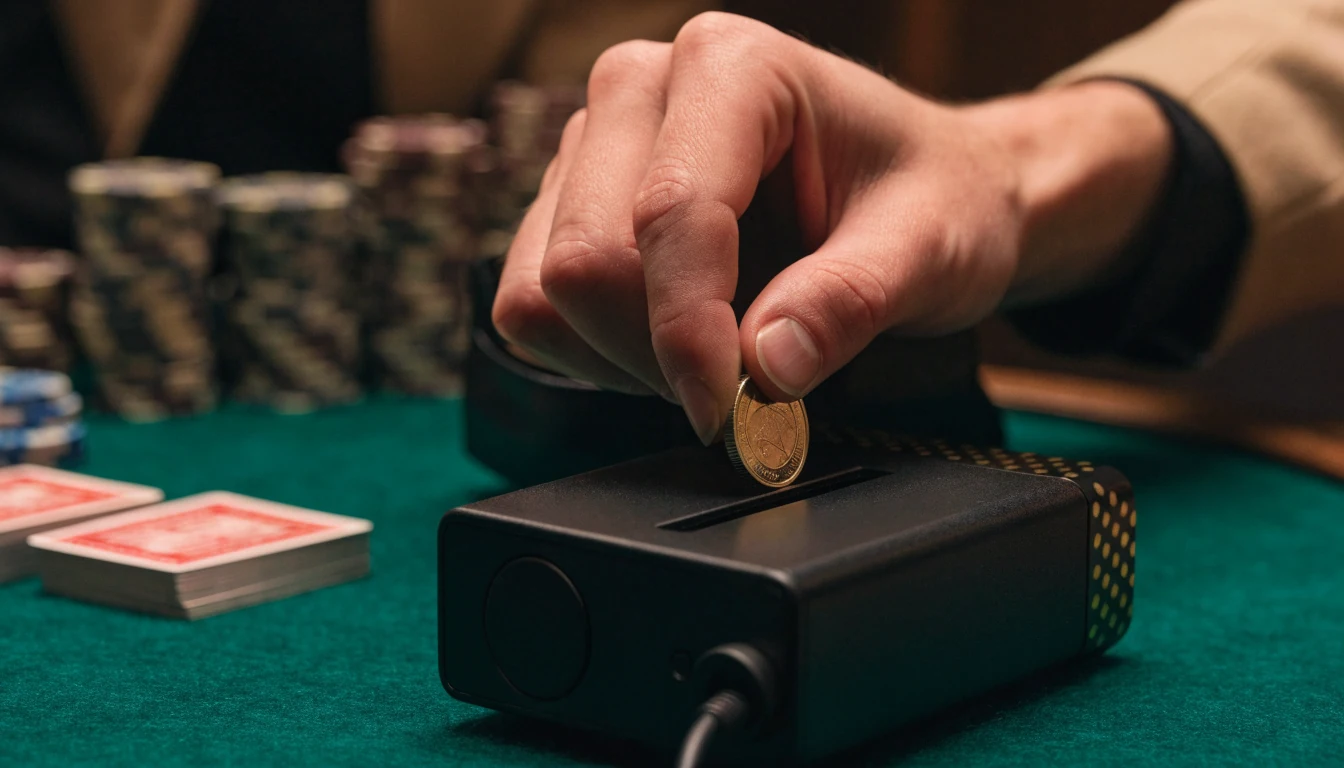
There is no special virtue in a payment route that obscures who is taking the bet. Crypto is a method of payment, not a regulatory passport.
Slot Jackpot Odds: Random Triggers, No Reliable Schedule
A progressive jackpot has no dependable timetable. Its trigger can occur at random on any spin, so a player cannot know that a win is due after a long run without one, or that a recent jackpot makes another less likely. The sequence offers no calendar.
That answers part of the question of how often a slot machine hits its jackpot: there is no reliable schedule to read from the previous results. A quiet stretch does not provide a countdown, and a recent win does not mark a predictable pause. The trigger remains uncertain at the point of play.
Nor is there a reliable method for making the jackpot happen. Choosing a particular moment, waiting for a run of spins, or changing the way a spin is made cannot guarantee a trigger. Each spin may be the one on which the jackpot appears; none can be identified in advance as that spin.


The odds of winning a jackpot on slots are not a promise hidden in a pattern of past outcomes. A visible pool or a sequence of near misses cannot establish when the next trigger will arrive. The distinction matters: possibility is not prediction. A jackpot may be available on a spin without being made more certain by patience or persistence.
This is an awkward feature of the word “odds”: it can suggest a figure that settles the matter. In practice, without a dependable trigger schedule, the useful answer is narrower. A progressive jackpot can trigger at random on any spin, but there is no guaranteed way to cause it. The uncertainty is not a puzzle with a player’s system as its solution.
No reliable schedule.
Published by the Rainbow Riches Casino 3 team.