Fast Withdrawal Casinos in the UK: How Payouts Work
 Available in GB
Payout timing depends on the cashier method, checks, limits and bonus terms, so a fast estimate is not a guaranteed arrival time.

Table of Contents
- Why Payout Speed Has Become Part of the Casino Experience
- The Cashier Route Can Matter More Than the Casino
- What “Fast” Means Once a Withdrawal Is in Motion
- Why a First Withdrawal May Take Longer
- Minimums and Caps: The Limits Around a Payout
- When a Transfer Can Be Measured in Minutes
- Crypto Withdrawals: Fast Networks, Variable Outcomes
- Real-Money Payouts and the Bonus Conditions Attached
- A Fast Payout Is Not the Same as a Guaranteed One
- Reading Speed Claims Without Turning Them Into a Ranking
Why Payout Speed Has Become Part of the Casino Experience
A casino visit does not end neatly when a game closes. For someone who has won, the experience carries on into the wait for the winnings to become available. That interval can colour the memory of the play itself: a satisfying result may feel less satisfying when access to it seems remote. The delay is not merely an administrative detail. It becomes part of the service being judged.
That is why payout speed has moved from the small print towards the centre of the casino experience. A quick, clearly handled payout can suggest that an operator respects the player’s time and has nothing to obscure. A drawn-out wait can have the opposite effect, even when the casino has a reason for taking longer. Trust is often tested in the unglamorous space between a promise and its fulfilment.
The expectation around speed has also changed beyond gambling. A specialist review describes customers in 2026 as accustomed to fast transactions in other parts of daily life, including banking apps, shopping and streaming. That is an observation from a review, not a universal rule about every customer. Still, it points to a contrast: many routine services make progress visible almost at once, while a casino payout can leave a person waiting without the same sense of movement.
Withdrawal speed can be a key factor when choosing a UK casino in 2026. Use the payout information below as a starting point, and check the casino’s terms for details that may affect processing.
Payout speed: 1-3 business days Revery Play lists a payout speed of 1–3 business days, giving readers a stated timeframe to consider.
Payout speed: 1-3 business days Chanze lists a payout speed of 1–3 business days. This stated timeframe makes it relevant to a search for faster withdrawals.
Payout speed: 1-3 business days Amunbet lists payouts as taking 1–3 business days, a useful point of reference when considering withdrawal speed.
Payout speed: 1-3 business days SpinFormula’s listed payout speed is 1–3 business days. That is the available information to consider for withdrawal timing.
Payout speed: 1-3 business days NightLuck lists a payout speed of 1–3 business days, providing a stated estimate for withdrawals.
Payout speed: 1-3 business days Zombillion lists payouts as taking 1–3 business days. Readers can use this stated timeframe when assessing withdrawal speed.
Payout speed: 1-3 business days BeOnBet’s listed payout speed is 1–3 business days, making its withdrawal timeframe clear at a glance.
Payout speed: 1-3 business days EvoSpin lists a payout speed of 1–3 business days. This is the available detail about its withdrawal timing.
Payout speed: 1-3 business days Jetsetspins lists payouts as taking 1–3 business days, offering a stated timeframe to keep in mind.
Payout speed: 1-3 business days NightWin lists a payout speed of 1–3 business days, giving readers a clear stated estimate for withdrawals.
The comparison is not quite fair, but expectations rarely wait for fairness. In ordinary digital life, a tap often produces a confirmation, a status update or a completed transaction. When winnings are involved, the absence of a clear signal can feel more consequential than the time itself. The player is left wondering whether the request is being handled, whether anything has gone wrong, or whether the casino is simply slow. Silence does poor public relations.
Payout speed therefore has a symbolic weight. It can make a casino seem organised and candid, or make its promises feel less persuasive. This does not mean that fast processing proves every aspect of a service is good. Nor does a slower experience, by itself, establish bad faith. Speed is one visible part of a larger relationship, and it is often the part that becomes memorable because money is waiting at the end of it.

The phrase “fast withdrawal casino UK” can suggest a simple contest, as though the quickest service must also be the best. But the appeal is broader than a race against the clock. An easy payout experience is one in which the process feels intelligible and the player is not left guessing. The feeling of ease depends on confidence as much as on elapsed time.
This is a fairly modern expectation, though not an especially mysterious one. People have always noticed when an institution makes access to their own money feel difficult. Digital systems have made that friction easier to compare with the apparent effortlessness of other services. The casino is judged not only by what happens at the table or on the screen, but by what happens after the result.
Waiting can be part of the experience. Uncertainty need not be.
The Cashier Route Can Matter More Than the Casino
A casino’s payout reputation can obscure a practical distinction: the same account may offer several ways to receive money, and each route has its own pace. Choosing a site is only part of the decision. The option selected in the cashier can change how long the transfer takes, even when the casino itself is unchanged.
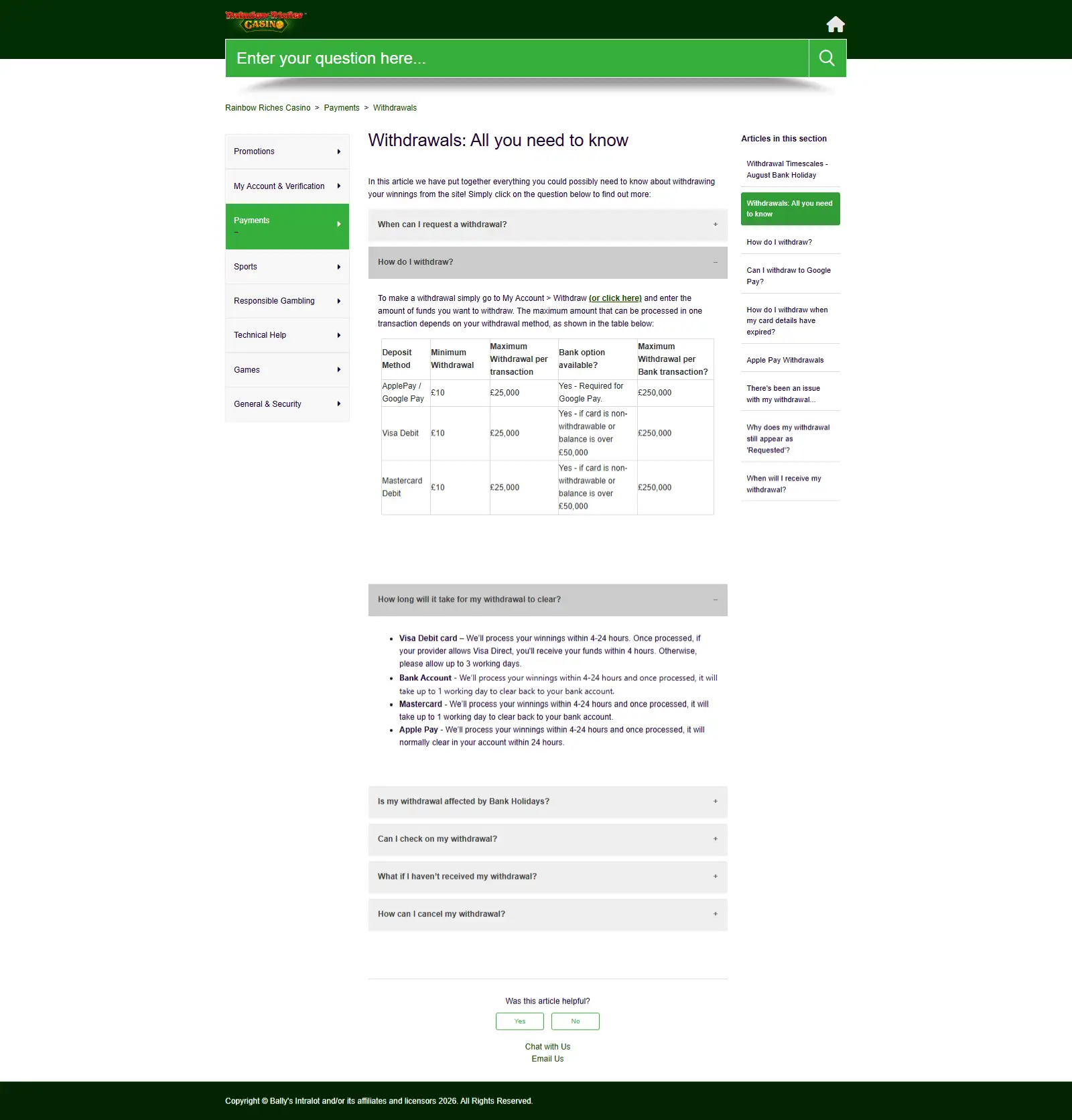
Bank wire transfers are the slowest of the routes covered here. A typical transfer takes 3–5 business days, so a payout requested near the end of a working week may feel quite different from one requested earlier. The bank still has to receive and process the transfer; the casino’s name does not make that part of the journey disappear.
Debit cards sit in a shorter window. Withdrawals to a debit card usually take 1–3 business days. That can make a card a more practical choice than a bank wire for someone who wants funds back through a familiar account, though it is not necessarily the quickest option in the cashier.
Digital wallets such as PayPal, Skrill and Neteller are generally quicker still: their payouts typically complete within 24 hours. That comparison is about the route, not a promise that every request arrives on the same schedule. A wallet can be quick while another available method at the very same casino takes longer.
PayPal, Skrill and Neteller typically complete payouts within 24 hours.
Withdrawals usually take between 1–3 business days.
The slowest route, typically taking 3–5 business days.
Apple Pay and Google Pay transfers can take up to 48 hours.
Mobile payment services have a separate timetable. Apple Pay and Google Pay transfers can take up to 48 hours. Their place in a cashier may look similar to other digital options, but the stated transfer window is not identical to the one associated with e-wallets. A method’s familiarity on a phone does not, by itself, tell the whole story of how swiftly money will reach its destination.
This is why “fast withdrawal” is not a single property attached to a casino like a badge. A specialist review has described the contrast of an online casino in the UK offering fast withdrawal on one payment rail while taking three working days on another. The point is not that every casino behaves this way, but that the route selected at the cashier can account for a meaningful difference. Same site, different journey.
The labels can also be misleadingly neat. “Bank transfer” sounds like one standard process, while card and wallet options seem self-explanatory; in practice, the useful comparison is the time attached to the specific method shown. A cashier may present several familiar names, but the names do not make their transfer windows interchangeable. A quick-looking interface is not evidence that every route moves at the same pace.
For a UK online casino fast withdrawal, then, the relevant question is not simply whether the operator advertises speed. It is which payment option is available for the payout and what timetable belongs to that option. The distinction matters particularly when the cashier offers both a card route and a wallet route: the debit-card window is usually 1–3 business days, whereas PayPal, Skrill and Neteller typically complete within 24 hours. The figures describe different channels, not a universal service standard.


That leaves bank wires and mobile payments with their own place in the comparison. A wire’s 3–5 business days make it a longer route than a debit card, while Apple Pay and Google Pay may take up to 48 hours. None of these options can be reduced to the casino’s headline claim. A casino may be quick on one rail and slower on another; the cashier is where that distinction becomes visible.
The phrase “online casino debit card withdrawal” therefore points to a particular route, not a general verdict on the casino. Cards are neither automatically the slowest choice nor automatically the fastest: the stated window places them between bank wires and the named e-wallets. Mobile payments form another category, with a window that can extend beyond the wallet timeframe. The small print of the cashier is less glamorous than a banner, but more useful.
Payout speed belongs partly to the operator and partly to the payment path. Comparing methods at the point of choice gives a clearer expectation than treating a casino’s reputation as a guarantee across every channel. The route matters. So does the wording attached to it.
What “Fast” Means Once a Withdrawal Is in Motion
A payout clock needs a start point and an end point. For a casino withdrawal, the useful measure begins when the request is confirmed and stops when the money reaches the account it was sent to. Anything else risks describing only one stretch of the journey as though it were the whole thing.
For a fast withdrawal experience, the practical measure is the full interval from the moment the request is confirmed until the funds are usable in the destination account.
That distinction matters because “processed” can sound like “paid” while leaving the final arrival unaccounted for. A request may have been accepted, yet the winnings are not accessible in the destination account. For someone judging a fast withdrawal casino UK experience, the practical question is not simply whether the casino has handled the request, but how long the confirmed withdrawal takes to become usable funds.
The wording around payout speed can therefore conceal more than it explains. A short processing time is not necessarily the same as a short wait from confirmation to arrival. The endpoint is plain enough: the money has reached the account. Before then, the player is still waiting.
This is why a delay can sour an otherwise straightforward experience. Winnings exist on the casino’s side of the transaction, but they have not yet become accessible where they are meant to go. The gap between those two states is not merely administrative. It is the part of the process that players feel.
The appetite is for winnings to be available quickly, without avoidable waiting. Days spent waiting for a withdrawal to be processed can detract from the experience, even when the amount itself is not in dispute. A casino withdrawal is not complete in any meaningful everyday sense while the money remains out of reach.
So “fast” is best understood as a description of the full interval, not a reassuring label attached to one step. The clock starts at confirmation; the measure ends at arrival. Everything between those points belongs to the payout experience. No shorter definition will do.

Why a First Withdrawal May Take Longer
A first withdrawal can bring an administrative pause that later requests do not. Before money is released, a casino may need to confirm who holds the account and where that person lives. The request therefore does more than move a balance: it can prompt a check of the documents attached to the account. A driving licence or passport may be requested as proof of identity, alongside a document confirming the address.
This is one reason a newly opened account can feel quick at the beginning and slower when winnings are requested. Registration creates an account; it does not necessarily settle every verification question that may arise when funds are due to leave it. If documents are missing, unclear or still awaiting review, the payout cannot simply be treated as an ordinary completed transaction. The paperwork becomes part of the journey.
For a UK-facing casino operating legally, verification is not an optional flourish. Remote gambling operators serving the British market must hold a Gambling Commission licence, and licensed operators are required to verify a customer’s identity, age and address before a withdrawal can be made. Age checks must also happen before a customer is allowed to deposit. In other words, an account may have passed an initial age check while still needing identity or address information to be supplied or confirmed later.
That distinction matters. A request for documents at withdrawal is not, by itself, evidence that the casino has invented a new obstacle after a win. It may be the point at which the operator completes checks that are necessary before releasing funds. Traditional casinos can add several business days to the process when identity, age and address must be verified before withdrawal. The first payout is where the neat promise of a fast cashier meets the less theatrical business of establishing who is on the other side of the screen.
Verification Requirements
UK-licensed operators are legally required to verify a customer’s identity, age, and address before a withdrawal can be made.
A claim of “no ID” should be read with particular care. It cannot mean that a UK-licensed operator is free to ignore verification requirements, or that a customer can use a payout request to step around identity checks. At most, such wording may describe an account process in which information is checked without a request for documents at that particular moment. If the operator later needs evidence, the requirement has not vanished; it has merely arrived at another point in the account’s life.
There is a small but revealing difference between frictionless and unverified. A service may make its checks feel unobtrusive, but the legal obligation remains. The phrase “no ID” can sound like liberation from administration; in a regulated market, it is not a licence to make the administration disappear. Paperwork is not glamorous. Neither is the alternative.
The practical effect is that a casino described as a new casino site with fast withdrawals may still take longer on a first payout than its headline suggests. That is not necessarily a contradiction. A speed claim may describe how quickly a payment is handled after the account has cleared its checks, while a first request may expose documents still to be reviewed. The distinction is between verification and payout processing, not a contest between a promise and a clock.
The useful question is therefore not simply whether an online casino advertises fast withdrawals, but whether its verification process is clear. Terms should explain what documents may be required and when the operator may ask for them. Account details should be accurate and consistent with the documents supplied; mismatches can leave a reviewer with an unresolved question rather than a clean confirmation. A passport proves identity, while proof of address answers a different question. Neither should be mistaken for a universal substitute for the other.

Fast withdrawal casino sites can make a strong first impression, but speed depends on more than a button marked “withdraw”. The first request may be the moment when the operator checks that the account belongs to the person claiming its funds. That check protects the integrity of the transaction as well as satisfying a regulatory duty. Once the documents are accepted, the process can move on; until then, the payout is waiting on an identity that must be established.
Minimums and Caps: The Limits Around a Payout
A payout can be approved quickly and still be less accessible than its speed suggests. The amount requested matters too: a minimum sets the point at which money can leave an account, while a cap sets the ceiling on what can be withdrawn over a stated period. They are separate constraints, and both can shape the practical meaning of a fast payout.
A specialist casino review gives a sense of the figures a player may encounter, rather than a rule applying across UK casinos: it describes minimum withdrawal thresholds starting between £10 and £20. Below a site’s own threshold, a balance may not be eligible for withdrawal as a single request. That can leave a small sum sitting in the account until it reaches the required amount, or prompt a player to reconsider whether to keep playing. The latter is precisely where a limit becomes more than a cashier setting. It can influence what happens to winnings before they reach a bank account.
- Check the minimum withdrawal threshold
- Review weekly or monthly withdrawal caps
- Assume all payouts are unlimited
- Mistake a fast route for a lack of limits
The threshold is not necessarily the same from one casino to another, and the quoted range should not be mistaken for a universal tariff. The useful detail is the existence of a floor, not the suggestion that every operator has adopted identical terms. A minimum can also matter differently depending on the size of a balance: a modest win may fall short, while a larger one clears the threshold without difficulty. Neither case says anything by itself about how promptly a casino handles an eligible request.
Caps work in the opposite direction. A specialist review reports that weekly or monthly withdrawal limits encountered by standard players can range from £2,000 to £10,000. These figures belong to that review’s account of possible terms, not to a market-wide standard. The relevant limit may be weekly or monthly, and the wording of a particular casino’s rules determines which applies. A player with a sizeable balance may therefore find that the amount available at once is lower than the balance shown on screen.
That distinction can become especially visible when a win is large. A cap does not necessarily mean the whole balance is lost; it means the amount that can be paid out within the stated period may be constrained. The remaining balance may have to wait for another permitted period, depending on the casino’s terms. A quick transaction cannot make a limit disappear. Speed answers how quickly an eligible amount moves; a cap answers how much can move under the applicable rules.

The phrase “no withdrawal limits” deserves the same care as any other broad promise. A casino may have no stated overall cap, while retaining a minimum, or it may apply limits that vary according to its terms. Without checking the exact conditions, “unlimited” says little about what can be requested, when, or in what amount. The cashier’s headline can be concise; the terms rarely are.
These boundaries are not just bookkeeping. They govern the point at which winnings become usable outside the casino, and they can make a rapid payout feel less immediate in practice. A minimum can keep a small balance inside; a cap can divide a larger one across time. The numbers are not interchangeable, and neither should be confused with processing speed. A fast route, a permissive minimum and a generous cap are three different things.
When a Transfer Can Be Measured in Minutes
Pay N Play belongs to a particular corner of the payout conversation: one where transactions may be handled in minutes rather than hours or days. A specialist review describes that pace for casinos using the approach. It is a striking possibility, but not a general timetable for every casino carrying the label, still less a promise that every request will be completed at that speed.
The appeal is easy to understand. A same-day payout can sound like a modest convenience, but “same day” leaves much unsaid: a payment may arrive later that day, or the phrase may simply describe a quick stage in a longer process. Pay N Play makes a more immediate claim about the handling of transactions. The distinction matters. Minutes are a measure of possible pace, not a guarantee written into the name.
Pay N Play vs Same-Day Payout
While same-day payouts imply arrival within the day, Pay N Play is associated with transactions that may be handled in minutes.
That difference also explains why the phrase can attract more attention than it deserves. Casino payments have inherited the language of ordinary digital errands, where a tap appears to settle the matter. Gambling has its own machinery, and a fast-sounding label cannot, by itself, establish what a particular casino will do with a particular payout request. The review’s description is evidence of a reported capability, not a universal rule.
There is something revealing in the promise. The older image of a casino was built around the table: the wager, the result, the next hand. Online, the cashier has become part of the setting, and the interval after a win is now visible enough to acquire its own vocabulary. Pay N Play answers that impatience with the prospect of a transaction measured in minutes. It does not make time disappear; it changes the scale on which the claim is made.
For anyone comparing a same-day withdrawal casino with one advertising Pay N Play, the labels should not be treated as interchangeable proof. One describes a broad expectation about arrival within the day; the other is associated, in a specialist review, with transactions handled in minutes. Neither wording alone confirms how an individual request will proceed. The distinction is small in print, but large in expectation.
Minutes, then. Not certainty.
Crypto Withdrawals: Fast Networks, Variable Outcomes
A cryptocurrency payout can be described as an instant withdrawal, but the word “instant” refers to a possibility, not a clock that starts and stops uniformly. A specialist review characterises crypto casinos as platforms able to process payouts in minutes, compared with the two to three business days associated there with traditional casino payouts. That contrast is useful as a broad picture of the potential, not a promise about any particular transaction.

The route has several moving parts. The casino must approve and send the request; the selected cryptocurrency determines which network carries it; and that network may be busy. A specialist review identifies the chosen currency, the casino’s internal procedures, network congestion and outstanding verification as factors that can affect the time taken. In other words, a quick network cannot make a casino’s approval process disappear. Nor can a casino control every delay once a transaction has been sent.
Bitcoin and Ethereum are familiar examples of cryptocurrencies that may be offered for deposits or payouts, but the name of the coin alone does not establish how quickly a particular withdrawal will arrive. The relevant question is whether the operator supports that currency and network, and what steps it applies before releasing funds. A payout estimate detached from those details is a thin piece of information.
There is also a difference between a casino using cryptocurrency as a payment option and a casino operating exclusively with it. Crypto casinos are not prohibited in the UK, but platforms that operate only with cryptocurrency are not licensed by the Gambling Commission. Remote operators serving Great Britain customers must hold the relevant Gambling Commission licence. The payment format does not erase that distinction; a digital asset is not a regulatory category of its own.
Attention Cryptocurrency prices may fluctuate between the moment winnings are received and the point at which they are withdrawn.
The value is another variable, and unlike a processing queue it can move in either direction. A specialist review notes that cryptocurrency prices may fluctuate between the moment winnings are received and the point at which they are withdrawn. The number of coins in an account can therefore remain unchanged while their value changes. A payout arriving quickly does not settle what those coins will be worth later.
That volatility gives crypto payouts a character different from a conventional transfer. With a bank payment, the amount sent is denominated in pounds; with a cryptocurrency payout, the asset itself may change in value before conversion or use. Any applicable network fee should also be visible to the customer, though fees are described as generally negligible. Small, but not imaginary.
The practical meaning of “fast” is therefore conditional: a casino may process a crypto payout in minutes, while the chosen network, the operator’s procedures, congestion or pending verification may stretch the wait. Speed is one feature of the route, not a settled property of every transaction. A fast network can carry a payment swiftly; it cannot promise that the whole journey will be swift.
Real-Money Payouts and the Bonus Conditions Attached
A balance can look substantial and still not be ready to leave the casino. When funds come from a promotion, the route to a payout may depend less on how quickly a payment is processed than on what the offer requires first. The distinction is easy to miss: money displayed in an account is not necessarily money available to withdraw.

Wagering requirements are one such condition. A specialist review gives a welcome-bonus illustration: a £100 bonus with a 35x wagering requirement would call for £3,500 in eligible wagers before the requirement was met. That figure describes the particular example, not a universal rule. Offers set their own terms, including which games count and how progress is treated.
Until the stated wagering condition is satisfied, instant withdrawals do not apply to the bonus funds, according to a specialist review. An unmet requirement may also lead to bonus forfeiture or a rejected withdrawal. The delay, then, is not necessarily a payment system sitting idle; the funds may not yet qualify for release.
Other promotions can impose a ceiling on winnings. A specialist review notes that some no-deposit bonuses and free-spins offers cap the amount that can be withdrawn from winnings they generate. If a balance exceeds that limit, a quick transfer cannot make the excess payable. The cap belongs to the promotion, not to the speed of the cashier.
This is why the terms attached to an offer matter even when the headline promises a simple bonus. They define whether promotional winnings can become withdrawable funds, and how much may be released once conditions are met. A useful distinction is between the cash already available and the amount still governed by bonus rules. They are not always the same pot.
The language of instant payout can sound like a promise about time. With bonus funds, eligibility comes first. Speed comes later.
A Fast Payout Is Not the Same as a Guaranteed One
A quick payout can say something about how a casino treats the administrative end of play. When requests are handled promptly and the process is communicated clearly, speed may signal transparency and respect for players’ time. It suggests that the cashier is not being treated as an afterthought.
Payout Speed
Speed is evidence of an operator’s approach and service priority, but it is not a warranty for every individual transaction.
But a signal is not a guarantee. “Fast” describes an expectation, not an assurance that every request will reach every account at the same pace. A claim about quick withdrawals cannot, by itself, establish what will happen in an individual case. The distinction matters: a casino can make speed a stated priority without controlling every part of the journey from request to arrival.
There is also a difference between processing and certainty. A service may be efficient in handling a payout while still being unable to promise an identical outcome for every player. Reading a speed claim as an absolute turns a measure of service into something it was never equipped to be: a forecast with no room for variation.
That does not make speed meaningless. It is one visible part of the relationship between a gambling business and its customers. Clear handling of money can make an operator seem more accountable; unexplained delay can have the opposite effect. The point is not to treat speed as a badge of virtue, but to notice what it can reasonably indicate—and where the inference ends.

In Britain, the rules around online gambling place licensed operators within a formal regulatory framework. That context matters, but it does not convert a quick-payout description into a promise of a particular result. Marketing language remains marketing language, however briskly it is delivered.
A fast payout may reflect a service that values clarity and the player’s time. It cannot settle every question about reliability, nor guarantee that each transaction will be completed without variation. Speed is evidence of an approach. Not a warranty.
Reading Speed Claims Without Turning Them Into a Ranking
Claims about the fastest withdrawal casinos in the UK often compress several different things into one label: the casino’s handling of a request, the payment route, and the time before funds appear in an account. A broad claim can describe a general expectation, but it cannot settle which online casino has the fastest withdrawal time for every customer and every method.
E-wallets such as PayPal, Skrill and Neteller are identified as the quickest payout route at UK online casinos, with most transactions processed within 0–24 hours. That is a useful point of comparison, not a verdict on every operator. A casino may offer an e-wallet and still handle a request differently from another site; the route’s typical pace does not establish the timing of a particular payout.

This distinction matters when a headline promises the fastest withdrawal online casino or names the fastest withdrawal online casinos UK. A ranking suggests that the sites have been compared on the same basis. Without a specified payment method and a clear account of what the timing measures, the label is more impression than measurement. The same caution applies to claims about the fastest withdrawal online casinos generally: a broad category cannot tell a customer how a particular request will proceed.
Bank transfers make the problem easy to see. A casino bank transfer withdrawal and a wire transfer withdrawal casino may sound like questions about the operator, while the actual timing can depend on the route selected. A fast result on one payment method does not turn every option at that casino into a fast one.
Search for an individual site’s stated processing time, and distinguish it from the period before money reaches the destination account. A casino withdrawal pending status, for instance, describes a request that has not completed; by itself, it does not establish when the funds will arrive. “Processing time” is only useful when its starting point and endpoint are clear.
The same care applies to fastest withdrawal crypto casinos. A claim about crypto cannot be transferred automatically to bank payments or to another casino’s procedures. A comparison is meaningful only when it holds the route and the stage being measured in view.
Labels travel faster than money. The better question is not which site owns the grandest adjective, but what payment method and precise timing that adjective describes.
Why does payout speed matter to iGaming users?
Quick access to winnings helps players feel that the casino respects their time and handles payments transparently. Long waits can undermine trust and make a win feel less satisfying.
What is the best payment method for fast casino withdrawals in 2026?
E-wallets such as PayPal, Skrill and Neteller are generally the fastest, with payouts typically completed within 24 hours. Pay N Play casinos can process payments in minutes.
Why do casino withdrawals remain pending?
Casinos may hold withdrawal requests for 24 to 72 hours, during which players can generally reverse them. Identity checks can also add time, particularly if documents still need to be processed.
Can bonus winnings be withdrawn before wagering requirements are met?
No. Bonus funds are not eligible for instant withdrawal until the wagering requirement is met, and some promotions also cap the amount that can be withdrawn.
Does Clover Casino review withdrawals before dispatching funds?
Yes. Clover Casino’s team must approve withdrawal requests, and its verification team processes submitted documents, often within 24 to 48 hours.
Published by the Rainbow Riches Casino 3 team.