Casinos That Accept Wire Transfers in the UK
 Available in GB
Casino cashiers vary by operator, so bank-transfer availability and the route used can differ from cards and e-wallets.

Table of Contents
- Bank Transfers in the Casino Cashier
- What “Wire Transfer” Means on a UK Casino Site
- Checking Whether a Casino Accepts Bank Transfers
- The Practical Shape of a Casino Bank Transfer
- Making a Bank-Transfer Deposit
- How Long a Bank-Transfer Deposit Can Take
- Bank-Transfer Withdrawals and Casino Approval
- What Makes a Bank-Transfer Casino a Better Fit
- Receiving Casino Winnings by Bank Transfer
- The Costs Hidden in a Casino Payment
Bank Transfers in the Casino Cashier
A casino cashier is less a universal menu than a record of what a particular operator has chosen to connect. One site may show a bank-transfer route beside debit cards; another may foreground e-wallets or offer a narrower selection. The label “bank transfer” therefore describes a possible way to move money, not a promise that every UK casino supports it or presents it in the same form.
For someone looking at a bank wire transfer casino option, the broad distinction is between a payment that moves money through a bank account and one made through a card or a separate payment service. The cashier may group these routes under headings such as bank transfer, cards and e-wallets, but the labels do not make them interchangeable. A card transaction is initiated with card details, while a bank transfer draws on a bank account through a transfer service or banking facility. An e-wallet sits between the bank and the casino as a separate account or service.
When looking for a UK casino that accepts wire transfers, check that the payment method is available before depositing. The payout speeds below are the only operator-specific details provided.
Payout speed: 1-3 business days Revery Play has a stated payout speed of 1–3 business days. No details are provided about wire transfer availability.
Payout speed: 1-3 business days Chanze has a stated payout speed of 1–3 business days. No details are provided about wire transfer availability.
Payout speed: 1-3 business days Amunbet has a stated payout speed of 1–3 business days. No details are provided about wire transfer availability.
Payout speed: 1-3 business days SpinFormula has a stated payout speed of 1–3 business days. No details are provided about wire transfer availability.
Payout speed: 1-3 business days NightLuck has a stated payout speed of 1–3 business days. No details are provided about wire transfer availability.
Payout speed: 1-3 business days Zombillion has a stated payout speed of 1–3 business days. No details are provided about wire transfer availability.
Payout speed: 1-3 business days BeOnBet has a stated payout speed of 1–3 business days. No details are provided about wire transfer availability.
Payout speed: 1-3 business days EvoSpin has a stated payout speed of 1–3 business days. No details are provided about wire transfer availability.
Payout speed: 1-3 business days Jetsetspins has a stated payout speed of 1–3 business days. No details are provided about wire transfer availability.
Payout speed: 1-3 business days NightWin has a stated payout speed of 1–3 business days. No details are provided about wire transfer availability.
That difference matters because payment options are part of an operator’s particular arrangement, not a standard feature of the industry. A site may accept debit cards without listing bank transfers; another may list a transfer option but not every service that a player associates with the phrase. Even the words “wire transfer” can be used loosely in payment descriptions. The cashier is the practical place where the available routes become visible, rather than a general description of casino payments.
Bank transfers have also changed their public image. The older picture is a formal instruction from one bank to another, with a sense of paperwork and delay attached. Newer open-banking services can connect a bank account to a payment flow more directly. A specialist review has described open banking and bank transfers as capable of supporting instant deposits and fast withdrawals at many sites; that is a report about possibilities, not a guarantee for every casino or every transaction. The broad category contains different services, and the experience depends on what the operator actually offers.
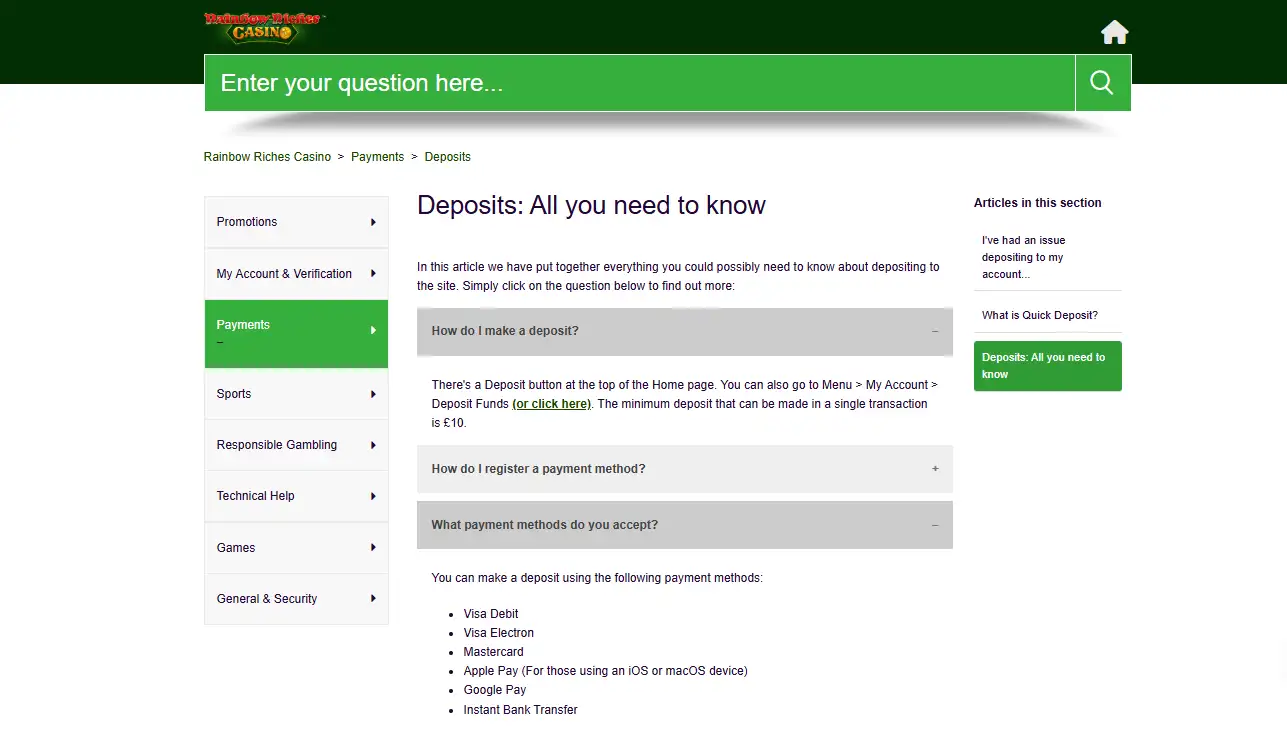
Debit cards remain a familiar part of the UK casino cashier. Visa and Mastercard debit cards are common payment routes at UK casinos, although the exact products accepted still depend on the site and the cashier’s current options. A debit card is linked to a bank account, but it is not the same payment method as a bank transfer. The distinction is easy to miss when both ultimately draw on the same account. In payment systems, the route matters as much as the source of funds.

Credit-card payments for gambling are a different matter. The regulator prohibited them on 14 April 2020, and the restriction remains in force. UK-licensed casinos cannot accept credit cards for gambling deposits. That applies not only to a card entered directly into a cashier but also to credit-card funding routed through a money service business. A payment route cannot make prohibited funding acceptable merely by adding another step.
The ban reflects a wider judgement about the boundary between gambling and borrowed money. A debit card spends funds available in a bank account; credit allows spending against a debt. The policy draws a line between those forms of payment, even when the checkout screens can make them look similar. Here, the cashier is not simply a convenience menu. It is also where the rules governing permitted payment routes have to be observed.
E-wallets form another distinct category. They can provide a separate balance or a layer between a bank account and a casino account, but their availability is not universal either. Some payment services may be absent from a particular cashier, and the restrictions applying to a wallet can matter as well: UK-licensed operators cannot accept wallet payments where the wallet permits credit-card funds to be used for gambling. The name of a payment brand alone does not settle how it may be used.
This variety explains why a page describing online casinos that accept bank wire transfers should be read as a starting point, not as evidence that all listed payment routes work alike. A transfer option is one part of the cashier’s design. It sits beside cards and wallets, but has its own connection to the banking system and its own conditions. The menu is local to the operator.
Credit Card Ban
UK-licensed casinos are prohibited from accepting credit cards for gambling deposits, including funds routed through money service businesses.
The modest conclusion is that “bank transfer” identifies a family of account-based payment routes, not a standard feature guaranteed across UK casino sites. Debit cards, e-wallets and bank transfers can all appear in the same cashier, but they remain different mechanisms. Credit-card gambling deposits, by contrast, are outside the permitted menu. A small distinction with a hard edge.
What “Wire Transfer” Means on a UK Casino Site
“Wire transfer” sounds precise: money moves from a bank account to a casino account, rather than through a card or an e-wallet. On a UK casino site, though, the label may describe a broad category rather than one clearly defined service. It does not, by itself, say how the transfer is initiated, which payment route handles it, or whether the same route can be used to send money back.
That distinction matters because a cashier’s wording is not a technical specification. “Bank transfer”, “wire transfer” and similar labels may appear to describe the same basic idea, but they do not establish that two casinos use the same process. One site might present a route that starts from its own cashier; another may ask for a transfer through the customer’s banking service. The visible label can be a useful signpost, but it leaves the practical details to be established elsewhere.
A search for an online casino wire transfer can therefore lead to a category, not a uniform payment product. The phrase does not identify a particular bank, payment provider or transfer network. Nor does it reveal whether the casino receives funds directly, whether an intermediary is involved, or what information is needed to associate a payment with the right account. Those particulars belong to the cashier’s instructions, not to the phrase “wire transfer”.


One label, two directions
A payment method can be presented as available for deposits without also being available for withdrawals. The reverse is possible too: a casino may have a route for sending approved funds to a bank account without offering that same route as a way to fund the casino account. Treating the word “transfer” as proof of a complete two-way service is an easy mistake. Money going in and money coming out are separate functions, even when both ultimately involve a bank.
This is why the wording beside a payment option matters. A listing that merely says “bank transfer” may not explain whether it covers deposits, withdrawals or both. A route described in one part of the cashier should not automatically be assumed to work in the other. The distinction can be especially easy to miss when a site uses a general heading for payment methods and gives the operational detail only after an option is selected.
The same caution applies to phrases such as “online casino sites that accept bank wire transfer”. “Accept” can mean that the casino will receive a deposit by that route; it does not necessarily mean that it will return funds through it. A payment route’s presence in a list is not a promise of symmetrical service. The cashier is the more useful record of what that option does.
A payment route’s presence in a list does not guarantee symmetrical service; a casino may accept deposits via bank transfer without offering the same route for withdrawals.
The account behind the transfer
The word “wire” can make a payment sound detached from the person arranging it, as if the movement of money were the only relevant fact. Gambling payments are more personal than that. The casino account, the bank account and the details supplied for a transaction need to make sense as belonging to the same customer. When the account information and payment route belong to that customer, basic ownership checks are less likely to create avoidable friction.
That does not mean every transfer will be handled in exactly the same way, or that matching details settles every question a casino might raise. It means that a payment route should not be treated as interchangeable with someone else’s account simply because the funds can be moved. A name mismatch, or a payment arranged through an account that does not belong to the casino customer, can complicate the ordinary task of identifying who sent the money.
There is a wider social logic here. Financial systems are built to identify the parties to a payment; gambling regulation adds a reason for a casino to care about that identity. A bank transfer is not anonymous simply because it bypasses a card number. The name attached to the account and the route used can matter alongside the amount sent. The rails may be electronic. The ownership questions remain stubbornly human.
What the label cannot tell
A casino described as accepting wire transfers may still use wording that differs from another site’s. That variation is not necessarily evidence of a different kind of banking system; it may simply reflect the operator’s terminology. But the label alone cannot settle what the customer will actually see when opening the cashier, or whether a listed method is available to that account.

Nor does “wire transfer” establish whether a casino accepts a particular card or banking product. A specialist review may list Visa and Mastercard among a site’s payment options, but current UK availability and eligibility for a particular card product still need to be confirmed in the cashier. The same principle applies more broadly: a general payment description is not a guarantee that every account, bank or product will be compatible.
A careful reading separates three questions that promotional shorthand tends to compress: what the casino calls the route, what the route does, and whose account is used to make or receive the payment. The first is vocabulary; the second is functionality; the third is ownership. They are related, but they are not interchangeable.
“Wire transfer online casino” is therefore a useful phrase for locating a payment category, not a reliable description of every step. The cashier’s own terms determine whether the option is for deposits, withdrawals or both, while the account details establish who is on either side of the transaction. A name is a beginning. Not a blueprint.
Checking Whether a Casino Accepts Bank Transfers
A payment logo on a casino’s homepage is not proof that the method is available to every customer. The useful evidence is the payment menu for the particular account: it shows which routes the operator currently presents, and may differ from a general page describing its cashier. A site may advertise bank transfer in broad terms while offering a narrower set of options at the point where a payment is arranged.
- Check the live cashier after logging in
- Verify the account currency
- Confirm the operator’s UKGC licence
- Rely on homepage logos as final proof
- Trust outdated reviews or cached pages
- Assume promotional copy equals account availability
The check begins with the operator’s own payment information, then moves to the cashier. If the account is not yet open, a public payments page can provide an initial indication, but it should not be treated as a final confirmation. Once logged in, the cashier is the relevant place to see whether a bank-transfer option is actually offered for that account. Availability can depend on the operator’s current arrangements, so an old review or a cached page cannot settle the question.
The wording matters less than the selectable option. A payment page might group several services under a broad bank-transfer heading, while the cashier may show a named banking route or no such choice at all. The practical test is whether the transfer option appears among the available methods for the account, not whether the phrase appears somewhere in promotional copy. For a casino that accepts a bank wire transfer, the transaction instructions should also be available before funds are sent.
The cashier is not the only place to check. The operator’s terms or payments page may explain whether bank transfers are supported, identify any account conditions, and state which currencies it handles. If those pages conflict with the logged-in options, the inconsistency deserves clarification from customer support before a transaction is started. A payment route should not have to be reconstructed from scattered hints.


Currency needs its own check. A specialist review describes GBP as supported, but that does not establish the currency assigned to every individual casino account. The account currency should be confirmed with the operator before the first transaction; otherwise, a transfer may be converted rather than credited in pounds. The account display and the cashier’s payment instructions are more relevant to that specific account than a general statement on a third-party page.
The name of the payment method and the currency are separate questions. Seeing a bank-transfer option does not, by itself, show whether the account is denominated in pounds, and seeing GBP mentioned does not prove that a transfer option is available in the cashier. Both need to line up. A small distinction on screen can become a real difference in the amount recorded.
There is also a basic regulatory check before any deposit. Remote gambling licensees serving Great Britain must hold the relevant UK Gambling Commission licence, and the licence number can be checked on the Commission’s public register. The payment menu answers whether the method is offered; the register answers whether the operator is authorised to serve the market. Neither check substitutes for the other.
The account itself must also be eligible to deposit. Operators are required to verify a customer’s age before permitting a deposit, and UKGC-licensed casinos must prompt new customers to set a financial limit before the first one. These are part of the account process, not evidence that a particular transfer method is compatible. A cashier option can be visible while account requirements remain unfinished. Paperwork has its own order.
Payment Verification
- Confirm bank transfer is available in the live cashier
- Verify that the account currency is set to GBP
- Check the UKGC public register for the operator’s licence
- Set a mandatory financial limit before the first deposit
Before proceeding, the available method, account currency, and operator’s licence should therefore be treated as separate checks. If a bank transfer is absent from the current cashier, a general page or an old recommendation does not make it available. If GBP is not clearly shown as the account currency, that point should be resolved with the operator first. The clearest answer is the one attached to the live account, not the most confident wording elsewhere.
The Practical Shape of a Casino Bank Transfer
A bank transfer is not a single movement with one fixed pace. Its delivery can depend on when the payment is initiated, whether that falls before the relevant cut-off, and whether the route crosses a weekend. Currency conversion can add another point at which the amount and the processing path need attention. These are features of the transfer itself, not proof that a casino’s cashier supports a particular service.
One specialist review identifies cut-off times, weekends and currency conversion as factors that can affect delivery. The details matter because “bank transfer” describes a broad payment route, not a promise that every instruction moves under identical conditions. A casino’s payment information and the bank or service handling the transfer may describe different parts of the same process.
Cut-off times and the working week
A cut-off is the point after which an instruction may be treated differently from one submitted earlier. The relevant time can depend on the bank or payment service involved, so a transfer started late in the day may not follow the same path as one started earlier. The casino’s own processing arrangements may also form part of the chain. There is no single cut-off that can safely be assumed for every UK casino wire transfer.


Weekends can change the shape of that chain as well. A transfer initiated near the end of the working week may encounter a different sequence from one initiated during the week. That does not establish a particular delay; it means the calendar is one of the conditions to account for when interpreting a payment status. A screen showing that an instruction was submitted does not, by itself, describe every stage of delivery.
The distinction is modest but useful: the moment a payment is initiated and the moment it reaches its destination are not necessarily the same event. A transfer can be in motion without the casino account yet reflecting it. For a casino wire transfer, the process is therefore better understood as a sequence of handling points than as a button press with an automatic result.
When currencies differ
Currency conversion changes the route in a different way. If the bank account and casino account do not use the same currency, the transfer may involve a conversion rather than a direct movement in one currency. That makes the account currency relevant to the process, even when the payment instruction itself appears straightforward.
Conversion also means that the amount sent and the amount recorded at the destination may not be expressed in the same currency. The practical question is not only whether a transfer can be initiated, but which currency applies at each end and where conversion takes place. Those details belong to the payment terms and account settings, not to a general description of wire transfers.
Instructions submitted after a specific time may be processed in a later period.
Transfers initiated near or during weekends may follow a different sequence of delivery.
Differing currencies between bank and casino accounts can add processing steps and affect the final amount.
This is separate from comparing charges. A conversion can affect delivery conditions as well as the final value shown, while the cost of any exchange-rate spread or fee is a different matter. Keeping those questions apart prevents a vague label such as “bank transfer” from carrying more meaning than it does.
The route is shaped by the calendar and the currency. No grand mystery.
Making a Bank-Transfer Deposit
A deposit begins with a figure in the cashier, not with a general promise that a casino takes bank transfers. The minimum can depend on the payment route selected, so a bank-transfer option may have a different threshold from a card or another method. A specialist review reports a starting range of £10–£20 across casino payment methods; that is a guide attributed to the review, not a fixed rule for every site or every transfer.
The cashier is the practical authority for the account in front of the player. Its deposit screen should show the minimum and any maximum that applies before a payment is made. Maximums may be set per transaction, per day or per month, and can differ with the method and the account’s status. A figure stated in a general review may not reflect a changed cashier or the conditions attached to an individual account.
These limits are not interchangeable. A transaction ceiling can prevent one large payment, while a daily or monthly cap governs the total accepted over a period. Where the cashier displays several limits, each describes a different boundary. The amount entered should fit the displayed terms; otherwise, a transfer may not be accepted as intended. Ordinary arithmetic, but an important part of payment design.


There is another prompt before the first deposit. UKGC rules require remote gambling operators to ask new customers to set a financial limit before that deposit, and to make account-level limit controls accessible. This makes the deposit screen part of a wider system of spending controls: the player is asked to decide a boundary before funds enter the gambling account, then must be able to find controls for managing it later.
A financial limit is not the same as a cashier minimum or maximum. The minimum is the smallest payment the selected method will accept; a payment cap restricts what can be deposited through a method or account; a financial limit is an account control for gambling spend. Confusing them can make a cashier look more permissive, or more restrictive, than it is.
For a casino wire-transfer deposit, the useful details are therefore the selected method’s own minimum, the applicable transaction and account limits, and the financial-limit prompt. These are presented at different points because they serve different purposes. The payment method governs what can be sent; the account controls govern how much can be committed to play. A bank transfer does not remove either layer.
That distinction matters in a market where remote gambling is licensed and regulated, rather than treated as an unexamined private arrangement between a bank and a website. Depositing is a financial action inside a regulated account, and the limit prompt is built into that relationship. The paperwork has a point.
Deposit Controls
- Minimum and maximum limits are set by the payment method and account status
- Transaction ceilings differ from daily or monthly caps
- Financial limits are separate account controls required by UKGC rules
How Long a Bank-Transfer Deposit Can Take
A bank-transfer deposit has no single arrival time that applies to every casino or every payment. The transfer’s progress can depend on when it is sent, whether that falls before the relevant cut-off, whether a weekend intervenes, and whether the payment has to be converted into another currency. These details matter because a transfer can be submitted successfully without the casino balance changing at the same moment.
A specialist payment review identifies cut-off times, weekends and currency conversion as factors that can affect delivery. A cut-off can shift processing into a later period; a weekend can leave a payment waiting for the next working period; conversion can add another step between the amount leaving the bank and the casino receiving funds in its account currency. The exact effect depends on the route and the accounts involved, so the phrase “bank transfer” alone is not a useful clock.
There is also a distinction between sending a payment and seeing it credited. A bank may show that a transaction has been initiated or completed on its side, while the casino balance has not yet updated. That gap does not, by itself, establish that anything has gone wrong. The two institutions may record different stages of the same movement, and the timing shown by one does not necessarily describe the other.
For a casino that accepts wire-transfer deposits, the cashier’s payment instructions and any stated processing information are more relevant than a general estimate found elsewhere. The account currency is part of that picture: when it differs from the currency being sent, conversion may affect the route and its timing. A payment made close to a cut-off, or before a weekend, may therefore follow a different path from one sent at another point in the banking cycle.


If a deposit appears delayed, the useful distinction is whether the bank has released the transfer and whether the casino has credited it. Keeping the transaction confirmation can help identify which stage needs attention, without assuming that a delay means the funds are lost. Online casino sites that accept wire-transfer deposits may use different payment arrangements, so timing statements should be read as applying to the particular route shown, not to every bank transfer.
No stopwatch.
Bank-Transfer Withdrawals and Casino Approval
A bank-transfer withdrawal is not simply a deposit travelling backwards. The casino must first approve the request, and that stage is separate from the bank’s handling of the payment. A specialist casino review notes that withdrawal processing can take longer when a first request triggers account checks; it also identifies the operator’s approval process and the account’s verification status as factors in how quickly funds are released. No single countdown covers both stages.
KYC may be requested before a payout is authorised. This is particularly relevant to a first withdrawal, when the casino may still need to confirm that the account belongs to the person named on it. Until the required checks are complete, a payment can remain pending even if the withdrawal request has been submitted. Later requests may still be subject to review; an established account does not turn approval into an automatic step.
Withdrawal Process
The player submits a withdrawal request through the casino cashier.
The operator reviews the request, which may include KYC account verification checks.
Once approved, the casino releases the funds to the bank account, often following closed-loop rules.
The payment route is also shaped by closed-loop rules. UK anti-money-laundering requirements generally direct a payout back to the source used for the deposit. In practice, that means a casino may return funds by bank transfer where the original deposit came from that route, rather than treating every withdrawal method as interchangeable. The details shown in the cashier and the operator’s payment rules determine how this works for a particular account.
This is why the phrase “casino wire transfer withdrawal” does not, on its own, describe the full process. It may refer to the method used to send approved funds, while leaving out the operator’s checks before release. If a casino cannot return money through the original source, an alternative route may call for additional verification. That is a control, not a promise of a quicker substitute.
For an online casino bank-transfer withdrawal, the useful distinction is between a request being received, the casino approving it, and the bank receiving the transfer. The first two are governed by the operator’s procedures and the state of the account; the final leg begins only after release. A delay at the approval stage is therefore different from a bank transfer still in transit. Three stages. One balance.
What Makes a Bank-Transfer Casino a Better Fit
A bank-transfer option is a better fit when its terms match the way an account is funded and managed, not because “bank transfer” sounds reassuringly familiar. A useful comparison starts with the amount that would actually move. A specialist review notes that there is no single payment route with the lowest cost in every case: the total can depend on charges from the casino, payment provider or bank, as well as currency conversion and network costs. A headline fee, where one is shown, is only part of the picture.

Currency deserves particular attention. A specialist review reports that GBP is supported on the pages it examined, but that is not a guarantee about every casino account or cashier. The account currency should be confirmed before the first transaction. If the account is held in another currency, conversion may affect the amount credited and the cost of later payments. A transfer that appears inexpensive at one stage can be less attractive once the exchange rate is applied.
The comparison is therefore less about finding a universal winner and more about whether the route has clear terms for the intended use. One casino may show a provider charge; another may leave the bank or exchange-rate cost to determine the final amount. Those details matter more than a generic claim that transfers are free. The same currency should also be considered on both sides of the payment, since a mismatch can introduce conversion where it was not expected.
Clarity is the practical test. If the cashier and payment terms make the likely charges and currency treatment understandable, the route can be assessed on its merits. If those conditions are obscure, convenience is difficult to weigh against cost. There is no tidy league table for a payment method whose price depends on the route taken.
Attention Total costs may include a combination of casino fees, provider charges, bank tariffs, and exchange-rate spreads, even if a method is labeled as free.
Receiving Casino Winnings by Bank Transfer
A casino can send winnings by bank transfer when that route is available for withdrawals and the account meets its payment conditions. The destination matters as much as the method: a bank account held in the same customer’s name creates a clearer link between the gambling account, the original deposit and the eventual payment.
That continuity is more than tidy bookkeeping. Remote gambling licensees have to consider anti-money laundering and fraud risks, so returning funds to the source used for payment is a common control. A consistent route can make basic ownership checks less complicated; changing to a different account or payment method may mean further evidence is needed. The purpose is to establish where money came from and who is entitled to receive it, not to make a payment look suspicious merely because it is a bank transfer.
For casino winnings by wire transfer, the account details should therefore belong to the account holder and match the information on the gambling account. A joint account, a recently changed bank account or a transfer requested through someone else’s payment details can create questions that a straightforward same-name route avoids. An alternative destination may still be possible, but it can bring additional verification rather than an automatic substitution.
The same logic applies when deposits and withdrawals use different routes. A casino may apply closed-loop rules and return funds to the original source where possible; a bank transfer is not necessarily an unrestricted way to redirect a balance elsewhere. Keeping the payment trail consistent helps distinguish a legitimate payout from a request that needs closer scrutiny.
There is a public-interest reason for this procedural caution. Gambling payments pass through systems designed to identify ownership and movement of funds, not merely to move money quickly. The checks can feel prosaic, but they are part of the price of a regulated market. Ownership first.

The Costs Hidden in a Casino Payment
A bank transfer can appear to have no charge at the point of payment and still cost money along the way. The possible charges sit with different parties: the casino, the transfer provider, the bank or payment issuer, and, where relevant, the network carrying the transaction. A specialist payment review identifies these as separate sources of cost, rather than one standard “wire fee”.
A casino may set its own charge for a payment route, while a provider or bank may apply a fee under its own terms. Those amounts need not appear together in the cashier. A charge shown by the casino therefore does not establish what the sending or receiving bank will take, and a bank’s tariff does not describe every cost attached to the casino transaction.
Currency conversion adds another layer. If the casino account and the bank account use different currencies, the exchange rate may include a spread: the difference between the rate applied to the payment and a reference rate. That cost can be less visible than a fixed fee, but it still reduces the value received. A specialist review notes that the conversion spread can exceed a clearly stated flat charge; the comparison depends on the actual rate and transaction, not on the appearance of the fee schedule.
The same payment may therefore carry a visible charge, a provider or bank deduction, and a less obvious exchange-rate cost. Network fees can also apply, depending on the route used. None should be assumed in advance, and a fee-free label at one stage does not prove the whole transfer is free.
The cost is not a single number. It is a chain of possible deductions, each set by a different participant. The cashier’s terms, payment-provider information and bank tariff describe different parts of that chain; only reading them together gives a useful account of what may be charged.
What is the fastest withdrawal method for UK casinos?
PayPal, open banking services and debit cards linked to fast payout systems are generally among the quickest. The actual speed also depends on casino approval and whether your account is fully verified.
Do UK casino withdrawals require verification?
Verification may be required, and first withdrawals can take longer while checks are completed. Having a fully verified account can affect how quickly a withdrawal is processed.
Which payment methods are accepted in Great Britain?
UK casino cashiers commonly offer Visa and Mastercard debit cards, bank transfers and e-wallets such as PayPal, Skrill or Neteller. Some sites also accept Apple Pay; Paysafecard is for deposits only, and available methods vary by casino.
Are Visa and Mastercard deposits definitely debit cards?
No—not every Visa or Mastercard product is necessarily eligible. UK casinos commonly accept debit cards, but check the cashier for the card types accepted; credit-card gambling deposits are prohibited.
Which method has the lowest fees?
There is no universally lowest-fee method. Compare the casino’s charges with provider or bank fees, currency-conversion spreads and any network costs for your transaction.
Are fast casino withdrawals guaranteed?
No. Withdrawal speed depends on the casino’s approval process, whether your account is verified, and— for bank transfers—factors such as cut-off times and weekends.
Why must withdrawals return to the deposit method?
Returning funds to the original payment source is a common anti-fraud and anti-money-laundering control. Using another route may require additional verification.
Created by the ”Rainbow Riches Casino 3” editorial team.