Casinos That Accept USDC in the UK: Payment Guide
 Available in GB
USDC availability depends on the cashier and account, while slot selection, bonus terms and withdrawal rules are separate considerations.

Table of Contents
- USDC, Slot Play and the Cashier
- A USDC Deposit Depends on the Site, Not the Search Phrase
- What Can Be Verified About USDC at Online Casinos
- Cards, Crypto and the UK Gambling Payment Line
- Slot Choices and Payment Terms Are Different Decisions
- Alternatives When USDC Is Not Available
- The Evidence a 2026 USDC Claim Needs
- USDC Withdrawals and the Return-to-Source Rule
- Deposit Costs, Currency and Limits Before the First Transaction
- Crypto Payments Do Not Determine GamStop Status
USDC, Slot Play and the Cashier
A slot’s presence in a casino lobby and the route used to fund an account belong to different parts of the experience. The game is the entertainment product; the cashier is the payment interface. Finding a familiar slot, or a large collection of them, says nothing by itself about whether a deposit can be made in USDC. Nor does a payment symbol on a general page establish that it will appear as an available choice for a particular account.
This distinction matters because searches for casinos offering USDC can blur several intentions together. Someone may be looking for slot games, a way to open an account, a cryptocurrency deposit route, or a bonus that can be claimed after depositing. Those are related decisions, but they are not interchangeable. A casino’s game library answers one question. Its cashier and the terms attached to a promotion answer others.
The cashier is where the available deposit methods are presented for the account and transaction. A cryptocurrency mentioned in a casino’s general description does not necessarily mean it can be selected there. Equally, seeing a slot in the lobby does not mean that the game has a special connection to a particular payment asset. The mechanics of a spin do not change according to how the balance was funded; the payment route sits outside the game.
When looking for a UK casino that accepts USDC, confirm its current deposit options before signing up. Payout timing is another practical detail to consider.
Payout speed: 1-3 business days Revery Play lists a payout speed of 1–3 business days. No information is provided here about whether it accepts USDC.
Payout speed: 1-3 business days Chanze lists a payout speed of 1–3 business days. No information is provided here about whether it accepts USDC.
Payout speed: 1-3 business days Amunbet lists a payout speed of 1–3 business days. No information is provided here about whether it accepts USDC.
Payout speed: 1-3 business days SpinFormula lists a payout speed of 1–3 business days. No information is provided here about whether it accepts USDC.
Payout speed: 1-3 business days NightLuck lists a payout speed of 1–3 business days. No information is provided here about whether it accepts USDC.
Payout speed: 1-3 business days Zombillion lists a payout speed of 1–3 business days. No information is provided here about whether it accepts USDC.
Payout speed: 1-3 business days BeOnBet lists a payout speed of 1–3 business days. No information is provided here about whether it accepts USDC.
Payout speed: 1-3 business days EvoSpin lists a payout speed of 1–3 business days. No information is provided here about whether it accepts USDC.
Payout speed: 1-3 business days Jetsetspins lists a payout speed of 1–3 business days. No information is provided here about whether it accepts USDC.
Payout speed: 1-3 business days NightWin lists a payout speed of 1–3 business days. No information is provided here about whether it accepts USDC.
That separation can feel artificial because casino websites place games, offers and account controls under one roof. The design suggests a single continuous product: browse, deposit, play. Behind the polished lobby, however, the cashier may have its own eligible methods, conditions and restrictions. The bonus page may have another set of rules. The game catalogue does not settle either.
Bonuses are a particularly easy source of confusion. A promotion may be available to eligible customers but exclude certain deposit methods, or set conditions that apply only when a qualifying route is used. A deposit reaching the account is not, on its own, proof that the payment qualifies for an offer. The promotion’s terms determine that. A casino bonus described alongside a USDC payment claim should therefore not be read as evidence that a USDC deposit earns the bonus.
Payment eligibility can differ even among methods that appear similarly convenient. PayPal, for instance, is valued for speed and ease of use, but a specialist casino review has reported that it may be excluded from bonus eligibility. That is a report about the conditions described in that review, not a rule that applies across the UK market. The useful point is narrower: payment access and promotional eligibility are separate questions.

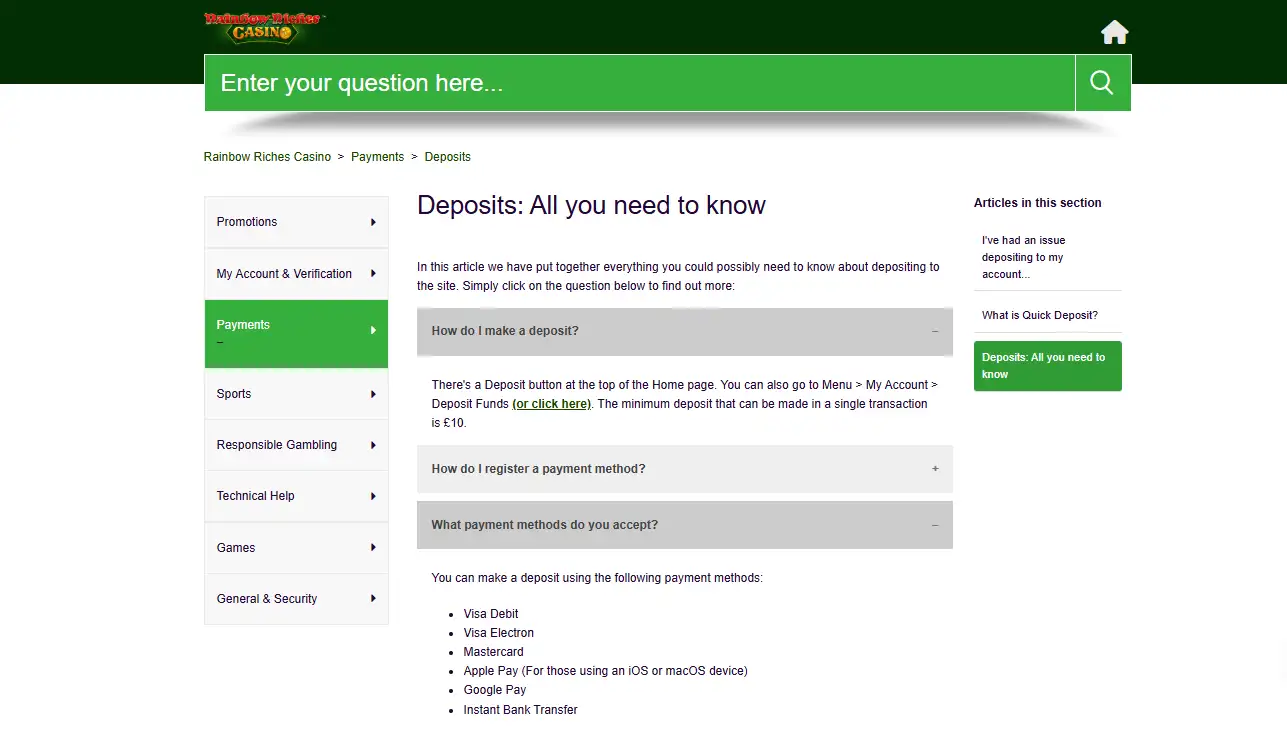
The same care applies to deposit thresholds. A specialist review places minimum deposits in a £10–£20 range, with the method selected affecting where the threshold falls. That range is not a promise that every casino, account or payment route will use those amounts. It is a reminder that the cashier can set method-specific entry conditions, while an offer may set its own qualifying deposit requirement. One figure cannot safely be assumed to govern every part of the transaction.
Slot-focused wording can also give payment claims more weight than they deserve. “Slots with USDC” might sound as though a game is built to accept a stablecoin. In practice, a slot is accessed through the casino account, while the account’s funding options are handled separately. A player can encounter the same game at a casino whose cashier offers different methods from another casino. Payment availability belongs to the operator’s account system, not to the title of the game.
This is one reason a list of games cannot stand in for a list of payment options. A long lobby may be useful to someone choosing what to play, but it cannot verify how a deposit is made. Conversely, a payment method shown in a cashier does not identify which games are available or whether an offer applies to them. Treating these as one feature is convenient for marketing and unreliable for understanding the transaction.
- Check the cashier for available deposit methods
- Review the offer’s terms for bonus eligibility
- Verify game availability in the casino lobby
- Assume a game lobby proves a deposit method
- Treat general crypto claims as USDC proof
- Assume a deposit automatically earns a bonus
In the UK, the wider setting is not an unregulated space where the cashier is merely a technical convenience. Remote gambling licensees serving Great Britain must operate under the relevant Gambling Commission licence, and licensed casinos must provide financial-limit controls. Those safeguards concern the account and the conduct of gambling; they do not make a particular payment method available, or turn a payment claim into proof of a bonus entitlement.
The practical order is therefore simple in principle, even if casino pages often mix the information together: game choice belongs to the lobby, deposit availability belongs to the cashier, and bonus eligibility belongs to the offer’s terms. A search for USDC slot play may combine all three, but the underlying decisions remain distinct. A slot is not a payment method. A deposit is not automatically a bonus.
A USDC Deposit Depends on the Site, Not the Search Phrase
A casino’s payment options belong to the casino, not to the wording used to describe it. A page labelled “crypto-friendly” may mention digital assets in general; that label does not establish that a particular stablecoin can be deposited. Nor does a result describing a casino as one of the best places for USDC turn that description into a working cashier option. The decisive point is what the individual operator makes available to a UK customer at the point of payment.
This distinction matters because payment information is often presented at several levels. A casino may have a general page listing methods, a promotional page describing its services, and a cashier that displays the methods actually offered for an account. Those pages can answer different questions. A general list gives an outline; the cashier is where a deposit route is selected. Search snippets and comparison pages are further removed still. They can be useful signposts, but they are not proof that a transaction can be made.


A specialist review of the analysed websites describes Visa, Mastercard, bank transfer, e-wallets and several cryptocurrencies. That is a broad description of the payment landscape, not a guarantee that every listed method appears at every casino, or that any particular cryptocurrency is enabled. A list of categories is not a list of confirmed deposit routes. Small distinctions; consequential ones.
The practical check begins with the casino’s own payment information. The cashier should be examined from the perspective of a UK account, because the relevant question is not whether a method exists somewhere on the service, but whether it is offered for the account and transaction in question. A payment method shown on a general page may not be selectable in the cashier. Conversely, a cashier may display options that are not prominent in an overview. The menu, not the marketing shorthand, is the operational answer.
The operator’s terms can clarify what the cashier does not. They may specify which methods are accepted for deposits, whether a route has conditions, and whether a method can be used for withdrawals. Those are separate issues: a method’s presence in one part of the payment process does not automatically establish its role elsewhere. If the wording remains unclear, a direct question to the operator can narrow the uncertainty. A useful answer identifies the method and the account’s country, rather than replying with a general assurance that “crypto” is supported.
Remote gambling licensees serving Great Britain must hold a relevant Gambling Commission licence, a status that is distinct from payment options or app availability.
The same care applies to casino apps. An app is an interface to an operator, not a separate guarantee about its payment menu. A method named on a desktop page may not be presented in the same way within an app, and an app’s availability says nothing by itself about which deposit methods it offers. The relevant check remains the cashier associated with the account, whichever interface is being used.
There is also a difference between a casino’s existence and its suitability for the British market. Remote gambling licensees serving Great Britain must hold the relevant Gambling Commission licence. A familiar brand name, a polished app or a payment logo cannot substitute for that status. The licence is a regulatory question; the cashier is a payment question. They should not be collapsed into one reassuring impression. Northern Ireland sits outside the Gambling Act 2005 framework described for England, Wales and Scotland, so the territorial details matter when making broad claims about UK availability.
Payment logos need similar restraint. A specialist review lists Visa and Mastercard among the methods shown by the sites it examined, but that does not settle current UK availability or eligibility for a particular card product. Those details need checking in the cashier. The wider lesson is not that logos are meaningless; it is that they describe less than they appear to. A logo can identify a payment brand without confirming that a specific account can use it.


Phrases such as “instant banking”, “Bitcoin casino” or “new crypto casino” can also compress several different claims into one. A site may mention a cryptocurrency without demonstrating that it accepts a particular asset, and a banking label does not identify every transfer route. Each claim needs to be unpacked at the operator level: which method, for which account, and at which stage of the transaction? This is ordinary due diligence, not a technical puzzle.
A sound comparison therefore records what the operator itself says, what appears in the UK cashier, and whether the terms agree. If those sources conflict, the conflict is information in its own right; it is not a reason to assume the more generous interpretation. Search language is broad by design. A deposit menu is not.
What Can Be Verified About USDC at Online Casinos
Whether an online casino accepts USDC cannot be settled by a general statement that it takes cryptocurrency. A specialist casino review describes payment options including bank transfers, e-wallets and several cryptocurrencies, alongside Visa and Mastercard. That is evidence of a broad payment-method category, not confirmation that USDC appears in a particular casino’s cashier.
The distinction matters because “crypto accepted” leaves the asset unnamed. A casino might support some digital currencies while not listing USDC at all. Even where a review uses broad wording, it does not establish which currencies are available, whether the list applies to deposits, or whether the information reflects the cashier’s current options. Those details belong to the individual operator’s published payment information.
Attention A general statement that a casino accepts cryptocurrency is not confirmation that USDC specifically is available in the cashier.
USDC should therefore be treated as a specific payment claim, not as a synonym for cryptocurrency. A casino’s mention of crypto does not make every token compatible with its payment system. Nor does a general list of methods show that a customer can select USDC during registration or at the point of deposit. The label needs to be explicit.
This leaves a narrow but useful answer to whether online casinos use USDC in the UK: general references to cryptocurrency do not prove that a particular UK-facing casino accepts it. They cannot support a dependable list of casinos offering USDC deposits, or establish that a casino pays out in USDC. Those are separate claims and need their own operator-specific confirmation.
The distinction is not pedantry. Payment pages are often written in categories, while transactions happen through particular routes. A broad label can make a cashier look more accommodating than it is. The detail matters.
A credible USDC claim would identify the casino and state that USDC is available as a selectable method, rather than merely mentioning cryptocurrencies. The operator’s own payment information is more useful for that purpose than a general review summary. If the cashier does not name USDC, a broader crypto reference should not be read as permission to send it.


There is also a difference between a method being discussed and being usable for a specific account. Payment options can be presented in general terms while the available choices at registration or in the cashier are narrower. A claim that a site accepts USDC needs to describe the actual route offered, not infer support from neighbouring entries in a list.
For now, the careful wording is that casino information may mention several cryptocurrencies, but that alone does not show that USDC is among them at any named site. It does not answer whether a USDC deposit will be accepted, and it says nothing conclusive about USDC withdrawals. Specificity is the evidence; the category is not.
Cards, Crypto and the UK Gambling Payment Line
A casino may accept a debit card without accepting cryptocurrency, and a card associated with a crypto account does not turn one payment method into the other. For anyone looking at USDC, that distinction matters: Visa or Mastercard appearing in a cashier says something about eligible card payments, not whether the casino accepts USDC or will process a card funded from a crypto balance.
UK casinos commonly accept debit cards, including Visa and Mastercard. Yet a brand name is not a promise that every card bearing it will work. Specialist casino reviews list those networks, but the current cashier is the practical place to confirm which card products are eligible in the UK. Availability can depend on the casino and the card itself. A logo in a review is a starting point, not a payment confirmation.
Credit Card Ban
The regulator prohibited credit-card payments for gambling on 14 April 2020, and this restriction applies even if the payment is routed through another service.
This is particularly important where a card or digital wallet sits between a crypto holding and the casino. The payment still needs to meet the operator’s rules and the UK gambling restrictions. A wallet cannot be used for gambling payments if it allows credit-card funds to be used for gambling. A debit card funded from a crypto service is not, by that description alone, evidence that the casino accepts a USDC deposit; the cashier’s listed methods and the provider’s own conditions remain separate questions.
The line around credit is firmer. The regulator prohibited credit-card payments for gambling on 14 April 2020, and that restriction has not been relaxed. Remote gambling licensees cannot simply accept a credit card because it is routed through another payment service. The point is to stop borrowed credit from reaching gambling through a cosmetic change of route. A payment chain does not erase its source.
That rule should not be confused with a ban on debit cards. Debit-card acceptance remains common, but the card product matters: a credit card is not an acceptable gambling payment, while a debit card may be, subject to the casino’s current eligibility checks. Nor does an accepted debit card establish that the same card can be used for a cryptocurrency purchase and then used at the casino. Those are distinct transactions, governed by distinct providers.
The cashier therefore needs to be read with care. It can show whether Visa or Mastercard is currently offered and whether a card payment is available for the account. It cannot be treated as proof of a USDC option simply because a card might be connected to a crypto service. For a claim about USDC specifically, the casino would need to identify that asset as an accepted payment route, rather than leave it to inference from a card logo.

The practical boundary is plain: card acceptance is not crypto acceptance, and a credit-funded route does not become permissible by passing through a wallet. The rules are less interested in the label on the front than in the money behind it.
Slot Choices and Payment Terms Are Different Decisions
A casino’s games and its deposit conditions belong to different parts of the experience. The lobby describes what can be played; the cashier sets out how money can be moved into the account. A familiar slot title, or a broad promise of a large games library, says nothing about whether USDC is accepted. Nor does a USDC deposit option, if offered, establish that a casino has a distinct catalogue of games designed for that currency.
That distinction matters because the word “USDC” can make an ordinary payment question sound like a game category. It is an asset used to fund an account, not a label that identifies particular slots. A page presenting a casino as suitable for USDC play still needs to separate the payment route from the games available after a deposit. Without that separation, a reader may mistake a general crypto claim for evidence of a particular USDC slot selection.
A sensible comparison therefore treats the lobby and cashier as separate records. Game information belongs to the former; payment methods, minimum deposits and any conditions attached to a transaction belong to the latter. Neither should be used as a substitute for the other. An attractive game catalogue does not prove that a chosen payment route works, while a payment method cannot tell anyone which titles are available or how they behave.
Game and Payment Decisions
- Game choice belongs to the lobby, while deposit availability belongs to the cashier
- Bonus eligibility is determined by the offer’s terms, not the payment method
- Minimum deposit thresholds can vary by the selected payment route
- “USDC slots” are not a distinct class of game, but an account-level funding matter
The same caution applies to bonuses. A promotional offer is governed by its own terms, which may specify eligible deposits or games. The presence of a payment option does not, by itself, show that a deposit made through it qualifies. Likewise, a bonus advertised alongside a slot does not establish that the slot can be funded through USDC. These are adjacent details, not interchangeable ones.
Payment thresholds also vary by method. A specialist review places minimum deposits in the £10–£20 range, depending on the selected route. That is a general guide to payment conditions, not a promise about any individual casino, and certainly not evidence of a USDC-specific minimum. The cashier is where the current amount and eligible method must be checked before a transaction. Small print has a practical life.
This leaves a straightforward way to read claims about games and payments. Look for a named title or a clear description of the games catalogue when the question concerns play; look for an explicit USDC entry and its conditions when the question concerns funding. If the two are bundled together without separate detail, the claim has blurred categories rather than established a connection.
There is no basis for treating “USDC slots” as a distinct class of game. A slot’s identity comes from the game itself, while the deposit route is an account-level matter. Keeping those decisions apart avoids confusing a payment headline with a promise about the games, bonuses or terms that follow.


Alternatives When USDC Is Not Available
A cryptocurrency option is only one possible route into a casino account. In the UK, established alternatives include debit cards, bank transfers, prepaid vouchers and e-wallets, though their availability and terms differ between sites. The payment menu is less a universal catalogue than a local arrangement: each operator decides what to offer and under what conditions.
Debit cards remain a familiar choice. UK casinos commonly accept Visa and Mastercard debit cards, but the names on a card network’s logo do not settle whether a particular card product will work at a particular cashier. A card may suit a direct deposit while offering none of the asset-based features associated with USDC. It is a conventional payment route, not a crypto substitute in disguise.
Bank transfers and open banking provide another route. A specialist review of casino payment services reports that these methods can support instant deposits and fast withdrawals at many sites. That is a description of the options the review found, not a promise about every operator or transaction. The cashier’s terms still determine whether a method is available, and delivery can depend on the bank and the site’s process.
Prepaid vouchers serve a narrower purpose. Paysafecard is a deposit-only option: it can put funds into an account, but it is not a route for receiving a withdrawal. That distinction matters when comparing alternatives. A payment method that works at the point of entry may leave a separate question about how any balance is returned.
Commonly accepted (Visa/Mastercard), providing a conventional route without asset-based features.
Can support instant deposits and fast withdrawals, depending on the bank and operator.
Deposit-only options, such as Paysafecard, which cannot be used for withdrawals.
Services like Skrill and Neteller that may be excluded from certain promotional offers.
E-wallets such as Skrill and Neteller appear at some casino sites. A specialist review reports that they are often excluded from promotions, so a deposit made through one may not qualify for a bonus. The promotion terms, rather than the payment brand alone, define the outcome. E-wallet availability should not be mistaken for universal acceptance or universal bonus eligibility.
The choice is therefore practical rather than ideological. A debit card may be straightforward, a bank route may offer a direct connection to an account, a voucher may be deposit-only, and an e-wallet may carry promotion conditions. None is automatically the best USDC alternative for every player; the useful comparison is the one between the cashier’s listed methods and the account’s actual terms.
There is also a quiet difference between payment language and payment function. “Crypto alternative” can suggest that another method behaves like a stablecoin, but these routes generally work through familiar card, bank, voucher or wallet arrangements. Their role is not to reproduce USDC. It is to provide another way to fund play where the casino supports it.
Different routes, different terms.
The Evidence a 2026 USDC Claim Needs
A claim that a casino accepts USDC needs to identify USDC itself, not merely a broad category called “crypto”. A specialist casino review of the sites discusses Visa, Mastercard, bank transfers, e-wallets and several cryptocurrencies. That is evidence of a varied payment menu, but it does not establish that any particular casino takes USDC. Several is not a name.


The distinction matters because cryptocurrency is an umbrella term, not a payment method with one shared balance or route. A page can mention crypto without identifying which assets are accepted, or whether the reference applies to deposits, withdrawals or both. Even a digital-asset logo would be weaker evidence than a cashier entry that names USDC and makes the relevant transaction option clear. A precise claim requires precise wording.
The same standard applies to phrases such as “USDC casino” or “USDC payment”. They can suggest a connection without showing what happens at the point of payment. A casino might be described as crypto-friendly, while its listed methods name other assets. That description cannot safely be enlarged into a claim that it accepts USDC deposits. Nor does the word “instant” prove that a USDC payment is available or that a particular transaction will be processed instantly.
For a claim about USDC cards or debit cards, the evidence would need to say what is being accepted: a card product, a crypto-funded card, or USDC transferred as cryptocurrency. These are not interchangeable descriptions. A card carrying a payment-network logo does not, by itself, show that USDC is involved in the payment. The distinction is especially important in the UK, where the rules for gambling payments depend on the payment route, not on the language used to market a product.
Why GBP support isn’t USDC proof
Supporting GBP indicates a stated account-currency option, whereas accepting USDC refers to a specific asset offered through a payment route; one does not prove the other.
The currency evidence is separate. A specialist review reports that the pages it considered support GBP. That indicates a stated account-currency option, not acceptance of USDC: one describes the currency used for an account, the other an asset offered through a payment route. GBP support therefore cannot fill the gap in a USDC claim. The account currency still needs confirming before a first transaction, since a mismatch can bring conversion into the process.
The most defensible description is consequently narrow: the reviewed pages refer to several cryptocurrencies and state GBP support, but those details do not name a casino with a confirmed USDC option. A 2026 claim should rest on an explicit USDC listing for the relevant site and transaction, not on a category label, a currency setting or a general impression of crypto acceptance. Anything less is a suggestion, not evidence.
USDC Withdrawals and the Return-to-Source Rule
A deposit and a withdrawal are separate stages, even when they appear to use the same payment route. Seeing a cryptocurrency option at deposit does not establish that a casino will send winnings back in that asset, to the same wallet, or at all. The cashier’s withdrawal rules and the operator’s checks determine what can happen after a balance is won.
In the UK, anti-money laundering controls commonly expect a payout to return to the original payment source. This closed-loop approach helps connect the money leaving the account with the funds that entered it. If a deposit were made in USDC, that principle would not by itself prove that a USDC withdrawal is supported: the casino may have separate rules for crypto transactions, or may require another route. The specific withdrawal terms matter.


Ownership details matter, too. Using an account and payment route belonging to the same customer can reduce avoidable friction when a transaction is reviewed. A mismatch may prompt further checks, while a change of destination can require additional verification. The principle is ordinary enough. The process is not automatic.
A withdrawal request also passes through the casino’s internal approval process. KYC may still be incomplete, particularly when an account has not previously made a withdrawal, and that can add time before funds are sent. A specialist review describes first withdrawals as potentially taking longer while verification is completed; it is not a fixed timetable for every operator. Processing speed depends on both the casino’s approval procedures and the account’s verification status.
For anyone comparing USDC casinos with deposit and withdrawal options, the useful distinction is between a deposit method being displayed and a withdrawal method being expressly permitted. Terms should identify eligible withdrawal routes, any conditions on returning funds to the source, and what happens if that route cannot be used. A claim of instant or direct USDC withdrawal needs to be read against those details, not inferred from the speed or availability of a deposit.
Where a casino serving Great Britain accepts real-money play, it must hold the relevant UK Gambling Commission licence. The payment asset does not alter that requirement, nor does it remove KYC or the return-to-source checks. A crypto label is not a payout promise.
Withdrawal Process
The request passes through the casino’s internal approval process, including KYC checks.
Anti-money laundering controls typically require funds to return to the original payment source.
Once approved, funds are sent via the permitted route, with processing speeds varying by operator.
Deposit Costs, Currency and Limits Before the First Transaction
The cost of a deposit is not always the amount shown beside the payment button. A specialist payment review identifies several possible charges along the route: a casino fee, a payment-provider fee, a fee from the card issuer or bank, currency conversion, and, for crypto transactions, a network fee. Which of these applies depends on the method and transaction.
A visible flat charge is easy to notice. The exchange rate is less obliging. A conversion spread—the difference between the rate used for the transaction and the market rate—can cost more than a stated fee, according to the same type of review. The total therefore needs to be compared for the intended amount, not inferred from a single “no fee” label. No method is the cheapest in every case: casino charges, provider fees, currency spread and network costs all matter.
Currency deserves a check before money moves. A specialist review reports GBP support on the pages it assessed, but the account currency still needs confirmation before a first transaction. If the account and payment are denominated differently, conversion may add a cost that is not obvious from the deposit screen. A USDC balance does not, by itself, show what exchange rate or network charge would apply; those terms depend on the payment route.
Limits are also attached to the selected method and, in some cases, account status. The minimum deposit can differ between options, while maximums may apply per transaction or across a stated period. Those figures belong to the casino’s cashier and payment terms, not to a general promise about USDC. A small advertised minimum would not establish that every currency or payment route can be used at that amount.
The useful comparison is therefore a net one: what leaves the payment account, what reaches the casino balance, which currency is held there, and whether any provider or network charge sits outside the cashier’s display. If those details are unclear, the apparent price is incomplete. A tidy button is not a receipt.
Crypto Payments Do Not Determine GamStop Status
A casino’s payment menu and its self-exclusion arrangements answer different questions. The presence of a cryptocurrency option, including USDC, does not show whether a site is connected to GamStop; its absence proves nothing either. A payment method describes how money may enter an account. It is not evidence of who regulates the operator or which safeguards apply.
For gambling offered to customers in Great Britain, remote gambling licensees must hold a UK Gambling Commission licence. That status is separate from the question of whether a particular operator participates in GamStop. A claim about “USDC casinos not on GamStop” therefore combines two facts that need separate confirmation. Crypto is not a status marker. Nor does a digital asset create an exception to the rules governing licensed gambling.
UKGC requirements also place financial controls at the account level. Remote operators must prompt new customers to set a financial limit before their first deposit and make account-level limit controls accessible. Those controls concern gambling funds, not the currency used to move them. Choosing USDC does not switch them off, and a casino’s advertised payment options do not establish how its exclusion arrangements work.
The distinction matters because payment labels can look like shortcuts through a system that is deliberately built around operator status and player protection. They are not. A site’s connection to an exclusion scheme cannot be established from a crypto logo, a deposit page or a claim that its slots are unaffected by GamStop. The relevant details concern the operator and its safeguards, not the token.
For UK play, legality is tied to licensing: online gambling is legal only at licensed and regulated sites. An offshore casino outside the UKGC system is not made safer or more suitable by accepting USDC, and a crypto option does not itself show that a site is outside GamStop. Different questions. Different evidence.
Why must withdrawals return to the deposit method?
Returning funds to the original payment source is a common anti-fraud and anti-money-laundering control. An alternative route may require additional verification.
What is the fastest withdrawal method for UK casinos?
PayPal, open banking services and debit cards linked to fast payout systems are generally among the quickest. The casino’s approval process and your verification status also affect the time.
Can I deposit in GBP?
Yes, GBP is supported. Check your account currency before depositing to avoid conversion.
What is the current minimum deposit?
Minimum deposits usually start at £10–£20, depending on the payment method.
Which payment methods are accepted in Great Britain?
Options include Visa and Mastercard debit cards, PayPal, open banking, bank transfers, and, at some sites, Apple Pay, Paysafecard, Skrill, Neteller or Jeton. Check the cashier for the methods available to your account; a site mentioning cryptocurrencies does not by itself confirm that USDC is available.
Which method has the lowest fees?
There is no universally cheapest method. Compare the casino’s charges, provider or bank fees, any currency-conversion spread and, for crypto, network costs for the amount you plan to transfer.
Do UK casino withdrawals require verification?
Verification may be required, and first withdrawals can take longer while it is completed. A fully verified account can help avoid delays.
Are fast casino withdrawals guaranteed?
No. Withdrawal speed depends on the casino’s internal approval and whether your account is fully verified.
Written by the editors at Rainbow Riches Casino 3.