Online American Roulette in the UK: Rules and Casinos
 Available in GB
The guide links the double-zero wheel and its bets with UK licensing rules for real-money and live-dealer play.
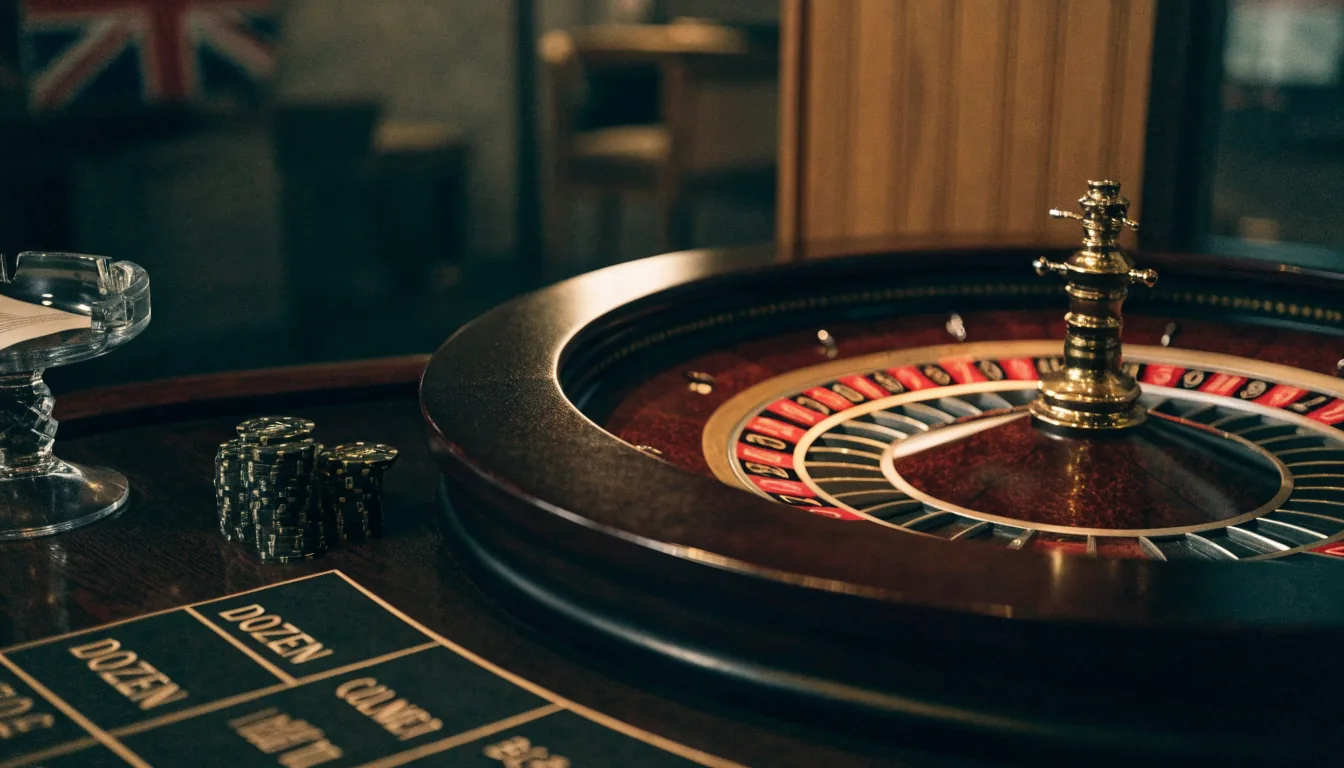
Table of Contents
- American Roulette in the UK: The Casino Context
- Choosing a Casino Without Mistaking Offers for Value
- Live Dealer Roulette: The Human Pace of the Wheel
- Reading the Bets and Their Payouts
- The American Roulette Table: Where 00 Sits
- A Wheel with 38 Pockets—and Two Green Ones
- Real-Money Stakes, Limits and the Cost of Playing Live
- Finding American Roulette Among Casino Games
- The Game Behind the Green Pockets
- How Many Pockets Does American Roulette Have?
American Roulette in the UK: The Casino Context
American Roulette in the UK belongs to a market where the legal status of an online casino depends on regulation, not on the appearance of its website or the location of its studio. Remote gambling operators offering services to people in Great Britain must hold the relevant licence from the UK Gambling Commission, even when the business itself is based elsewhere. A live dealer casino is legal in the UK on that same condition: it must hold a UK Gambling Commission licence.
That requirement gives the online setting a distinctly British frame. A casino may present its games through polished screens, familiar terminology and a dealer speaking from a studio, but the presentation does not replace the licence. For real-money play, the operator’s regulatory status is part of what makes the service lawful in the market. The boundary is not a matter of branding. It is a matter of oversight.
The central law for gambling in England, Wales and Scotland is the Gambling Act 2005. Northern Ireland is not covered by that Act, so the legal map is not quite identical across the United Kingdom. That distinction can disappear in the broad language of online casino advertising, where a single site may address a UK audience as though it were one uncomplicated territory. In legal terms, it is more carefully drawn.
When choosing an online casino for American roulette in the UK, payout timing is one practical detail to check alongside the game itself. This list gives a concise reference for the payout speed stated for each operator.
Payout speed: 1-3 business days Revery Play lists a payout speed of 1–3 business days.
Payout speed: 1-3 business days Chanze lists a payout speed of 1–3 business days.
Payout speed: 1-3 business days Amunbet lists a payout speed of 1–3 business days.
Payout speed: 1-3 business days SpinFormula lists a payout speed of 1–3 business days.
Payout speed: 1-3 business days NightLuck lists a payout speed of 1–3 business days.
Payout speed: 1-3 business days Zombillion lists a payout speed of 1–3 business days.
Payout speed: 1-3 business days BeOnBet lists a payout speed of 1–3 business days.
Payout speed: 1-3 business days EvoSpin lists a payout speed of 1–3 business days.
Payout speed: 1-3 business days Jetsetspins lists a payout speed of 1–3 business days.
Payout speed: 1-3 business days NightWin lists a payout speed of 1–3 business days.
The rule for remote operators serving Great Britain is clear: they need a Gambling Commission licence. It applies whether the company is based in Britain or operates from abroad. The regulator’s role is therefore not confined to casinos with a physical presence on the high street. An online American roulette casino may be only a screen and a streamed game from the player’s perspective, while the operator behind it remains subject to British licensing requirements.
This is useful context because the online casino market can make distance feel irrelevant. A game may be hosted in a studio far from the customer, and the interface may look much the same from one jurisdiction to another. But the legal relationship is not created by the screen alone. Operators selling remote gambling into the British market are expected to hold the local licence, wherever their offices or studios happen to be.
For live dealer casinos, the licence condition applies alongside the format’s visible theatre. The dealer, studio and broadcast give the game a human presence, but none of those features makes a casino lawful by itself. The legal test rests with the operator and its authorisation to serve the market. A real person on camera is not a substitute for a regulated business.

The UK’s approach reflects a broader civic assumption: gambling offered commercially is not simply a private arrangement between a customer and a website. It is an activity the state permits within a system of licensing. The casino may borrow the visual language of a grand room, a velvet table or a small ceremony around each game, but the modern version also has an administrative address. The licence is less theatrical. It matters more.
That distinction is especially relevant when the same game name appears across a wide range of online destinations. “American roulette” describes a game, not the legal standing of the casino offering it. A site’s use of British currency, familiar wording or locally recognisable design does not establish that it is authorised to provide gambling to people in Great Britain. Nor does an overseas location exempt a remote operator from the requirement to hold the relevant British licence.
The legal market is also age-restricted. Online gambling in the UK is permitted for people aged eighteen and over when it takes place with a UK Gambling Commission-licensed operator, and operators must verify a customer’s age before allowing a deposit. That requirement places the casino within a regulated service rather than treating access as an informal matter of clicking through a page.

In this setting, American roulette is not an exception to the rules because it is a particular variant, nor does the live format create a separate exemption. The market frame is the same: the operator’s licence determines whether the service may lawfully be offered to British customers. The game’s name attracts attention; the regulatory status is what anchors it.
A neat interface can make every casino look equally available. The law does not. This text is for entertainment purposes only and is not gambling advice.
Choosing a Casino Without Mistaking Offers for Value
A casino can make a game easy to find and an offer easy to notice; neither tells much about the value of playing there. For American Roulette, comparison begins with more prosaic questions: whether the game is available in the form sought, whether its rules are clearly set out, and whether the conditions attached to an offer make sense for someone intending to play roulette rather than slots.
The word “best” is a poor substitute for those checks. A prominent bonus, a polished lobby or a long catalogue may matter less than whether the casino is properly licensed for the British market and provides clear terms. Operators serving customers in Great Britain must hold the relevant UK Gambling Commission licence. That is a threshold, not a ranking: it establishes the regulatory framework in which a legal casino operates, but says nothing by itself about whether a particular offer suits a particular style of play.
There is also a difference between finding a casino that offers American Roulette and finding one where an introductory promotion has meaningful value for a roulette player. Welcome offers often foreground free spins or other slot-focused incentives. A headline amount can therefore look generous while being largely irrelevant to someone who has come for a table game. The small print matters more than the banner.
Read the offer as a set of conditions
Wagering requirements describe how much play is required before bonus funds or associated winnings can be withdrawn. That requirement should be read alongside game weighting: the share of a qualifying wager that counts towards meeting it. A casino may permit roulette play while crediting only a limited portion of the stake towards the requirement. Live games often contribute a small share, with 10% given as an example of the kind of weighting that may apply. Permission to play is not the same as useful contribution.
The distinction can change the apparent character of an offer. A promotion that seems relevant because it allows table games may still be structured chiefly around other games if roulette contributes little to its conditions. That does not make the offer automatically poor; it means its value depends on whether the player’s intended activity matches the games and weighting specified in the terms. A bonus designed around slots is not transformed into a roulette bonus by a broad phrase in a lobby.
The maximum bet permitted while wagering is another condition to check before opting in. So are exclusions, expiry conditions and the rules for withdrawing any balance connected with the promotion. These details belong together: reading only the headline or only the wagering requirement leaves out part of the bargain. The casino’s terms should say which games qualify, how their contribution is calculated and whether special restrictions apply while an offer is active.
A promotion can be declined. That option is sometimes more valuable than a complicated offer whose conditions do not fit the intended game. When no bonus is involved, there is no bonus wagering requirement to satisfy; the ordinary rules and account conditions still apply. The choice is not between taking a reward and missing out. It is between accepting a set of conditions and deciding that they are not worth carrying.
- Review wagering requirements and game weighting
- Check for maximum bet limits while wagering
- Verify expiry conditions and withdrawal rules
- Rely on the headline bonus amount alone
- Assume a slot-focused bonus applies to roulette
- Accept a complicated offer that doesn’t fit your play
Compare the game, not just the lobby
A useful comparison also looks at how clearly the casino presents its roulette rules and paytable. These should be available before play, not hidden behind promotional language. Rules affect how a game is understood; the paytable explains how selections are settled. The details should be reviewed before any stake is placed, rather than inferred from familiarity with roulette in general. Similar names do not guarantee identical presentation or conditions.
The interface matters in a less dramatic way. A clear game page makes it easier to identify the version being opened and to find its rules. A crowded lobby can make a game technically available but unnecessarily difficult to distinguish from other roulette formats. This is not a question of decoration. Clarity reduces the chance of beginning a game under an assumption that its label, rules or promotional eligibility has already settled.
Comparisons should also separate the casino’s general reputation from the specific terms of the game and offer. A well-known brand cannot make an unfavourable bonus condition favourable; nor does an attractive promotion establish that the game is available under the expected rules. Licensing, game information and promotion terms answer different questions. None should be used as a proxy for the others.
For anyone choosing between casinos, a sensible order is therefore to establish that the operator is licensed for the British market, confirm that American Roulette is offered, inspect its rules and paytable, then assess any promotion on its own terms. If live play is involved, its bonus weighting should be checked rather than assumed to match that of other games. No ranking can replace that comparison, because the relevant value is not the largest headline but the fit between the offer and the intended play.
A bonus is a contract with confetti. Content for entertainment purposes only; this is not gambling advice.
Live Dealer Roulette: The Human Pace of the Wheel
In live American roulette, the wheel is not an animation assembled after a click. A human dealer spins a physical wheel in a studio, and the game reaches the screen as a real-time stream. Bets are entered through an on-screen interface, so the scene has two kinds of action: the dealer’s measured gestures and the player’s selections made at a distance.

That arrangement gives the game a human centre. The camera shows a person working at a table, not merely a result appearing from software. The wheel turns, the ball travels, and the dealer manages the sequence in view of the participants. A digital version has no comparable performance: its outcomes are generated by a Random Number Generator. The distinction is not that one is chance and the other is theatre; both produce roulette outcomes. It is that the live format makes the interval before a result part of the experience.
The interval is longer. Digital games can move from one round to another with little ceremony, while a live table follows the dealer’s pace. Bets are placed, the wheel is spun, the result is called, and the next round begins. That rhythm can feel closer to a casino table, but it also means fewer decisions fit into a given stretch of play. Waiting is built into the format. The camera does not hurry.
Live games also tend to set higher minimum bets than digital versions. The difference matters less as an abstract comparison than as a condition of participation: a table’s minimum establishes the smallest stake available there, and a preferred pace or atmosphere cannot alter it. Limits and budgeting belong together, particularly when rounds unfold slowly enough for the session to feel more social than mechanical. A budget set in advance gives the experience a boundary. Chasing a result does not improve the wheel’s next turn.
The stream brings a practical dependency that a locally rendered digital game does not have in the same way. A stable internet connection is needed to follow the dealer and submit bets through the interface. If the picture freezes or the connection falters, the live table’s defining feature—the visible, shared sequence—becomes difficult to follow. The physical wheel may be turning perfectly well in the studio; the screen is still the route into the game.
This is why live American roulette is not simply a more decorative version of computerized roulette. It exchanges speed for presence: a dealer, a real wheel and a pace set by a person, with the screen acting as both window and betting surface. Some players value that human timing; others may prefer the brisker flow of a digital game. Neither format changes the need to keep play within a chosen budget.

The content is for entertainment purposes only and is not gambling advice.
Reading the Bets and Their Payouts
A roulette round resolves when the ball comes to rest. A bet wins when the result matches the selection; otherwise, the stake is lost. The casino then settles each winning selection according to its payout, with the amount depending on the kind of bet placed. That is the simple transaction beneath the theatre of the spin: a result, a comparison, and a payment.
A straight-up bet selects one number. It is the most concentrated wager: the selection either matches the result or it does not. Other bets cover broader groups of outcomes, so their chance of matching is different, as is the payout attached to a win. Those groups may be built around shared characteristics rather than a single number. The distinction matters more than the names: a smaller payout on a broader selection does not, by itself, make a bet better value.
The house edge describes the casino’s mathematical advantage over repeated play, not a deduction from every individual winning bet. In roulette, the stated edge is 2.9% for straight-up bets and 2.7% for other bets. The difference is modest, and neither figure predicts what will happen in a particular round. A player can win or lose in the short term; the edge describes the underlying expectation across play, not a schedule for when money changes hands.
That distinction is easy to lose amid the neatness of a betting interface. A stake appears, a result arrives, and the account balance changes. The arithmetic behind those changes is less visible. A winning bet returns according to its stated payout, while the house edge reflects the relationship between possible results and the payments offered over time. A striking win does not erase that long-run advantage, and a run of losses does not make a win due.
For anyone looking to play American Roulette online in the UK, the practical task is to understand how the chosen bet is settled before placing it. The table rules and paytable specify what counts as a winning selection and what the return will be. They are worth reading before play, rather than relying on the visual shorthand of the betting controls. Two bets can look equally simple on screen while covering very different outcomes.
In American Roulette, the house edge is 2.9% for straight-up bets and 2.7% for other bets.
This is how to play American Roulette at the level of the wager: choose a selection, let the round resolve, then compare the result with that selection. The mechanics are brief; the risk is not made smaller by their simplicity. No betting pattern changes the house edge, and past results do not determine the next outcome.
The numbers look tidy. The uncertainty does not.
This material is for entertainment purposes only and is not gambling advice.
The American Roulette Table: Where 00 Sits
An American roulette table is recognisable at a glance: a broad field of numbered betting spaces, with places around it for the different selections players can make. The double-zero version keeps that familiar visual grammar but adds a marked space for 00. It is a small addition in ink and a conspicuous one in meaning.
That extra marking is what distinguishes the American table layout from the version many players know from European roulette. The surface is not simply a copy with a new label attached to the edge. The double zero belongs to the betting field itself, so it becomes part of the set of numbers that can be selected. The table tells the story before a game begins: this is the American arrangement, and 00 is included.
A layout is a practical map, but also a quiet piece of instruction. It shows where selections are made and gives the eye a structure to follow. On a familiar table, regular spaces encourage habitual scanning; an additional space interrupts that pattern. Players moving between versions may find that the difference is easy to overlook precisely because the rest of the surface feels recognisable. Familiarity can be an unreliable guide.
The American roulette casino table therefore asks for a moment of orientation before any bets are placed. The important detail is not a decorative variation or a different name for an existing space. The layout has an additional double-zero number, clearly represented as 00. It changes what the table includes, even while preserving the broad look of a roulette betting surface.
This is why checking the table matters more than relying on a remembered arrangement. A player who has used another version may carry its visual assumptions across without noticing that the American format has a different number field. The double zero is easy to identify once the eyes are directed towards it; less easy when the table is being treated as an old acquaintance.

There is a modest social history in such markings. Casino games depend on rules that must be visible enough to use and stable enough to recognise. A layout does both jobs: it gives players a common surface and makes the particular version legible. Here, one additional symbol alters that shared map. No speech is required. The table announces the distinction in its own quiet typography.
The result is an arrangement that remains familiar without being identical. Its numbers and spaces still read as a roulette table, but 00 is not an incidental note. It is part of the American betting surface, and the detail that separates this layout from the one players may otherwise expect. A glance is not always enough.
A Wheel with 38 Pockets—and Two Green Ones
The American roulette wheel gives green an extra place. Its pockets include both 0 and 00, while the European wheel has a single green pocket, marked 0. The distinction is small enough to fit in one symbol, but it changes the arithmetic of the game: the American wheel has 38 pockets, against 37 on the European wheel.
Green is not a colour reserved for a special kind of prize. It marks the pockets that sit outside the familiar red-and-black alternation. On the American wheel, the second green pocket is not another way of writing zero; 00 is a separate outcome. When the ball settles there, it has landed on its own number.
That extra result matters because every pocket is another possible destination for the ball. The stated chance of winning in American Roulette is 1 in 38, compared with 1 in 37 in European Roulette. The difference is easy to overlook when the wheel is presented as a familiar circle of colours. It is less easy to overlook once the two green spaces are counted.
A wheel’s design turns chance into a visible arrangement. Red and black divide most of the surface between them, while green interrupts that division. In the American version, the interruption occurs twice. The extra green pocket gives the wheel its defining numerical distinction, without changing the basic spectacle: a ball circling the rim before dropping into one destination.

The comparison with the European wheel is useful precisely because the rest can look so familiar. Both versions use numbered pockets and the same three colours; the American wheel adds 00. It does not make the wheel twice as generous or introduce a second kind of game. It adds one more possible landing place, and the odds reflect that larger field.
There is a certain bluntness to the double zero. It announces that the American wheel is not merely a European wheel with a decorative variation. The extra pocket changes the chance attached to an outcome, even though the difference on the surface is just one green mark. In games of chance, small design decisions rarely stay small for long.
The numbers are plain; their effect is structural. With one green pocket, the European wheel has 37 possible results. With two, the American wheel has 38. The stated winning odds move accordingly, from 1 in 37 to 1 in 38. That comparison describes the wheel’s numerical field, not a promise about what any individual spin will do.
The ball has no memory of the previous result, and the extra pocket does not make a particular number due. It simply belongs to the set of places where the ball may stop. Green, twice over.
Real-Money Stakes, Limits and the Cost of Playing Live
Playing American Roulette for real money involves two separate decisions: whether the game uses cash rather than a practice balance, and how much to stake on a round. The first determines whether a result can affect an account balance; the second determines the amount exposed to that result. A modest stake does not turn real-money play into free play, and a large balance does not make a particular bet safer.
A table sets boundaries around the amount that can be placed on a bet. Those limits matter as much as the displayed minimum: a low entry point can sit beside a maximum that rules out larger stakes, while a table with higher thresholds may be unsuitable for a tightly controlled budget. American Roulette betting options are therefore not just a matter of choosing where to place money; the table’s limits define the scale at which those choices can be made.
Real-Money Risks Real-money gambling involves the risk of losing the money placed at stake. Never stretch your budget to meet a table’s minimum stake.
Live tables can carry higher minimums than digital games, so the same intended stake may not fit every version. One specialist review reports live roulette and baccarat tables starting at around 20p, while blackjack tables often begin at higher levels. That is a report about the tables it examined, not a fixed tariff for the British market. Limits can differ between tables and operators, and the displayed rules are the useful evidence at the point of play.
The distinction becomes practical when a budget is set before opening a live table. That budget is a ceiling, not a target to reach. If the minimum stake makes the table incompatible with it, choosing another table—or not playing—is more coherent than stretching the budget to meet the game. If the available maximum encourages stakes beyond the planned amount, it is a boundary to respect, not an invitation.
Table limits should be read alongside the rules and paytable before play begins. A stake can be lost when a selection does not win; no limit changes that basic exposure. Nor does a smaller stake remove the possibility of repeated losses. Keeping a fixed budget prevents the amount committed from being quietly revised in response to a run of results.
Real-money American Roulette is gambling, not a method of producing income. The cost is the money placed at risk, and a table’s minimum and maximum shape how that cost can be managed. This material is for entertainment purposes only, not gambling advice.
Finding American Roulette Among Casino Games
American Roulette may appear in a casino’s games catalogue beside other table games, but its label alone does not tell how the round is produced. Digital roulette is computerised: a Random Number Generator determines the result. Live dealer roulette is different in kind, not merely in appearance. A human dealer spins a physical wheel, with the game streamed from a studio and bets placed through an on-screen interface.

That distinction matters when browsing a catalogue. A digital table can be opened as a software game; a live table belongs to a streamed format, with the dealer and wheel visible as the round unfolds. Both may be presented under roulette, yet they offer different ways of taking part. The category name is a starting point, not a description of the experience.
There is also a small linguistic trap in the word “American”. It identifies a particular roulette variant, not a casino’s nationality or the location of its studio. In a catalogue, the useful distinction is whether the game is explicitly marked American Roulette and whether it is listed as digital or live. Those labels answer separate questions: which version is being offered, and how the game is run.
Promotions sit in a different part of the catalogue, though they can affect what appears playable. A specialist review reports that UK welcome offers are often built around free spins on slots, which cannot be used at live tables. The wording of an offer therefore matters more than its headline: a promotion aimed at slot play does not automatically extend to roulette, and a live table may be excluded. A bonus is not a universal key.
This helps explain why American Roulette can be present in a casino’s offering without being part of every promotional route through it. The game listing describes availability; the offer’s terms define where any bonus can be used. Treating those as the same thing turns a menu into a promise it never made.

The Game Behind the Green Pockets
Roulette reduces a noisy room to a small, exact event: a ball comes to rest on a number. A selection wins when it matches the number where the ball lands. Everything else—the anticipation, the table’s careful order, the theatre of the spin—gathers around that moment.
That simplicity helps explain why roulette travels so easily between a casino floor and a screen. In an online American roulette casino game, the setting changes, but the central question does not: which number will the ball settle on? The player makes a selection before the result is known; the result then decides whether that choice was right. No narrative is needed. The number either matches or it does not.
There is a peculiar social compact in this arrangement. The house supplies a fixed procedure, players make separate choices, and chance supplies the ending. For a brief interval, a choice feels consequential, even though the outcome is beyond anyone’s command. The game turns uncertainty into a public ritual: attention narrows, the ball moves, and a scattered group of people waits for the same small verdict.
The American roulette casino game carries that same structure whether encountered in a venue or online. A screen can make the event quieter and more private; a room can make it communal. Neither changes what counts as a win. It is not enough to have watched the spin closely, or to have felt certain about a number. The selected number must be the one on which the ball stops.
That distinction is the game’s plain centre, and perhaps its most durable invention. Roulette does not ask players to explain why a number should appear. It asks only for a selection, then puts that selection beside an outcome. The ceremony may vary; the test remains spare.
A match, or no match.

How Many Pockets Does American Roulette Have?
An American roulette wheel has 38 pockets. The count is made up of the numbered pockets from 1 to 36, plus two separate zero pockets: 0 and 00. The double zero is not another way of writing the single zero; it is an additional place for the ball to land.
That distinction is easy to miss when the game is reduced to a name on a casino menu. On the wheel itself, the two symbols occupy distinct pockets, and the total is therefore not the 37 associated with a wheel carrying only one zero. The extra pocket belongs to the American version’s defining arithmetic.
The 36 numbered spaces form the familiar main run. The two zeros sit alongside them as separate outcomes, bringing the count to 38. Each pocket is a possible landing place for the ball; the labels are not decorations around a smaller set of results. The wheel is a compact little census, and every pocket gets its own entry.
The same double-zero number also appears on the American betting surface, where it is represented as a distinct selection. This can make the game’s naming seem less tidy than its count: “00” looks like a typographical flourish, but on the wheel it marks an actual pocket. A zero is already a result; the second zero is another one.
So the direct answer is 38 pockets on an American roulette wheel: 36 numbered pockets, one marked 0 and one marked 00. The total does not depend on how a casino presents the game on screen or whether the wheel is shown in a live stream. It is the structure of the American wheel, not a display preference.
A small difference in notation, then, has a physical counterpart. The double zero takes its place beside the single zero, and the wheel’s count follows from that addition. No hidden pocket, no ambiguity: 38 in all.
Is the house edge the same at live dealer casinos online?
The live format alone does not determine the house edge; it depends on the roulette variant and bet. American Roulette has both 0 and 00, while European Roulette has only 0.
How can you win live dealer roulette?
You win when the ball lands on a number you selected. The game is chance-based; no staking system can guarantee a win.
How do you choose a live dealer casino?
Choose a casino licensed by the UK Gambling Commission, check that its roulette rules and offer terms are clear, and make sure your internet connection is stable. Check whether promotions apply to live tables, as many welcome offers are for slot free spins and live games may count only a small share towards wagering requirements.
What are the different types of roulette you can play with a live dealer?
Live roulette includes variants such as American, European and French Roulette. American Roulette has 0 and 00, European Roulette has a single 0, and in French Roulette an even-money bet loses only half when the ball lands on 0.
How do you play live roulette?
Place bets using the on-screen interface, then watch a human dealer spin a physical wheel. You win if the ball lands on a number you selected.
Prepared by the Rainbow Riches Casino 3 editorial staff.